Trends in Massive Open Online Courses (MOOC) [Infographic]

MOOC-InfoGraphic

Source: Enterasys

Posted in Digitization, Education, Infographics, Internet, MOOC | Leave a comment

Envisioning Television, 1908 and 2013

Campbell-SwintonToday in 1908, Alan Archibald Campbell-Swinton published a letter in the journal Nature titled “Distant Electric Vision” in which he envisioned television as it was developed three decades later. He wrote: “Possibly no photoelectric phenomenon at present known will provide what is required in this respect, but should something suitable be discovered, distant electric vision will, I think, come within the region of possibility.”

Last month, Netflix stated its view on the future of television:

Over the coming decades and across the world, Internet TV will replace linear TV. Apps will replace channels, remote controls will disappear, and screens will proliferate. As Internet TV grows from millions to billions, Netflix, HBO, and ESPN are leading the way.

Posted in Forecasts, Predictions, Television, This day in information | Leave a comment

The IBM Idea Launched, Defying Management Gurus for 102 Years

Computing-Tabulating-Recording_Company-logo-F2451021FC-seeklogo.comToday in 1911, the Computing-Tabulating-Recording Company was incorporated. It changed its name to IBM in 1924. Many commentators on IBM’s centenary two years ago attributed its longevity to the power of idea or ideas. In “Ideas make IBM 100 years young,” IBM’s Bernard Meyerson said: “…if you really think about what keeps a company going, it’s that you have to keep reinventing yourself. You cannot reinvent yourself in the absence of great ideas. You have to have the great ideas, and you have to follow them through.” Meyerson equated the great ideas that sustain the life of a company with great innovations but The Economist quoted Forrester Research’s George Colony: “IBM is not a technology company, but a company solving business problems using technology” and concludes: “Over time [the close relationships between IBM and its customers] became IBM’s most important platform—and the main reason for its longevity. Customers were happy to buy electric ‘calculating machines’, as Thomas Watson senior insisted on calling them, from the same firm that had sold them their electromechanical predecessors. They hoped that their trusted supplier would survive in the early 1990s. And they are now willing to let IBM’s services division tell them how to organise their businesses better.”

In a thoughtful essay, Kevin Maney lists five lessons he drew from his close study of IBM’s history, the first one being “At the start, convince the troops you’re a company of destiny, even if that seems crazy.” Thomas Watson Sr. did this and more. In a 1917 speech he said: “My duty is not the building of this business; it is rather, the building of the organization. … I [know] only one definition of good management; that is, good organization. So, as I see it, my work consists in trying to build a bigger and better organization. The organization, in its turn, will take care of the building of the business.”

So what was the Big IBM Idea? A trusted supplier? A focus on destiny and longevity? Building a bigger and better organization? All of the above?

In a 1994 Harvard Business Review article titled “The theory of the business,” Peter Drucker advanced the argument that great businesses revolve around a certain idea or “a theory of the business,” articulating the company’s assumptions about its environment, its mission, and its core competencies. In response, I discussed in a letter-to-the-editor the similarities and dissimilarities between scientists and managers: “Managers [like scientists] must articulate their theories and how they can be refuted and then seek data that prove their theories wrong. That will prevent them from falling into the trap of discarding successful theories… the theory of the business may not just explain reality or past business success; it may also define it by communicating and convincing employees and customers that the company is unique. A business theory, then, unlike a scientific theory, can be true and false at the same time. That is how, as Drucker has illustrated, IBM and General Motors could both succeed and fail when they applied the same business theory to two different businesses.”

In short, an idea or a set of ideas may explain past business success. But, all business school education and management gurus notwithstanding, one cannot extract from history “management lessons,” prescriptions, and predictions about the future of this or any other business. Sorry, even if we had a perfect understanding of the reasons for IBM’s longevity, that would not tell us anything about the future of Apple or Cisco or Google or Facebook. There is no one explanation or theory of business success and the same reasons for success in one case can be the very same reasons for failure in another.

I didn’t know it in 1994, but it turns out I was channeling Thomas Watson Sr. who said in another speech, this one in January 1915, shortly after he joined C-T-R: “We all know there have been numerous books written on scientific factory management, scientific sales management, the psychology of selling goods, etc. Many of us have read some of those books. Some of them are good; but we can’t accept any of them as a basis for us to work on. Neither can you afford to accept my ideas as whole and attempt to carry them out, because I do not believe in a fixed method–in any fixed way of selling goods, or of running a business.”


Posted in Business history, Computer history, IBM, This day in information | Leave a comment

Bob Metcalfe on Ethernet at 40

See also my interviews with Metcalfe here and here

Posted in Computer history, Computer Networks | Leave a comment

When Mauchly Met Atanasoff: Creating the Digital Computer

Atanasoff–Berry Computer replica at Iowa State University

Atanasoff–Berry Computer replica at Iowa State University

Today in 1941, John Mauchly visited John Atanasoff at Iowa State University. During the next five days he learned everything he could about what became to be known as the Atanasoff-Berry Computer (ABC) which he first heard about when Atanasoff visited Philadelphia in December 1940. The ABC was the first electronic digital computing device but was never put to actual use because both Atanasoff and Berry left Iowa in 1942 to contribute to the war effort and did not resume the work after the war. The significance of this meeting emerged years later when it became part of the evidence that led the judge in the case of Honeywell, Inc. v. Sperry Rand Corp., et al. to decide that the ENIAC patent was invalid, among other reasons, because “Eckert and Mauchly did not themselves invent the automatic electronic computer, but instead derived that subject matter from one Dr. John Vincent Atanasoff.”

Campbell-Kelly and Aspray conclude in Computer: A History of the Information Machine: “The extent to which Mauchly drew on Atanasoff’s ideas remains unknown, and the evidence is massive and conflicting. The ABC was quite modest technology, and it was not fully implemented. At the very least we can infer that Mauchly saw the potential significance of the ABC and that this may have led him to propose a similar electronic solution to the Ballistic Research Laboratory [at the Moore School of Electrical Engineering at the University of Pennsylvania] computing needs.”

They also note that in June 1941, Mauchly and Atanasoff “parted on very amicable terms.” Indeed, Mauchly wrote to Atanasoff on September 30th of that year:  “A number of different ideas have come to me recently anent computing circuits—some of which are more or less hybrids, combining your methods with other things, and some of which are nothing like your machine. The question in my mind is this: is there any objection, from your point of view, to my building some sort of computer which incorporates some of the features of your machine? … Ultimately a second question might come up, of course, and that is, in the event that your present design were to hold the field against all challengers, and I got the Moore School interested in having something of the sort, would the way be open for us to build an ‘Atanasoff Calculator’ (a la Bush analyzer) here?”

Posted in Computer history | Leave a comment

The Google Libray

Google_library


Source: Google’s Best Perk: The Library in Building 42

Posted in Books, Google, Libraries | Leave a comment

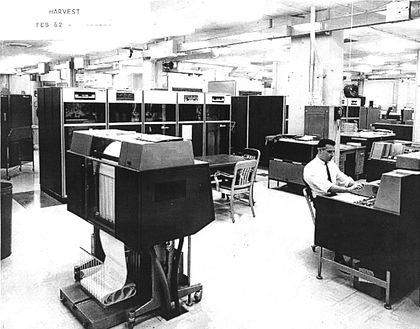
Big Data Analysis at the NSA, 1962

HARVEST-ComputerNSA1962The IBM 7950, also known as Harvest, was a one-of-a-kind adjunct to the Stretch computer which was installed at the US National Security Agency (NSA). Built by IBM, it was delivered in 1962 and operated until 1976, when it was decommissioned. Harvest was designed to be used for cryptanalysis. From a single foreign cipher system, Harvest was able to scan over seven million decrypts for any occurrences of over 7,000 key words in under four hours.

The computer was also used for codebreaking, and this was enhanced by a system codenamed RYE, which allowed remote access to Harvest. According to a 1965 NSA report, “RYE has made it possible for the agency to locate many more potentially exploitable cryptographic systems and `bust’ situations. Many messages that would have taken hours or days to read by hand methods, if indeed the process were feasible at all, can now be `set’ and machine decrypted in a matter of minutes.” Harvest was also used for decipherment of solved systems; the report goes on to say that, “Decrypting a large batch of messages in a solved system [is] also being routinely handled by this system.”

Source: Wikipedia

Posted in Big Data, Computer history | Leave a comment

Ballpoint Pen Patented

1945 Ad, Argentina

1945 advertisement, Argentina

Seventy years ago today (June 10, 1943), László Bíró filed for a patent on a new type of pen and, with his brother György, formed Biro Pens of Argentina. While working as a journalist in Hungary in the previous decade, he noticed that the ink used in newspaper printing dried quickly, leaving the paper dry and smudge-free. He tried using the same ink in a fountain pen but found that it would not flow into the tip, as it was too viscous. Working with his brother, a chemist, he developed a new tip consisting of a ball that was free to turn in a socket, and as it turned it would pick up ink from a cartridge and then roll to deposit it on the paper. Bíró first patented the invention in Paris in 1938. The new design patented in Argentina (where the brothers have moved in 1943) was licensed for production in the United Kingdom for supply to Royal Air Force aircrew, who found they worked much better than fountain pens at high altitude. In 1945 Marcel Bich bought the patent from Bíró for the pen, which soon became the main product of his Bic company.

Source: Wikipedia

Posted in This day in information, Writing | Leave a comment

Sound on Film Demonstrated for the First Time

Poster for Warner Bros.’ Don Juan (1926), the first major motion picture to premiere with a full-length synchronized soundtrack

Poster for Warner Bros.’ Don Juan (1926), the first major motion picture to premiere with a full-length synchronized soundtrack

Today in 1922, Joseph Tykociński-Tykociner publicly demonstrated for the first time a motion picture with a soundtrack optically recorded directly onto the film. In the first sounds ever publicly heard from a composite image-and-audio film, Helena Tykociner, the inventor’s wife, spoke the words, “I will ring,” and then rang a bell. Next, Ellery Paine, head of University of Illinois’ Department of Electrical Engineering (where Tykociner worked), recited the Gettysburg Address. A dispute between Tykociner and University of Illinois president David Kinley over patent rights to the process thwarted its commercial application.

Posted in Film, This day in information | Leave a comment

Nineteen Eighty-Four, in 1949 and 2013

1984firstToday in 1949, George Orwell’s Nineteen Eighty-Four was published.  “The thought police would get him just the same. He had committed–would have committed, even if he had never set pen to paper–the essential crime that contained all others in itself. Thoughtcrime, they called it. Thoughtcrime was not a thing that could be concealed forever. You might dodge successfully for a while, even for years, but sooner or later they were bound to get you.”

In Nineteen Eighty-Four, the memory hole is a small chute leading to a large incinerator used for censorship:

In the walls of the cubicle there were three orifices. To the right of the speakwrite, a small pneumatic tube for written messages, to the left, a larger one for newspapers; and in the side wall, within easy reach of Winston’s arm, a large oblong slit protected by a wire grating. This last was for the disposal of waste paper. Similar slits existed in thousands or tens of thousands throughout the building, not only in every room but at short intervals in every corridor. For some reason they were nicknamed memory holes. When one knew that any document was due for destruction, or even when one saw a scrap of waste paper lying about, it was an automatic action to lift the flap of the nearest memory hole and drop it in, whereupon it would be whirled away on a current of warm air to the enormous furnaces which were hidden somewhere in the recesses of the building.

In the novel, the memory hole is a slot into which government officials deposit politically inconvenient documents and records to be destroyed. Nineteen Eighty-Four’s protagonist Winston Smith, who works in the Ministry of Truth, is routinely assigned the task of revising old newspaper articles in order to serve the propaganda interests of the government.

As soon as Winston had dealt with each of the messages, he clipped his speakwritten corrections to the appropriate copy of The Times and pushed them into the pneumatic tube. Then, with a movement which was as nearly as possible unconscious, he crumpled up the original message and any notes that he himself had made, and dropped them into the memory hole to be devoured by the flames.


Posted in Books, Censorship, This day in information | Leave a comment