What Did Alexander Graham Bell’s Voice Sound Like?

From Berkeley Lab:

Berkeley Lab’s sound-restoration experts have done it again. They’ve helped to digitally recover a 128-year-old recording of Alexander Graham Bell’s voice, enabling people to hear the famed inventor speak for the first time. The recording ends with Bell saying “in witness whereof, hear my voice, Alexander Graham Bell.” The project involved a collaboration between Smithsonian’s National Museum of American History, the Library of Congress, and Berkeley Lab…

The Bell recording, which was etched onto a wax-on-binder-board disc, was made April 15, 1885 in the American inventor’s Washington, D.C., Volta laboratory. It was among a trove of recordings Bell gave to the Smithsonian before his death in 1922…

This isn’t the first time [Berkeley Lab’s] Haber and Cornell have made headlines for recovering sound from the distant past. Last summer, they digitally restored an 1878 St. Louis Edison tinfoil, revealing the oldest playable recording of an American voice.  And in 2008, they restored the earliest sound recording in history, a “phonautograph” paper recording made in 1860 by French inventor Edouard-Leon Scott.

Posted in Digitization, Recorded sound | Leave a comment

First Showing of Vitascope

VitascopeToday in 1896, the Vitascope was introduced to the public for the first time at Koster and Bial’s Music Hall in New York City. In They Made America, Harold Evans describes the scene that day: “… an enraptured elite audience lapped up short chasers of vaudeville skits, ballet dancers, burlesque boxers and the like.” And in Inventing the Movies, Scott Kirsner records the reaction of the New York Times to a film shown that day, Rough Sea at Dover: “The waves tumbled in furiously and the foam of the breakers flew high in the air. So enthusiastic was the appreciation of the crowd long before this extraordinary exhibition was finished that vociferous cheering was heard.”

The Vitascope was the first commercial projector mass-produced for the American market. In 1895, C. Francis Jenkins and Thomas Armat developed a projection device which they called the Phantoscope. It was publicly demonstrated in Atlanta in September 1895 at the Cotton States Exposition. Soon after, the two parted ways, with each claiming sole credit for the invention.

Armat showed the Phantoscope to Raff and Gammon, owners of the Kinetoscope Company, who recognized its potential to secure profits in the face of declining kinetoscope business. They negotiated with Armat to purchase rights to the Phantoscope and approached Edison for his approval. Evans: “It took something for the Old Man, as he was now called, to suppress the pride of the inventor in favor of the enterprise of the innovator.” But he did just that–the Edison Manufacturing Company agreed to manufacture the machine and to produce films for it, but on the condition it be advertised as a new Edison invention named the Vitascope.

The Edison Company developed its own projector known as the Projectoscope or Projecting Kinetoscope in November 1896, and abandoned marketing the Vitascope.

Posted in Film, This day in information | 1 Comment

World Digital Library Launched

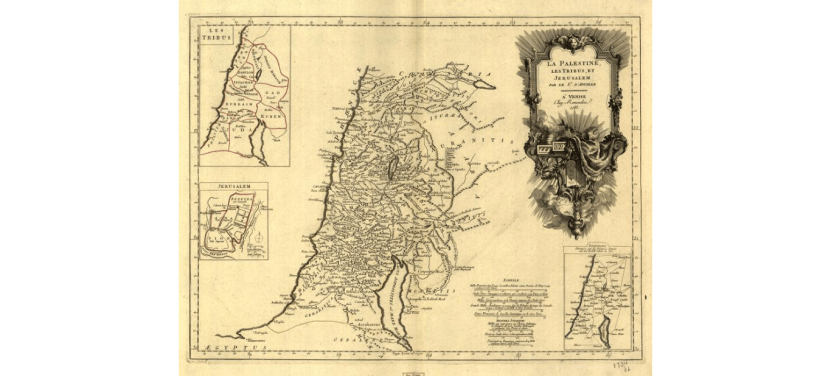
palestine_mapToday in 2009, The World Digital Library was launched. From the the library’s website: “U.S. Librarian of Congress James H. Billington proposed the establishment of the WDL in a speech to the U.S. National Commission for UNESCO in June 2005. The basic idea was to create an Internet-based, easily-accessible collection of the world’s cultural riches that would tell the stories and highlight the achievements of all countries and cultures, thereby promoting cross-cultural awareness and understanding.”

Above is one of the items displayed by the library, a 1738 map of Palestine that was part of the work of French geographer Jean Baptiste Bourguignon d’Anville (1697-1782), to “re-map the lands of the Old Testament. It displays insets of the city of Jerusalem, the territories of the Twelve Tribes of Israel, and the locations of the region’s cities in relation to each other.”

See also The Digital Public Library of America Launched

Posted in Digitization, Libraries, Maps, This day in information | Leave a comment

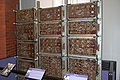
The First Real-Time Computer

Whirlwind's Core Memory

Whirlwind’s Core Memory

Today in 1951, MIT’s Whirlwind computer first came online.  It was the first computer that operated in real time and used video displays (cathode-ray tubes) for output. In the 1950s, Whirlwind became the prototype for a series of computers that enabled the air force to build a sophisticated air defense system, the Semi-Automatic Ground Environment or SAGE.

The MIT150 website has a great video from the early 1950 describing the Whirlwind and its applications and another one from the appearance on December 16, 1951, of the Whirlwind and Jay Forrester on Edward Murrow’s “See It Now” television show.

Posted in Computer history | Leave a comment

The Digital Public Library of America Launched

DPLAThe Digital Public Library of America (DPLA) brings together the riches of America’s libraries, archives, and museums, and makes them freely available to the world. It strives to contain the full breadth of human expression, from the written word, to works of art and culture, to records of America’s heritage, to the efforts and data of science. The DPLA aims to expand this crucial realm of openly available materials, and make those riches more easily discovered and more widely usable and used.

The DPLA offers a single point of access to millions of items—photographs, manuscripts, books, sounds, moving images, and more—from libraries, archives, and museums around the United States. Users can browse and search the DPLA’s collections by timeline, map, format, and topic; save items to customized lists; and share their lists with others. Users can also explore digital exhibitions curated by the DPLA’s content partners and staff.

The DPLA offers institutions the opportunity to reach more users, increase access to their content, and collaborate in new ways.

The DPLA API offers access to metadata on millions of items and hundreds of collections (and growing!).

The DPLA contains metadata records—information describing an item—for millions of photographs, manuscripts, books, sounds, moving images, and more from libraries, archives, and museums around the United States. Each record links to the original object on the content provider’s website.

Access to the DPLA is free of charge for all users.

Posted in Digitization, Libraries, Preservation | 1 Comment

No News is Good News Day

BBC_1930_savoy_newsToday in 1930, according to the BBC, listeners who tuned in to hear the news bulletin on Good Friday were informed: “There is no news.” Piano music followed.

Posted in News, This day in information | Leave a comment

A Very Short History of IT

WWW's "historical" logo, created by Robert Cailliau

WWW’s “historical” logo, created by Robert Cailliau

If you were asked to name the top three events in the history of computer technology (or the history of what came to be known as the IT industry), which ones would you choose? Here’s my very short list:

June 30, 1945: John Von Neumann published the First Draft of a Report on the EDVAC, the first documented discussion of the stored program concept and the blueprint for computer architecture to this day.

May 22, 1973: Bob Metcalfe “banged out the memo inventing Ethernet” at Xerox Palo Alto Research Center (PARC).

March 1989: Tim Berners-Lee circulated “Information management: A proposal” at CERN in which he outlined a global hypertext system.

[Note: if round numbers are your passion, you may opt—without changing the substance of this condensed history—for the ENIAC proposal of April 1943, Ethernet in 1973, and CERN making the World Wide Web available to the world free of charge in April 1993, so that 2013 marks the 70th, 40th, and 20th anniversaries of these events.]

Why bother at all to look back? And why did I select these as the top three milestones in the evolution of information technology?

Continue reading

Posted in Computer history, Computer Networks, Internet, Internet of things, IT history, Predictions, World Wide Web | 1 Comment

First Showing of Commercial Motion Pictures

KinetoscopeToday in 1894, the first commercial exhibition of motion pictures in history was given in New York City, using ten Kinetoscopes.  Though not a movie projector—it was designed for films to be viewed individually through the window of a cabinet housing its components—Edison’s Kinetoscope introduced the basic approach that would become the standard for all cinematic projection before the advent of video: it creates the illusion of movement by conveying a strip of perforated film bearing sequential images over a light source with a high-speed shutter.

Scott Kirsner brings to life the scene on this day in 1894 in Inventing the Movies: “The Holland brothers had rented a former shoe store at 1155 Broadway… and turned it into the world’s first Kinetoscope parlor. … Greeting patrons at the entrance was a bust of Thomas Edison… painted to look like it had been cast out of bronze, and perched atop a Greek column to give the place an air of class…. The novelty of life and motion stored inside a box and triggered on command–the startling realism of those flickery, black-and-white scenes–was what drew in customers, not the films being exhibited. … By the close of the first day of business, nearly five hundred people have watched Edison’s movies, and the Holland brothers had raked in $120.”

A year earlier, Edison wrote about the invention: “I’m doubtful there is any commercial feature in it, and fear it will not earn their cost. These… devices are of too sentimental value to get the public to invest in it.”

He was wrong. The Kinetoscopes were an immediate hit. Edison sold nearly a thousand of them at $200 each to a syndicate; his $24,000 investment in experimentation had by February 1895 returned $177,847 on machines and films. And then, says Harold Evans in They Made America, “[Edison] took the first step on a long, long road to synchronized talking pictures, when he installed a phonograph in a peep-show machine.”

Posted in Uncategorized | 1 Comment

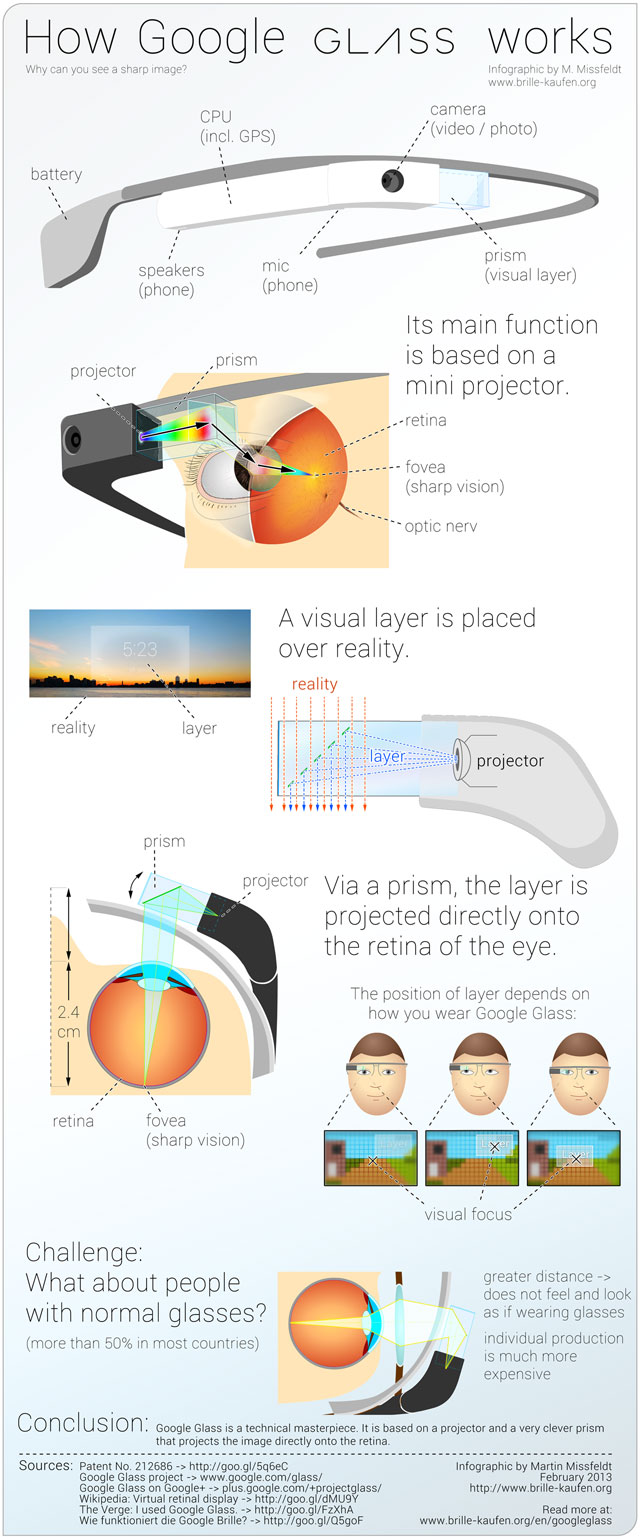
How Google Glass Works (Infographic)

google-glass-infographic1


Source: Martin Missfeldt

Posted in Futures, Google, Infographics | Leave a comment

What’s the Greatest Invention of the 20th Century?

frictionMatchToday in 1827, English pharmacist John Walker sold the first friction matches, which he called “Friction Light,” from his pharmacy in Stockton on Tees. The previous year, Walker discovered through lucky accident that a stick coated with chemicals burst into flame when scraped across his hearth at home. Until the first half of the nineteenth century, the process by which fire was created was slow and laborious. Walker’s friction match revolutionized the production, application and the portability of fire.

Frederick Schwartz observed in “The end of the millennium (as we know it)” in Invention & Technology, Winter 2000: “…the first item on [The New York Times’ list of greatest inventions of the 19th century, published in 1899] was one that is often forgotten today: friction matches, introduced in their modern form in 1827. For somebody to whom the electric light was as recent an innovation as the VCR is to us, the instant availability of fire on demand had indeed been one of the greatest advances of the century.”

What was the greatest invention of the last 100 years? And which invention of the last century is overshadowing an even more important invention of recent years?

Posted in Innovation, This day in information | Leave a comment