Star Photography

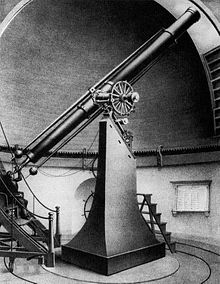
The Great Refractor

Today in 1850, the first daguerreotype of a star (Vega) was taken. Between 1847 and 1852  William Cranch Bond and pioneer photographer John Adams Whipple used the Great Refractor telescope to produce images of the moon that are remarkable in their clarity of detail and aesthetic power. This was the largest telescope in North America at that time, and their images of the moon took the prize for technical excellence in photography at the 1851 Great Exhibition at The Crystal Palace in London.

Posted in Photography, This day in information | Leave a comment

America’s First Television Theatre

568 Commonwealth Avenue Today

Today in 1938, musical performances in an upstairs area at 568 Commonwealth Avenue, Boston, are screened on a television display in the auditorium below, which seats 200 patrons paying 25 cents each. The studio and auditorium are linked by cable. About two weeks later, Time magazine reported: Continue reading

Posted in Television, This day in information | 1 Comment

The Future of Newspapers

“The biggest shift is that journalism is no longer the exclusive preserve of journalists. Ordinary people are playing a more active role in the news system, along with a host of technology firms, news start-ups and not-for-profit groups. Social media are certainly not a fad, and their impact is only just beginning to be felt… Successful media organisations will be the ones that accept this new reality. Continue reading

Posted in News, Quotes | Leave a comment

On Memory

“Memory is the finest index”–Menahem Zulay (quoted in Adina Hoffman & Peter Cole, Sacred Trash: The Lost and Found World of the Cairo Geniza) Continue reading

Posted in Lost and Found, Memory, Quotes | Leave a comment

First Mention of Computer Programs?

Today in 1836, Charles Babbage wrote in his notebook: “This day I had for the first time a general but very indistinct conception of the possibility of making an engine work out algebraic developments. I mean without any reference to the value of the letters. My notion is  that cards (Jacquards) of the Calc. engine direct a series of operations and then recommence with the first so it might perhaps be possible to cause the same cards to punch others equivalent to any given number of repetitions. But their hole [their holes?] might perhaps be small pieces of formulae previously made by the first cards.”  Continue reading

Posted in Computer history, This day in information | 1 Comment

The Computer as a (Highly Productive) Bible Scholar

“We have thus been able to largely recapitulate several centuries of painstaking manual labor with our automated method”–Moshe Koppel, Navot Akiva, Idan Dershowitz, and Nachum Dershowitz on the software they developed which, according to the AP, “…analyzes style and word choices to distinguish parts of a single text written by different authors, and when applied to the Bible, its algorithm teased out distinct, writerly voices in the holy book. The program, part of a subfield of artificial intelligence studies known as authorship attribution, has a range of potential applications — from helping law enforcement to developing new computer programs for writers.”

Posted in Artificial Intelligence, Computational Lingusitics, Textual Analysis | Leave a comment

Junction Transistor Announced

Sixty years ago today, the bipolar junction transistor was announced by its inventor, William Shockley. It was an improvement over the bipolar point-contact transistor which was invented four years earlier by John Bardeen and Walter Brattain and became the device of choice in the design of discrete and integrated circuits for the next three decades.

Posted in Computer history, This day in information | Leave a comment

Project Gutenberg Born

Forty years ago today, Michael Hart keyed in The United States Declaration of Independence to the mainframe he was using, all in upper case, because there was no lower case yet. Hart was a student at the University of Illinois and was given $100,000,000 of computer time at the Materials Research Lab.   Continue reading

Posted in Books, Digitization, This day in information | Leave a comment

Typesetting, Counting, Sensing

Today in 1886, the first Linotype machine in the U.S. was installed at the Tribune newspaper in New York City. Invented by Ottmar Mergenthaler, a Linotype machine could produce five lines per minute compared to the one line per minute typically produced by typesetters. Steven Lubar in InfoCulture: “Mark Twain, who lost a great deal of money investing in an autoamatic typesetting machine, suggested its value when he wrote that a Linotype ‘could work like six men and do everything but drink, swear, and go out on strike.'” A competitor to the Linotype, the Monotype, was invented in 1887 by Tolbert Lanston. It produced higher quality type and was controlled by a punched paper tape.

On July 1, 1890, two thousand clerks began processing the results of the 1890 U.S. Census, employing ninety-six of Herman Hollerith’s  tabulating machines, using a punched card system where a hole punched in a specific place on the card signified a fact about an individual. The information on the population of the United States (62,947,714 in 1890) was processed in one year, compared to the eight years it took to process the 1880 Census.

Kevin Maney in Making the World Work Better: “Hollerith gave computers a way to sense the world through a crude form of touch. Subsequent computing and tabulating machines would improve on the process, packing more information unto cards and developing methods for reading the cards much faster. Yet, amazingly, for six more decades computers would experience the outside way no other way.”

Posted in Computer history, Print, This day in information | Leave a comment

Storage Bottleneck Born

Today in 1945, John von Neumann published “A First Draft of a Report on the EDVAC.” Campbell-Kelly and Aspray call it in Computer “the technological basis for the worldwide computer industry.” In The History of Modern Computing, Paul Ceruzzi says it “is often cited as the founding document of modern computing.” What became to be known as the “von Neumann Architecture,” separated the processing of information from its storage, leading to an ongoing imbalance between the speed of the computer’s storage unit and the speed of its processing unit, each advancing along different technological trajectories.

Posted in Computer history, This day in information | 6 Comments