The Disk Drive is Born

IBM-RAMACToday in 1956, IBM introduced the disk drive.

In 1953, Arthur J. Critchlow, a young member of IBM’s advanced technologies research lab in San Jose, California, was assigned the task of finding a better information storage medium than punch-cards. Visiting a number of customers, Critchlow learned that punch-card equipment performed well when the processing of information could be done in batches or sequentially stored information but became problematic when random access was needed.

Inventory control was such an activity. In warehouse operations, for example, each order typically required several cards to be manually located, removed from a stack of cards, the inventory information updated, and the updated cards returned to their original locations. To facilitate this activity, drawers of cards were set out on work tables so that several people could access cards from the same file. This manner of organizing and processing information, widely known as the “tub file,” was time consuming and error-prone.

The IBM project’s staff evaluated every existing storage technology in an attempt to find the best technological solution to the loss of productivity and poor quality associated with “tub files.” In addition to superior capacity and reliability, the storage technology eventually selected, magnetic disks, could provide random access to information. A new method (encoded in software) for finding stored information when its physical location on the disk was unknown, ensured the success of the new way to store, organize, and share business records.

Announced on September 4, 1956, the IBM 350 Disk Storage Unit
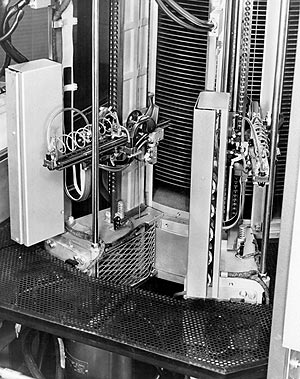
came with fifty 24-inch disks and a total capacity of 5 megabytes; its first customer was United Airlines’ reservations system. Incorporated into the 305 RAMAC(Random Access Memory Accounting Machine, announced ten days later), it promised, as the IBM press release said, “that business transactions will be completely processed right after they occur. There will be no delays while data is grouped for batch processing. People running a business will be able to get the fresh facts they need, at once. Random access memory equipment will not only revolutionize punched card accounting but also magnetic tape accounting.” Later, it was exhibited in the 1958 Brussels World’s Fair, where visitors could query “Professor RAMAC” using a keyboard and get answers in any of ten languages.  This public relations coup heralded a day when millions of people would access and retrieve information from the largest tub file ever assembled – the World Wide Web.

The RAMAC became obsolete within a few years of its introduction as the vacuum tubes powering it were replaced by transistors. But disk drives, invented more than 55 years ago in a search for faster access to information, are still used as the containers for almost all digital information today.

Today, you can buy from Seagate a 3TBs disk drive, the size and weight of a small book, for $199.99 (the entire 305 RAMAC system leased for $3,200 per month or $25,784.96 in 2010 dollars). The market for disk drives in 2011 is projected to reach $28.1 billion, according to iSuppli.

And tomorrow? Steve Lohr in the New York Times: “Flash [memory] stores data in the cells of semiconductor chips instead of on spinning magnetic disks. The data-storing density of hard disks has improved at an extraordinary pace… But the performance bottleneck has been the scant improvement in the speed of finding and transferring the data from the spinning disks — the mechanical side of hard-disk storage.

As companies grapple with a flood of new data — from the Web, social networks, sensors and video — the constraint of traditional storage only becomes greater. That, analysts say, is a crucial reason flash will sooner or later become a mainstream technology in data centers.

‘It will become increasingly difficult to do tomorrow’s work with today’s storage technology,’ said Mark Peters, an analyst at the Enterprise Strategy Group, a research firm. ‘Flash is the only way to deal with big data-crunching challenges ahead.’”
Posted in Uncategorized | Leave a comment

The first issue of the first daily newspaper in the U.S is published

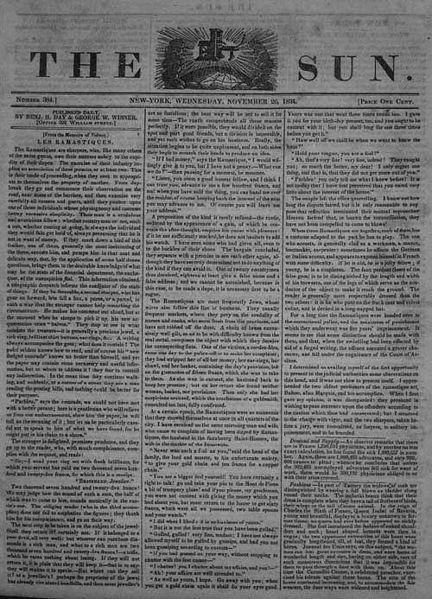
NewYorkSun1834Today in 1833, the first issue of the The New York Sun was published. Steven Lubar in InfoCulture: “New technology, in fact, came along after (italics mine) the renaissance of the newspaper. The New York Sun was the first ‘penny paper,’ featuring sensational stories aimed at mass audience… it stretched the limit of its hand presses with its 10,000 copies a day. (When a series of stories announcing the discovery of life on the moon appeared, it sold 20,000 copies in a day; by then it had switched to a steam-powered press). Benjamin Day, its published, bragged about its power: ‘Since the Sun began to shine upon the citizens of New York, there had been a great and decided change in the condition of the laboring classes, and the mechanics. Now every individual, from the rich aristocrat who lolls in his carriage to the humble laborer who wields a broom in the streets, reads the Sun.’… Between 1828 and 1840 the number of daily newspapers doubled from 852 to 1,631 and total circulation increased from 68 million to 195 million. More daily newspapers were printed in the United States than in the rest of the world.”

Day also introduced a new way of selling papers– newsboys hawking their newspapers on the streets. After paying a visit to the United States, Charles Dickens described (in Martin Chuzzlewit, 1844) the newsboys greeting a ship in New York Harbor: “’Here’s this morning’s New York Stabber! Here’s the New York Family Spy! Here’s the New York Private Listener! … Here’s the full particulars of the patriotic loco-foco movement yesterday, in which the whigs were so chawed up, and the last Alabama gauging case … and all the Political, Commercial and Fashionable News. Here they are!’ … ‘It is in such enlightened means,’ said a voice almost in Martin’s ear, ‘that the bubbling passions of my country find a vent.’”

Another visitor from abroad, the Polish writer Henryk Sienkiewicz, could discern (inPortrait of America, 1876) in the mass circulation of newspapers, the American belief about the universal need for information: “In Poland, a newspaper subscription tends to satisfy purely intellectual needs and is regarded as somewhat of a luxury which the majority of the people can heroically forego; in the United States a newspaper is regarded as a basic need of every person, indispensable as bread itself.”

Basic need for information, of all kinds, as Mark Twain observed (in Pudd’nhead Wilson, 1897): “The old saw says, ‘Let a sleeping dog lie.’ Right. Still, when there is much at stake, it is better to get a newspaper to do it.”

Today, the need for “serious” and “sensational” information is satisfied less and less by newspapers alone. The Pew Research Center (March 2010): “The days of loyalty to a particular news organization on a particular piece of technology in a particular form are gone. The overwhelming majority of Americans (92%) use multiple platforms to get news on a typical day, including national TV, local TV, the internet, local newspapers, radio, and national newspapers. Some 46% of Americans say they get news from four to six media platforms on a typical day. Just 7% get their news from a single media platform on a typical day.” 

And tomorrow? Nick Bilton of the New York Times: “Paper is dying, but it’s just a device. Replacing it with pixels is a better experience.”

Posted in Newspapers, This day in information | Leave a comment

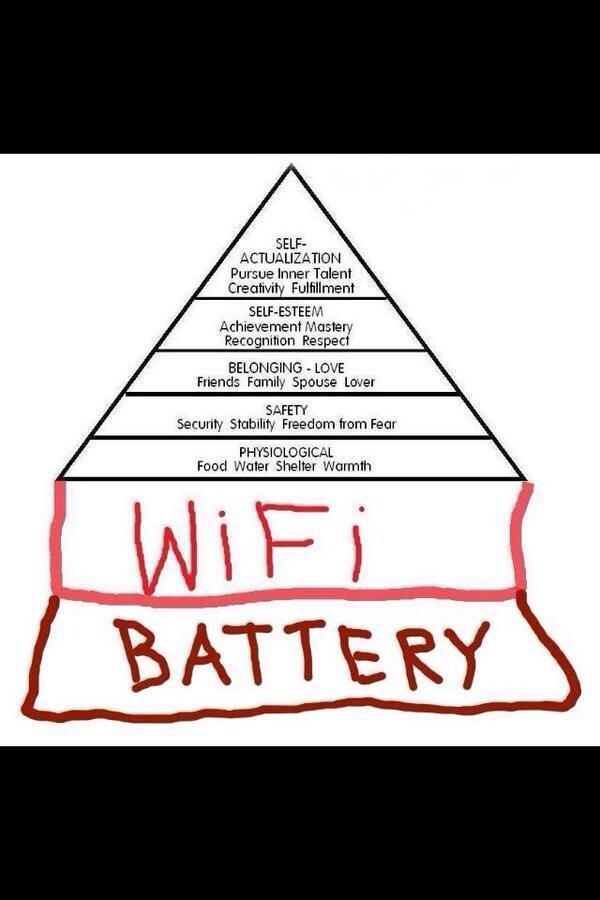
Maslow’s Hierarchy of Needs Updated for the 21st Century

Maslow-21stC

Posted in Social Impact | Leave a comment

The First Node of the Internet Goes Live

3420 Boelter Hall, UCLA

3420 Boelter Hall, UCLA

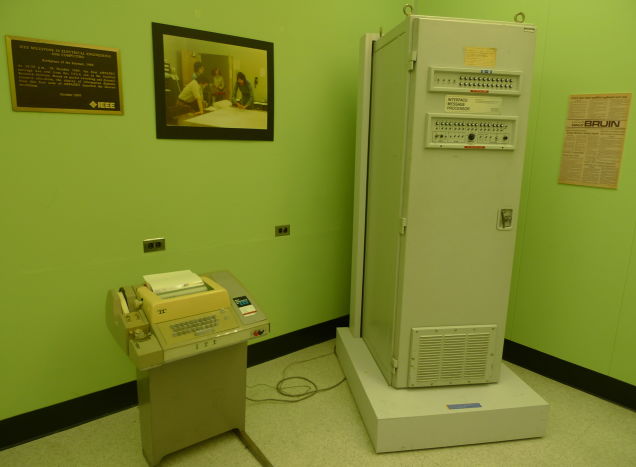
45 years ago today (September 2, 1969), at the University of California in Los Angeles (UCLA), the first Interface Message Processor (IMP), built by BBN, is connected for the first time to its SDS Sigma-7 mainframe, thus establishing the first node of what will become the ARPANET (and later, the Internet), the first wide-area packet switching network. 

“We cautiously connected and the bits began to flow.

The pieces really functioned, just why I still don’t know.

Messages were moving pretty well by Wednesday morn.

All the rest is history. Packet switching had been born.”

–Leonard Kleinrock on the day the first ARPAnet IMP was connected to the mainframe at UCLA, quoted in Stephen Segaller, Nerds 2.0.1, 1998

The photo above is of 3420 Boelter Hall at UCLA, where the IMP was installed, today serving as a small museum marking the beginning of the history of the Internet. See This Is The Room Where The Internet Was Born

Posted in Computer history, Internet | Leave a comment

World’s First Female Telephone Operator

Emma_Nutt_circa_1878-1900Today in 1878, Emma Mills Nutt (1860–1915) became the world’s first female telephone operator on when she started working for the Boston Telephone Dispatch company in Boston, Massachusetts.

Wikipedia: In January 1878 the Boston Telephone Dispatch company had started hiring boys as telephone operators, starting with George Willard Croy. Boys (including reportedly Emma’s husband) had been very successful as telegraphy operators, but their attitude (lack of patience) and behavior (pranks and cursing) was unacceptable for live phone contact, so the company began hiring women operators instead. Thus, on September 1, 1878, Emma was hired, starting a career that lasted between 33 and 37 years, retiring between 1911 and 1915.

Automated telephone switching, patented in 1891, eventually replaced telephone operators. In yet another example of the debates regarding Man Vs. Machine (in this case, distinctly of the female persuasion), a labor organizer testified in 1940 that “Electromechanical switching … … was ‘inanimate,’ ‘unresponsive,’ and ‘stupid,’ and did ‘none of the things which machinery is supposed to do in industry’–making it a ‘perfect example of a wasteful, expensive, inefficient, clumsy, anti-social device.’”


Posted in Automation, Telephone, This day in information | Leave a comment

Man Vs. Machine

deskset“Computers will never rob man of his initiative or replace the need for his creative thinking. By freeing man from the more menial or repetitive forms of thinking, computers will actually increase the opportunities for the full use of human reason. Only human beings can think imaginatively and creatively in the fullest sense of these words”–Thomas Watson Jr., CEO, IBM, April 25, 1960 (quoted in John E. Kelly III and Steve Hamm, Smart Machines, 2013). 

“They can’t build a machine to do our job; there are too many cross-references in this place”–the head librarian (Katharine Hepburn) to her anxious colleagues in the research department when a “methods engineer” (Spencer Tracy) is hired to “improve workman-hour relationship” in a large corporation; by the end of the film, Desk Set (released in 1957 and sponsored by IBM), she proves her point by winning, not only the engineer’s heart, but also a contest with the ominous looking “Electronic Brain” (aka computer).

Posted in Uncategorized | Leave a comment

London Sounds, 1928

leicesterSquareSounds1928

From the incredible London Sound Survey:

THERE ARE NO BBC radio recordings surviving from before 1931, so the job of representing the 1920s falls to this curiosity from the Columbia Graphophone Company. It’s a 12” 78rpm disc made in 1928 in association with the Daily Mail newspaper. It seems likely that the disc was somehow tied in with a Daily Mail campaign over urban traffic noise. The commentator on both sides of the disc is a man named Commander Daniel and he doesn’t approve of everything he hears in the city streets. The recordings were made from single, static locations in Leicester Square and Beauchamp Place on Tuesday 11th and Thursday 20th September respectively. Columbia probably used a recording van equipped with a disc-cutter.

The Leicester Square recording features hammering sounds from a building site, the repeated cry of Post! from a newspaper boy, the honking of car horns and the passing of horse-drawn and motor vehicles…

Commander Daniel warms to his task of identifying noise nuisances: “That was a large lorry with building materials, very noisy. There’s a motor bicycle without a proper silencer!”


Alexis Madrigal in the Atlantic on why no soundscapes recordings before the 1920s:

It wasn’t until the 1920s, Barton said, that microphones were developed. They could electronically amplify sounds and enabled the recording of soundscapes. From the very first, film could be used as a documentary device, easily recording ambient scenes. Sound recording, on the other hand, required performance for its first 50 years.

This timeline, when you match it up with other technological changes, has some very important consequences.

There will always be a large gap between our visual and audio historical records. Decades when we can see our places, but not hear them. We will never know what New York, Los Angeles, or any other city sounded like before the automobile hit the streets and electricity was commonplace.

Some things, like what it sounded like for a million Americans to live together without internal combustion engines on wheels, can be lost forever.

HT: Brian Dooley

Posted in Recorded sound | Leave a comment

“Silicon Valley” First Appeared in Print on January 10, 1971

SiliconValley

“It was only by a quirk of fate, however, coupled by lack of management foresight, that Boston failed to become the major semiconductor center San Francisco is today.” Don Hoefler, “Silicon Valley, USA,” Electronic News, January 11, 1971

Source: Computer History Museum

Posted in Computer history | Leave a comment

Claude Shannon and the Invention of Digital

The Man Who Turned Paper Into Pixels from Delve on Vimeo.


Posted in Computer history, Digitization | 1 Comment

The Internet is Coming to NPR

npr-internet-memo


Source: “If We’d Only Known About The Impending Spam

HT: “Dawn of the Web: an oral history


Posted in Computer history, Internet, World Wide Web | Leave a comment