John Hollar about the Computer History Museum (Video)

Posted in Computer history, Museums | Leave a comment

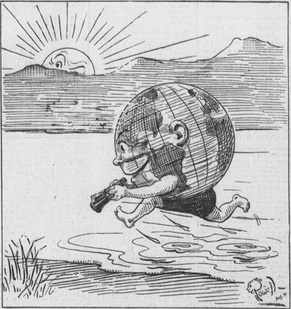
“Ye Coming of September Morn”

1913_cartoonSource: Omaha daily bee., August 31, 1913, Library of Congress, Chronicling America

HT: Chris Adams


Posted in Digitization, News, Newspapers | Leave a comment

Information R/evolution (Video)

Posted in Digitization, Information diffusion, information organization, Information Visualization, World Wide Web | 1 Comment

Timeline of Enterprise Technology (Infographic)

Enterprise Technology TimelineSource: Novell

Posted in Computer history, Infographics, IT history | Leave a comment

1956 Big Data: Launching the Disk Storage Industry

IBM-RAMAC305Today in 1956, IBM announced the 305 and 650 RAMAC (Random Access Memory Accounting) “data processing machines,” incorporating the first-ever disk storage product. The 305 came with fifty 24-inch disks for a total capacity of 5 megabytes, weighed 1 ton, and could be leased for $3,200 per month ($27,482 in today’s dollars). Using language familiar to anyone reading today about “Big Data,” IBM described the product as “a stack of disks that stores millions of facts and figures less than a second from management’s reach. Because transactions are processed as they occur, the fresh facts held in a random access memory show business as it is right now, not as it was hours or weeks ago.”

Today you can buy a 1 terabyte Seagate 3.5-inch disk drive, the size and weight of a small book, for $85 from Amazon.

The 305 RAMAC created an industry that is estimated at $32.6 billion in 2013, according to iSupply. But this is down from $36.7 billion last year, as solid state drives (flash memory) used in mobile devices are growing fast at the expense of hard disk drives. Indeed, a leading disk manufacturer, Western Digital, just acquired flash storage supplier Virident.

Whatever form the storage takes, IBM created in 1956 new markets and businesses based on fast access to digital data. As Seagate’s Mark Kryder reminded us in 2006:  “Instead of Silicon Valley, they should call it Ferrous Oxide Valley. It wasn’t the microprocessor that enabled the personal video recorder, it was storage. It’s enabling new industries.”

See also Spinning Disks and First Disk Drive Announced

Posted in Computer history, Digitization | 1 Comment

They Saw It as Destiny

Stock Exchange, Chicago, 1903

Stock Exchange, Chicago, 1903

Louis H. Sullivan, the father of the modern skyscraper, said this about Chicago in 1875, as it emerged from the Great Fire of 1871 and the Economic Panic of 1873:

As everybody said: “Chicago has risen phoenix-like from its ashes.” But many ashes remained, and the sense of ruin was still blended with ambition of recovery. Louis thought it all magnificent and wild: A crude extravaganza: An intoxicating rawness: A sense of big things to be done. For “Big” was the word. “Biggest” was preferred, and “the biggest in the world” was the braggart phrase on every tongue. Chicago had had the biggest conflagration “in the world.” It was the biggest grain and lumber market “in the world.” It slaughtered more hogs than any other city “in the world.” It was the greatest railroad center, the greatest this, and the greatest that. It shouted itself hoarse in réclame. The shouters could not well be classed in the proverbial liars of Ecclesiastes, because what they said was true; and had they said, in the din, we are the crudest, rawest, most savagely ambitious dreamers and would-be doers in the world, that also might be true. For with much gloating of self-flattering they bragged: “We are the most heavily mortgaged city in the world.” Louis rather liked all this, for his eye was ever on the boundless prairie and the mighty lake. All this frothing at the mouth amused him at first, but soon he saw the primal power assuming self-expression amid nature’s impelling urge. These men had vision. What they saw was real, they saw it as destiny… When Louis came to understand the vast area of disaster, he saw clearly and with applause that this new half-built city was a hasty improvisation made in dire need by men who did not falter.

Posted in Business history | Leave a comment

The Value of Television

farnsworthToday in 1927, 21-year-old Philo T. Farnsworth succeeded in transmitting through purely electronic means an image of a line with a device he called an “image dissector.” Today in 1957, the original version of the animated NBC peacock logo, used to denote programs “brought to you in living color,” made its debut at the beginning of “Your Hit Parade.” Quoting Wikipedia: “In a 1996 videotaped interview by the Academy of Television Arts & Sciences, Elma Farnsworth recounts Philo’s change of heart about the value of television, after seeing how it showed man walking on the moon, in real time, to millions of viewers:

Interviewer: The image dissector was used to send shots back from the moon to earth.
Elma Farnsworth: Right.
Interviewer: What did Phil think of that?
Elma Farnsworth: We were watching it, and, when Neil Armstrong landed on the moon, Phil turned to me and said, “Pem, this has made it all worthwhile.” Before then, he wasn’t too sure.
Posted in Television, This day in information | Leave a comment

From Distance Learning to MOOC (Infographics)

The history of distance learning [INFOGRAPHIC]
[Source: Career FAQs]

Trends in Adoption of MOOC (Massive Open Online Courses

Explore more infographics like this one on the web’s largest information design community – Visually.

Posted in Digitization, Education, Infographics, MOOC | Leave a comment

“It Shines for All”: Newspapers in America

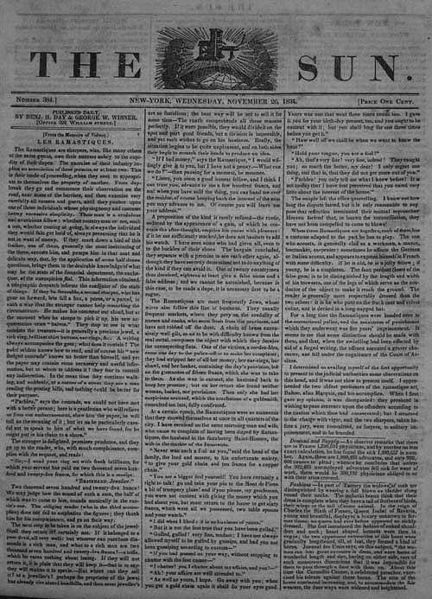
NewYorkSun1834One hundred and twenty years ago today (September 3, 1833), the first issue of the The New York Sun was published. Steven Lubar in InfoCulture: “New technology, in fact, came along after (italics mine) the renaissance of the newspaper. The New York Sun was the first ‘penny paper,’ featuring sensational stories aimed at mass audience… it stretched the limit of its hand presses with its 10,000 copies a day. (When a series of stories announcing the discovery of life on the moon appeared, it sold 20,000 copies in a day; by then it had switched to a steam-powered press). Benjamin Day, its publisher, bragged about its power: ‘Since the Sun began to shine upon the citizens of New York, there had been a great and decided change in the condition of the laboring classes, and the mechanics. Now every individual, from the rich aristocrat who lolls in his carriage to the humble laborer who wields a broom in the streets, reads the Sun.’… Between 1828 and 1840 the number of daily newspapers doubled from 852 to 1,631 and total circulation increased from 68 million to 195 million. More daily newspapers were printed in the United States than in the rest of the world.”

Day also introduced a new way of selling papers–newsboys hawking their newspapers on the streets. After paying a visit to the United States, Charles Dickens described (in Martin Chuzzlewit, 1844) the newsboys greeting a ship in New York Harbor: “’Here’s this morning’s New York Stabber! Here’s the New York Family Spy! Here’s the New York Private Listener! … Here’s the full particulars of the patriotic loco-foco movement yesterday, in which the whigs were so chawed up, and the last Alabama gauging case … and all the Political, Commercial and Fashionable News. Here they are!’ … ‘It is in such enlightened means,’ said a voice almost in Martin’s ear, ‘that the bubbling passions of my country find a vent.’”  Continue reading

Posted in Digitization, News, Newspapers | Leave a comment

Cash Flow: First ATM Installed

ATMToday in 1969, Chemical Bank installed the first ATM in the U.S. at its branch in Rockville Centre, New York. The first ATMs were designed to dispense a fixed amount of cash when a user inserted a specially coded card. A Chemical Bank advertisement boasted “On Sept. 2 our bank will open at 9:00 and never close again.” Today, there are more than 2.2 million ATMs installed worldwide. And tomorrow? The value of mobile commerce transactions conducted via mobile handsets and tablets will exceed $3.2 trillion by 2017, up from $1.5 trillion this year, according Juniper Research: “The increasing popularity of mobile devices for bill payment is reflected in the fact that the mobile banking sector accounts for the lion’s share of transaction values over the next five years. However, to put global mCommerce into context, total financial transactions in the US alone exceeded $4,400 trillion in 2012.”

Posted in Automation, eCommerce, Economic Impact | Leave a comment