E-Books Born on July 4, 1971

ProjectGutenbergToday in 1971, Michael Hart keyed in The United States Declaration of Independence to the mainframe he was using, all in upper case, because there was no lower case yet. Hart was a student at the University of Illinois and was given $100,000,000 of computer time at the Materials Research Lab.  Hart recalled in 2009:

On July 4, 1971, while still a freshman at the University of Illinois (UI), I decided to spend the night at the Xerox Sigma V mainframe at the UI Materials Research Lab, rather than walk miles home in the summer heat, only to come back hours later to start another day of school. I stopped on the way to do a little grocery shopping to get through the night, and day, and along with the groceries they put in the faux parchment copy of The U.S. Declaration of Independence that became quite literally the cornerstone of Project Gutenberg. That night, as it turned out, I received my first computer account – I had been hitchhiking on my brother’s best friend’s name, who ran the computer on the night shift. When I got a first look at the huge amount of computer money I was given, I decided I had to do something extremely worthwhile to do justice to what I had been given. This was such a serious, and intense thought process for a college freshman, my first thought was that I had better eat something to get up enough energy to think of something worthwhile enough to repay the cost of all that computer time. As I emptied out groceries, the faux parchment Declaration of Independence fell out, and the light literally went on over my head like in the cartoons and comics… I knew what the future of computing, and the internet, was going to be… “The Information Age.” The rest, as they say, is history.

Continue reading

Posted in Books, Digitization, ebooks, This day in information | Leave a comment

50 Years of Visionary Sci-Fi Computer Interfaces

50 Years of visionary Sci Fi Computer Interfaces
50 Years of visionary Sci Fi Computer Interface Design by Glow New Media

Posted in Science Fiction, Yesterday's Futures | Leave a comment

The Origins of the Internet (Video)

Computer magazine’s multimedia editor Charles Severance interviews Katie Hafner about the history of the APRANET project as described in her 1996 book, Where Wizards Stay Up Late: The Origins of the Internet.

Posted in Computer history, Internet | Leave a comment

Feeding Information to Machines to Speed Up Processing

Hollerith card as shown in the Railroad Gazette in 1895

Hollerith card as shown in the Railroad Gazette in 1895

Today in 1886, the first Linotype machine in the U.S. was installed at the Tribune newspaper in New York City. Invented by Ottmar Mergenthaler, a Linotype machine could produce five lines per minute compared to the one line per minute typically produced by typesetters. Steven Lubar in InfoCulture: “Mark Twain, who lost a great deal of money investing in an automatic typesetting machine, suggested its value when he wrote that a Linotype ‘could work like six men and do everything but drink, swear, and go out on strike.’” A competitor to the Linotype, the Monotype, was invented in 1887 by Tolbert Lanston. It produced higher quality type and was controlled by a punched paper tape.

On July 1, 1890, two thousand clerks began processing the results of the 1890 U.S. Census, employing ninety-six of Herman Hollerith’s  tabulating machines, using a punched card system where a hole punched in a specific place on the card signified a fact about an individual. The information on the population of the United States (62,947,714 in 1890) was processed in one year, compared to the eight years it took to process the 1880 Census.

Kevin Maney in Making the World Work Better: “Hollerith gave computers a way to sense the world through a crude form of touch. Subsequent computing and tabulating machines would improve on the process, packing more information unto cards and developing methods for reading the cards much faster. Yet, amazingly, for six more decades computers would experience the outside way no other way.”

Posted in Computer history | Leave a comment

The Founding Document of Modern Computing Published

John von Neumann

John von Neumann

Today in 1945, John von Neumann published “A First Draft of a Report on the EDVAC.” Campbell-Kelly and Aspray call it in Computer: The History of the Information Machine “the technological basis for the worldwide computer industry.” In A History of Modern Computing, Paul Ceruzzi says it “is often cited as the founding document of modern computing.” What became to be known as the “von Neumann Architecture,” separated the processing of information from its storage, leading to an ongoing imbalance between the speed of the computer’s storage unit and the speed of its processing unit, each advancing along different technological trajectories.

Posted in Computer history, This day in information | Leave a comment

First Classical Music Recording

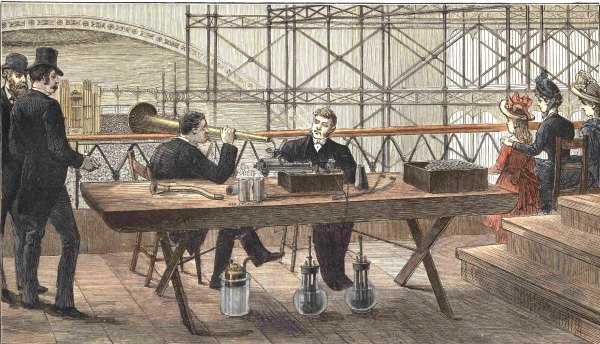
The 1888 Crystal Palace Recordings as depicted by the London Illustrated News

The 1888 Crystal Palace Recordings as depicted by the London Illustrated News

Today in 1888, Thomas Edison’s foreign sales agent, Colonel George Gouraud, made a wax cylinder recording in the Crystal Palace, London, of a 3016-person choir performing Handel’s Israel in Egypt at a distance of more than one hundred yards from the phonograph. It was the first “field” recording outside of a studio, as well as the first known recording of classical music. (Wikipedia has the audio file).

Later that year, the composer Arthur Sullivan, after hearing the phonograph for the first time, sent a recorded speech to Thomas Edison, saying, in part “I can only say that I am astonished and somewhat terrified at the result of this evening’s experiments: astonished at the wonderful power you have developed, and terrified at the thought that so much hideous and bad music may be put on record forever. But all the same I think it is the most wonderful thing that I have ever experienced, and I congratulate you with all my heart on this wonderful discovery.”


Posted in music, Recorded sound | Leave a comment

News Networks Launched, Newspapers Survive

ap_logo_historyToday in 1846, the first telegraph link was established between New York City and Boston. From the AP Archives: “In the spring of 1846, Moses Yale Beach (1800-68), publisher of The New York Sun, establishes a pony express to deliver news of the Mexican War.   His pony express speeds dispatches ahead of the Great Southern Mail from Mobile to Montgomery, Alabama, where the mail coaches carry them 700 miles to the nearest telegraph point near Richmond, Virginia. In offering an equal interest in the express venture to the major New York City daily papers (four of whom accept), Beach effectively organizes what soon became known as The Associated Press. The papers that joined Beach’s venture were: The Journal of Commerce, The Courier and Enquirer, The New York Herald, and The Express. The first dispatches from the Mexican War are carried by the Sun on May 29, 1846.

Telegraphic communications between Washington and New York are established on June 5; the New York-Boston line goes into operation on June 27; and by summer’s end, the telegraph extends from New York to Albany and Buffalo, and from Philadelphia west to Harrisburg, creating a telegraph network. Editors now actively collect news as it breaks, rather than gather already published news.”

As Richard John points out in Network Nation, the establishment in 1846 of the New York Associated Press (not the Associated Press, which descended from the Western Associated Press, a Chicago-based rival of the NYAP), was a reaction to the  New York and Offing Telegraph Association (Offing was the furthest point on the Atlantic horizon that was visible by telescope), a corporation with a special telegraph charter from the New York state legislature, owned and managed by Samuel Colt (of later small arms fame) and William Robinson. Richard John: “By publicizing the news gathering potential of the electric telegraph, [Colt and Robinson] challenged two powerful institutions: the Post Office Department and the New York City newspaper press.” And he quotes from a promotional pamphlet published by Colt and Robinson: “It is evident that the system of telegraphing news is destined to supersede, in a great degree, the publication of commercial newspapers in this and other northern cities.”

Newspapers survived the telegraph and the telephone, partly because of successful monopolistic business practices (as exemplified, among many other examples, by the NYAP in the 1880s), and mostly because of the invention of mass advertising. Will they survive the Internet?

Posted in News, Newspapers, This day in information | Leave a comment

The Internet of Things Launched

Internet_of_thingsToday in 1974, a Universal Product Code (UPC) label was used to ring up purchases at a supermarket for the first time. The first UPC ever scanned is on a package of Wrigley’s chewing gum (now on display at the Smithsonian’s National Museum of American History), which was purchased at the Marsh Supermarket in Troy, Ohio, utilizing NCR scanners.  Stephen A . Brown in Revolution at the Checkout Counter: The Explosion of the Bar Code: “The opening of the March store is very important from a historical perspective. By no means, however, did it signify the success of the U.P.C. Several  years would pass before it became obvious that scanning would become widespread. In the interim, a number of doubters publicly proclaimed the failure of the U.P.C…  By 1976, Business Week was eulogizing ‘The Supermarket Scanner that Failed.’” The bar code was invented on the beach in Miami in 1949, when graduate student Norman Joseph Woodland, 27, drew four lines in the sand. Woodland, who patented the basic idea for a linear bar code, later became an IBM engineer. More than  twenty years later, another IBMer, George Laurer, was one of those primarily responsible for refining the idea for use by supermarkets.

See also Co-Inventor of Bar Code Dies

Posted in Internet of things | 1 Comment

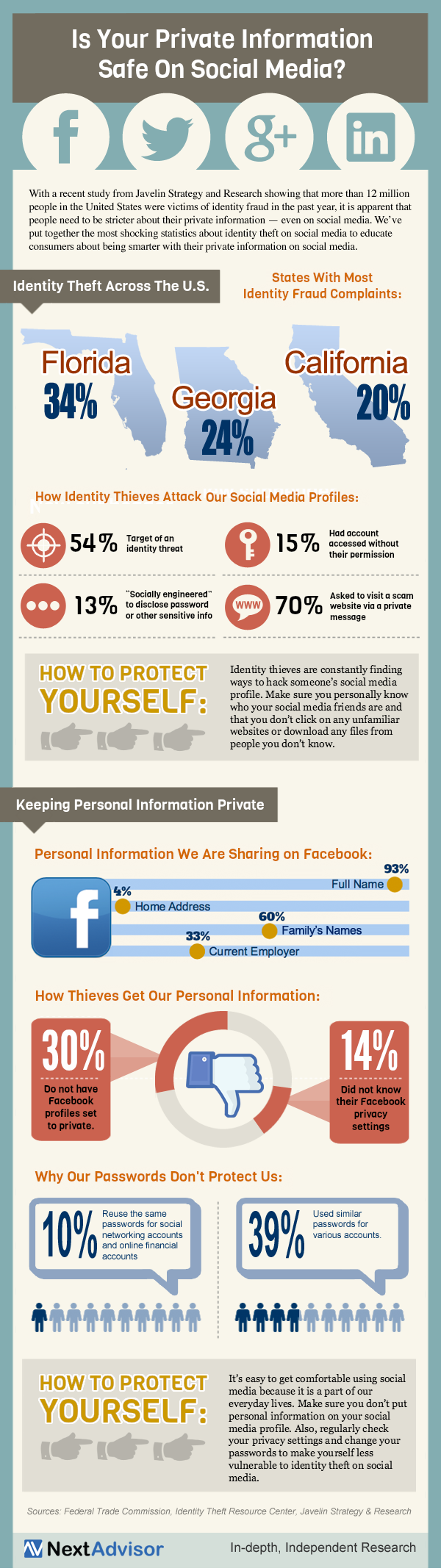
Do You Reveal Too Much About Yourself on Social Media? [Infographic]

Privacy-infographic-v3-1mSource: AllTwitter/NextAdvisor

Posted in Infographics, Privacy, social media, Social Networks | Leave a comment

The Oxford English Dictionary: The First Crowdsourcing Project?

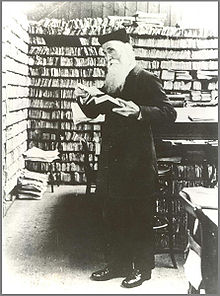
Murray in the Scriptorium, 1880s

Murray in the Scriptorium (the data center housing quotation slips), 1880s

The Oxford English Dictionary (OED) added the word “crowdsourcing” in its most recent quarterly online update. While the term was coined by Jeff Howe in 2006, after the Word Wide Web has made it easier to solicit “input from a large number of people,” this “new” practice launched the OED itself a century and a half ago:

In July 1857 a circular was issued by the ‘Unregistered Words Committee’ of the Philological Society of London, which had set up the Committee a few weeks earlier to organize the collection of material to supplement the best existing dictionaries. This circular, which was reprinted in various journals, asked for volunteers to undertake to read particular books and copy out quotations illustrating ‘unregistered’ words and meanings—items not recorded in other dictionaries—that could be included in the proposed supplement. Several dozen volunteers came forward, and the quotations began to pour in.

The volume of the “unregistered” material was such that in January 1858, The Philological Society decided that “efforts should be directed toward the compilation of a complete dictionary, and one of unprecedented comprehensiveness.” It took a while, but in April 1879, the newly-appointed editor James Murray issued an appeal to the public, asking for volunteers to read specific books in search of quotations to be included in the future dictionary. Within a year there were close to 800 volunteers and over the next three years, 3,500,000 quotation slips were received and processed by the OED team.

Was this the first big-data-crowdsourcing project?

Posted in Big Data, Crowdsourcing, Dictionaries, World Wide Web | Leave a comment