A Very Short History of Information Technology (IT)

WWW_logo_by_Robert_Cailliau.svgIf you were asked to name the top three events in the history of computer technology (or the history of what came to be known as the IT industry), which ones would you choose?

Here’s my very short list:

June 30, 1945: John Von Neumann published the First Draft of a Report on the EDVAC, the first documented discussion of the stored program concept and the blueprint for computer architecture to this day.

May 22, 1973: Bob Metcalfe “banged out the memo inventing Ethernet” at Xerox Palo Alto Research Center (PARC).

March 1989: Tim Berners-Lee circulated “Information management: A proposal” at CERN in which he outlined a global hypertext system.

[Note: if round numbers are your passion, you may opt—without changing the substance of this condensed history—for the ENIAC proposal of April 1943, Ethernet in 1973, and CERN making the World Wide Web available to the world free of charge in April 1993, so that 2013 marks the 70th, 40th, and 20th anniversaries of these events.]

Why bother at all to look back? And why did I select these as the top three milestones in the evolution of information technology?   Continue reading
Posted in Computer history, Computer Networks, World Wide Web | Leave a comment

First Regularly Scheduled U.S. Airmail Service

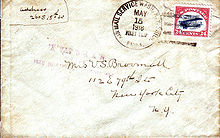
First_US_Air_Mail_Flight_Phila_1918Today in 1918, the first regularly scheduled airmail service in the United States was inaugurated over a route between Washington, DC, and New York City with an intermediate stop in Philadelphia, PA. 

Continue reading

Posted in Information diffusion, Post Office, This day in information | Leave a comment

Timeline of Information Access and Sharing (Infographic)

Coveo-Infographic_internal_2Source: Coveo


Posted in Big Data, Infographics, Information diffusion, information organization, InfoStory Timeline | Leave a comment

AIEE (IEEE) Established

IEEEToday in 1884, the American Institute of Electrical Engineers (AIEE) was established in New York.  The small group of men participating in the first meeting, a cross section of the electrical experts of the era, were responding to Nathaniel S. Keith’s call to organize a society of electrical professionals to represent the United States to foreign dignitaries who would be attending the International Electrical Exposition the Franklin Institute was hosting in Philadelphia that fall. The first AIEE president, Norvin Green, was the president of Western Union; the six vice presidents included Thomas Edison, telephone inventor Alexander Graham Bell, MIT physics professor Charles Cross, two veteran telegraphers, and an employee of equipment manufacturer Western Electric.

50 years ago, on January 1, 1963, the AIEE joined with the Institute of Radio Engineers (IRE) (established in 1912) to form the Institute of Electrical and Electronic Engineers (IEEE).

Posted in Computer history, Engineering, IEEE, This day in information | Leave a comment

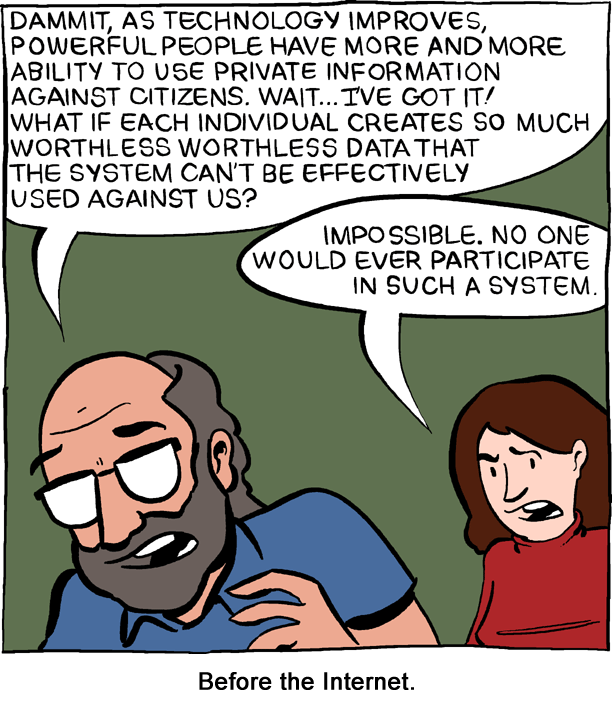
Before the Internet


Posted in Internet, Social Impact, World Wide Web | Leave a comment

The Dvorak Keyboard: Network Effect or Market Efficiency?

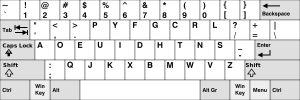
Dvorak_keyboardToday in 1936, U.S. patent No. 2,040,248 was issued to August Dvorak and William Dealey for their keyboard layout design, later to be commonly known as the Dvorak keyboard.  Wikipedia: “A discussion of the Dvorak layout is sometimes used as an exercise by management consultants to illustrate the difficulties of change. The Dvorak layout is often used in economics textbooks as a standard example of network effects.” In contrast, economists Stan J. Liebowitz and Stephen E. Margolis have argued that “the continued use of Qwerty is efficient given the current understanding of keyboard design.”

Posted in Business history, Economic Impact, Network Effect, Patents, This day in information | Leave a comment

National Gallery Opens

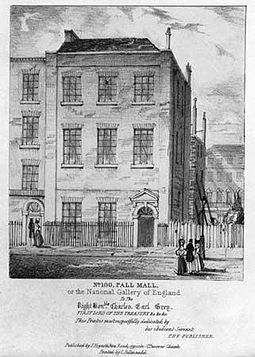
100 Pall Mall, the home of the National Gallery from 1824 to 1834.

100 Pall Mall, the home of the National Gallery from 1824 to 1834.

Today in 1824, The National Gallery opened to the public. It houses the UK’s national collection of Western European painting from the 13th to the 19th centuries. A complete list of the 2300 paintings is available online.

Posted in Museums, This day in information | Leave a comment

The Best and Worst of Moving Pictures

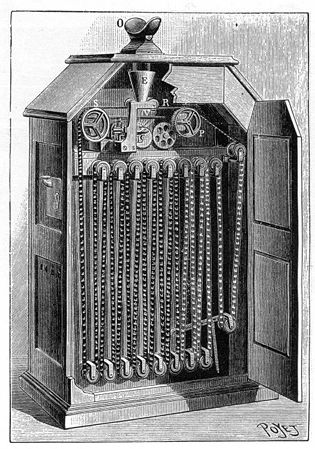
KinetoscopeOne hundred and twenty years ago today (May 9, 1893), Thomas Edison presented the Kinetoscope, the first film-viewing device, at the Brooklyn Institute of Arts and Sciences. The first film publicly shown on the system was Blacksmith Scene, the earliest known example of actors performing a role in a film.

In InfoCulture, Steven Lubar reports that in 1908, the Nation called film “the first democratic art” and that Jane Addams wrote in 1909 that for “hundreds of young people… going to the show is the only possible road to mystery and romance.” The poet Vachel Lindsay wrote in the The Art of the Moving Picture (1915): “Whitman brought the the idea of democracy to our sophisticated literati, but did not persuade the democracy itself to read his democratic poems. Sooner or later the kinetoscope will do what he could not, bring the nobler side of the equality idea to the people who are so crassly equal.” Says Lubar: “Movies, Lindsay suggested, would be the first truly American cultural form.”

Also today, in 1961, Federal Communications Commission (FCC) chairman Newton N. Minow delivered a famous speech to the convention of the National Association of Broadcasters, in which he said:

When television is good, nothing—not the theater, not the magazines or newspapers—nothing is better.

But when television is bad, nothing is worse. I invite each of you to sit down in front of your own television set when your station goes on the air and stay there, for a day, without a book, without a magazine, without a newspaper, without a profit and loss sheet or a rating book to distract you. Keep your eyes glued to that set until the station signs off. I can assure you that what you will observe is a vast wasteland.

See also First Showing of Vitascope and First Showing of Commercial Motion Pictures and From recording sounds to projecting moving pictures


Posted in Film, Social Impact, Television, This day in information | Leave a comment

The Annotated Newspapers of Harbottle Dorr, Jr.

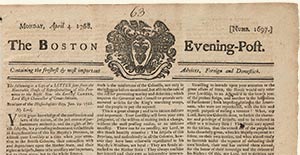
boston_newspaperThe Massachusetts Historical Society presents the complete four volume set of Revolutionary-era Boston newspapers and pamphlets collected, annotated, and indexed by Harbottle Dorr, Jr., a shopkeeper in Boston.

Posted in Digitization, Newspapers | Leave a comment

A Measurement Milestone

measurementsToday in 1790, the French National Assembly passed two decrees: One asked the French Academy of Sciences to determine “the scale of division most suitable for weights and measures and for coins;” the other instructed the French Academy to work with the Royal Society in London to “deduce an invariable standard for all the measures and all the weights.”  This, says a web site dedicated to the man who first advanced the idea, Charles-Maurice de Talleyrand-Périgord, was “the first legislation in a series of acts that led, fifty years later, to the final adoption of the metric system in France and later, with few exceptions, worldwide.”

Continue reading

Posted in Measurement | Leave a comment