Wikipedia Launched

Wikipedia Day cupcakes.Washington DC event, 2010

Wikipedia Day cupcakes.
Washington DC event, 2010

Today in 2001, Wikipedia was launched. Since its creation, Wikipedia has grown rapidly into one of the largest reference websites, attracting around  470 million unique visitors monthly in 2012.  Today, there are more than 77,000 active contributors working on over 22,000,000 articles in 285 languages. English Wikipedia has 4,143,989 content articles, and 29,202,822 pages.

Posted in Digitization, Education, Knowledge compilations | Leave a comment

Teaching with the Library of Congress


Teaching With the Library of Congress


Source: Best Colleges Online

Posted in Education, Libraries | Leave a comment

Birth of Public Radio Broadcasting

1910 New York Times advertisement for the wireless radio

1910 New York Times advertisement for the wireless radio

Yesterday and today in 1910, opera was first heard on the radio in what is considered the first public radio broadcast. On January 12, Lee De Forest conducted an experimental broadcast of part of the live Metropolitan Opera performance of Tosca and, on January 13, Enrico Caruso and Emmy Destinn singing arias from Cavalleria Rusticana and I Pagliacci. Susan Douglas tells the story in Inventing American BroadcastingContinue reading

Posted in Radio, Wireless | 1 Comment

America’s First Public Museum

Museum_firstUSToday in 1773, America’s first public museum, The Charleston Museum, was established in South Carolina. Today, there are approximately 850 million visits each year to American museums, more than the attendance for all major league sporting events and theme parks combined (471 million). The Official Museum Directory, the most comprehensive directory of museums in the United States, lists more than 14,400 museums.

Posted in Museums | Leave a comment

Al Gore Gives Birth to the Internet

AlGoreToday in 1994, The Superhighway Summit was held at UCLA’s Royce Hall. It was the “first public conference bringing together all of the major industry, government and academic leaders in the field [and] also began the national dialogue about the Information Superhighway and its implications.” The conference was organized by Richard Frank of the Academy of Television Arts & Sciences and Jeffrey Cole and Geoffrey Cowan, the former co-directors of UCLA’s Center for Communication Policy. The keynote speaker was Vice President Al Gore who said:  “We have a dream for…an information superhighway that can save lives, create jobs and give every American, young and old, the chance for the best education available to anyone, anywhere.”

According to Cynthia Lee in UCLA Today: “The participants underscored the point that the major challenge of the Information Highway would lie in access or the ‘gap between those who will have access to it because they can afford to equip themselves with the latest electronic devices and those who can’t.'”

As of June 30, 2012, 78.1% of (total) U.S. population had access to the Internet, according to Internet World Stats.


Posted in Information diffusion, Internet, This day in information, World Wide Web | Leave a comment

How Long Does It Take to Build an App?

Posted in Apps, social media, Social Networks, Software, World Wide Web | Leave a comment

Standardizing Information Transmission: The Uniform Penny Post Established

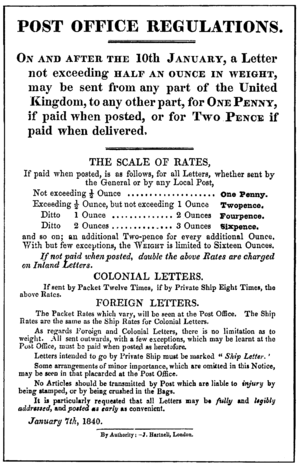
PennyPost_1840jan7Today in 1840, the Uniform Penny Post was established throughout the UK, facilitating the safe, speedy and cheap conveyance of letters.“At this time I did not stand very well with the dominant interest at the General Post Office. My old friend Colonel Maberly had been, some time since, squeezed into, and his place was filled by Mr. Rowland Hill, the originator of the penny post. With him I never had any sympathy, nor he with me. In figures and facts he was most accurate, but I never came across any one who so little understood the ways of men,–unless it was his brother Frederic. To the two brothers the servants of the Post Office,–men numerous enough to have formed a large army in old days,–were so many machines who could be counted on for their exact work without deviation, as wheels may be counted on, which are kept going always at the same pace and always by the same power. Rowland Hill was an industrious public servant, anxious for the good of his country; but he was a hard taskmaster, and one who would, I think, have put the great department with which he was concerned altogether out of gear by his hardness, had he not been at last controlled.”–Anthony Trollope, Autobiography  Continue reading

Posted in Information diffusion, Post Office, Standards, The Information Business, This day in information | 1 Comment

Information Visualization: Mapping the Underground

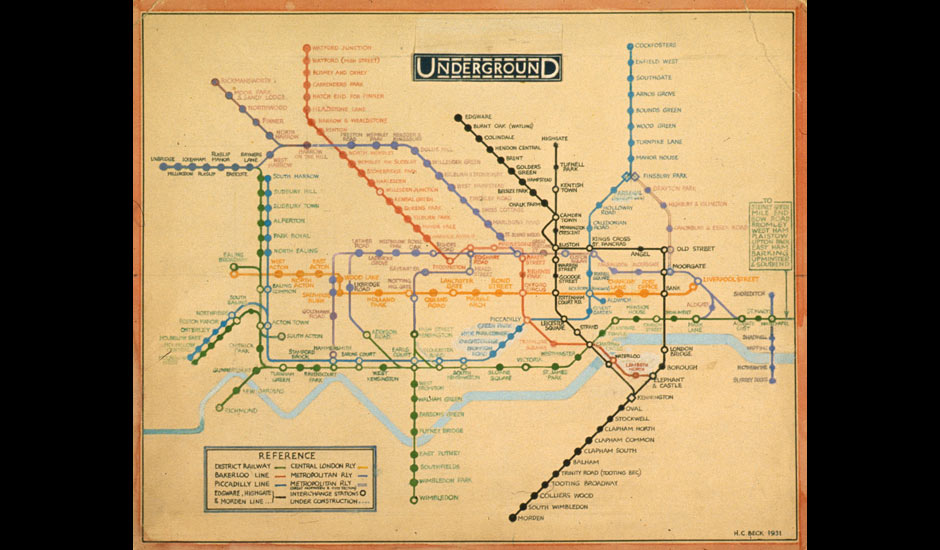
Today the London Underground celebrates its 150th birthday. The Guardian: Engineer Harry Beck, came up in 1931 “with the radical idea of presenting the ever-expanding network as a circuit diagram rather than a geographical map – so creating a modernist design icon that has never been bettered.”

Henry Beck's original drawing for the 'diagrammatic' tube map (1931)

Henry Beck’s original drawing for the ‘diagrammatic’ tube map (1931)

Posted in Information Visualization, Maps | Leave a comment

The First Cloud: First Battery-Operated Switchboard Installed

NewEnglandBellToday in 1894, New England Telephone and Telegraph installed the first battery-operated switchboard in Lexington, Massachusetts. With what became to be known as the “common battery” (replacing the local battery attached to the telephone), the subscriber could signal the operator simply by lifting the receiver from its hook. According to the 1911 edition of the Encyclopaedia Britannica, with this development, “the time occupied by an operator per call was reduced from 50.77 seconds to 16.63 seconds.”

By the way, the 1911 edition also tells us that the term “telephony” was first used 150 years ago by Philipp Reis of Friedrichsdorf, in a lecture delivered before the Physical Society of Frankfurt.

Posted in Centralization, Cloud Computing, Telephone, This day in information | 2 Comments

Launching the Photography Industry

Francois Arago

Francois Arago

Today in 1839, the Daguerreotype process was presented to the French Academy of Sciences by Francois Arago, a physicist and politician. Arago told the Academy that it was “…indispensable that the Government should compensate M. Daguerre, and that France should then nobly give to the whole world this discovery which could contribute so much to the progress of art and science.”

First surviving photograph by Daguerre, 1838

Earliest surviving photograph by Daguerre, 1838


On March 5, 1839, another inventorlooking (in the United States, England, and France) for government sponsorship of his invention, met with Daguerre. A highly impressed Samuel F. B. Morse wrote to his brother: “It is one of the most beautiful discoveries of the age… No painting or engraving ever approached it.”

Continue reading

Posted in Digitization, Photography | 1 Comment