35 years of Personal Computing

See Ars Technica for a great article on 35 years of personal digital devices, from the advent of PCs to smartphones and tablets.

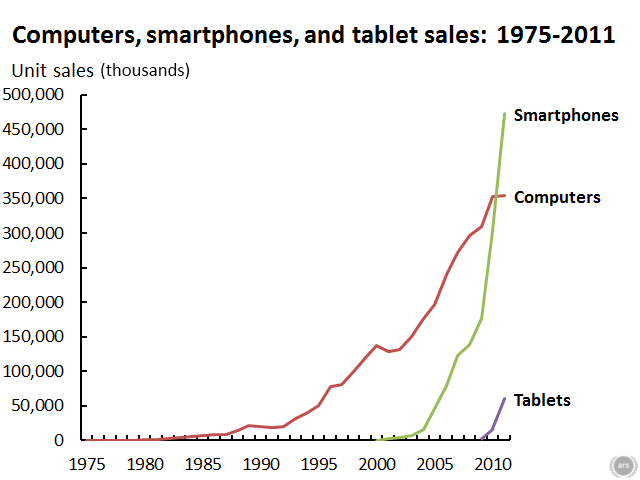
What’s most interesting is that the new and smaller personal computing devices have not replaced PCs, at least so far: “The truth of the matter is that the PC isn’t going away anytime soon. Sales figures show that the market may have flattened out somewhat, but it is still growing: 353 million PCs were sold in 2011. That’s a massive figure despite a global recession, and it’s the highest it has ever been.”

The adoption of smart phones and tablets, however, has been much faster than the adoption of PCs (see graph below where “computers” should read “PCs”), no doubt because of the existence of the World Wide Web. It has served as a universal and open platform for the creation of all the exciting applications that have made these devices so useful and so addictive for so many people.
Posted in Computer history | Leave a comment

Yesterday’s Futures: The Limits of Our Vision

Demonstration of a telephone exchange at the Post Office Research Station

In 1969, the Post Office Research Station at Dollis Hill, U.K., produced a video titled “Telecommunications services for the 1990s.” Predictably, it extrapolates from the reality (no distortion here) of the telephone network of the 1960s. Only the transmission is digital; the rest of the future is mostly analog (e.g., digital-to-analog picture/document scanning) and device-challenged (pager instead of a mobile phone).


Twenty years later, Tim Berners-Lee invented the Word Wide Web on top of a global public network, the Internet, launched in 1969. Yet, IBM published (internally) a report in 1989 and AT&T produced a video in 1993 that, just like the 1969 Post Office video envisioned great “information services” delivered by a powerful global multimedia private telephone/computer network.

To quote myself: “Many predictions are what the forecasters want the future to be or simply an extension of what they are familiar and comfortable with.”


Posted in Futures, Predictions, World Wide Web, Yesterday's Futures | Leave a comment

The Penguin Takes Off

Today in 1935, the first ten Penguin Books, paperback reprints of titles previously published as hardbacks, are issued by publisher Allen Lane. Each title costs only sixpence each, the price of a pack of cigarettes, and all the titles feature the Penguin brand image and a standardized cover design. Within the first ten months, one million Penguin books had been printed.   Continue reading

Posted in Books, This day in information | Leave a comment

Personal Computing, 1977

In July 1977, IEEE’s Computer magazine quoted Jim C. Warren, Jr., of Dr. Dobb’s Journal of Computer Calisthenics and Orthodontia: “What happens when you have access to all the news–not just what’s fit to print–or to a shopping algorithm for price comparison of all supermarkets in a 20-mile radius, or to your congressman’s complete voting record? These are very real possibilities in a field that, in less than three years, has progressed to the point where a personal computing network is probably in two to three months.”

Posted in Computer history, PCs | Leave a comment

The Integrated Circuit: Bringing Mass Production to the Computer Industry

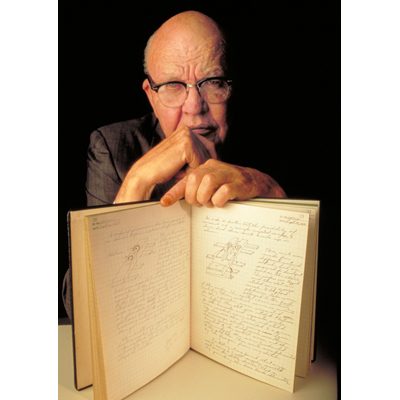
Jack Kilby with his lab notebook open at his first solid circuit drawing

Today in 1958, Jack Kilby sketched a rough design of the first integrated circuit in his notebook. By the early 1960s, some computers had more than 200,000 individual electronic components–transistors, diodes, resistors, and capacitors–and connecting all of the components was becoming increasingly difficult. From Texas Instruments’ website:    Continue reading

Posted in Computer history, This day in information | Leave a comment

The Rise and Fall of Typewriters

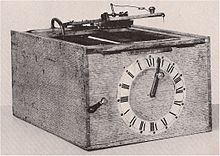
Today in 1829, William Austin Burt, a surveyor from Mount Vernon, Michigan, received a patent for the typographer, the earliest forerunner of the typewriter. Fifty-one years ago this month (July 31), IBM introduced the IBM Selectric, replacing typebars and the moving carriage with a spherical printing element.

In 2006, a Boston Globe article described the fate of typewriters today: “When Richard Polt, a professor of philosophy at Xavier University, brings his portable Remington #7 to his local coffee shop to mark papers, he inevitably draws a crowd. ‘It’s a real novelty,’ Polt said. ‘Some of them have never seen a typewriter before … they ask me where the screen is or the mouse or the delete key.’”

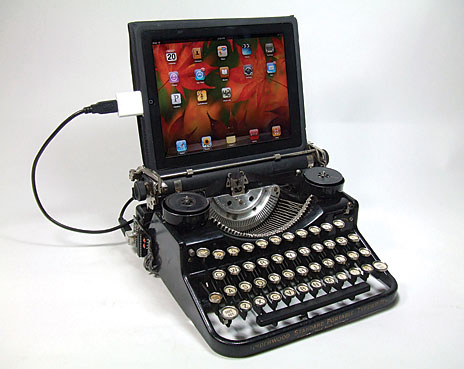
In 2011, Dangerous Prototypes reported  on the “brainchild of Jack Zylkin, a Philadelphia-based electrical engineer who has designed a kit” with which anyone with a passion for hands-on projects can “repurpose old manual typewriters as keyboards for computers or Ipads, using an Arduino as the intermediary.”

Posted in This day in information, Typewriters | Leave a comment

The Way We Want it Now

Online Graduate Programs: “Since the burgeoning of the Internet industry, the way people live their lives has rapidly changed. The U.S. has seen people turn to their computers for everything, from working to shopping to attending school. The speed at which the Internet moves has also changed, shifting from a snail’s pace dial-up connection to wide-spread, high speed WiFi. Every day, people conduct more Google searches, update more statuses, and visit more new sites than the day before. In the world of high speed browsing, no one waits for answers. But it seems that a desire for speedy information has made Americans impatient for just about everything: From fast-food to speed dating, the U.S. has begun its shift toward an instant nation.”   Continue reading

Posted in Infographics, The InfoStory Quant, World Wide Web | Leave a comment

A Robot in Every Home?

Petman of Boston Dynamics

Today in 1984, a factory robot in Jackson, Michigan, crushed a 34 year-old worker in the first ever robot-related death in the United States.  The robot thus violated Issac Asimov’s First Law of Robotics, “A robot may not injure a human being or, through inaction, allow a human being to come to harm,” first articulated in 1942.  Today, Robots have gone beyond the factory and thousands of Kiva Systems cute orange Robots safely run around warehouses fulfilling our online orders. And a few months ago, DARPA announced a grand challenge for the development of humanoid robots that could perform dangerous and difficult tasks. Four years ago, “Roboticist” Rodney Books predicted: “[In the 1950s, when I was born] there were very few computers in the world, and today there are more microprocessors than there are people. Now, it almost seems plausible that in my lifetime, the number of robots could also exceed the number of people.” He must have had in mind some specific catalysts that will cause rapid acceleration in the proliferation of Robots—at that time (2008), the world’s Robot population stood at 8.6 million. One of these catalysts could be South Korea’s plan to put a Robot in every home by 2020.

Posted in Robots, This day in information | Leave a comment

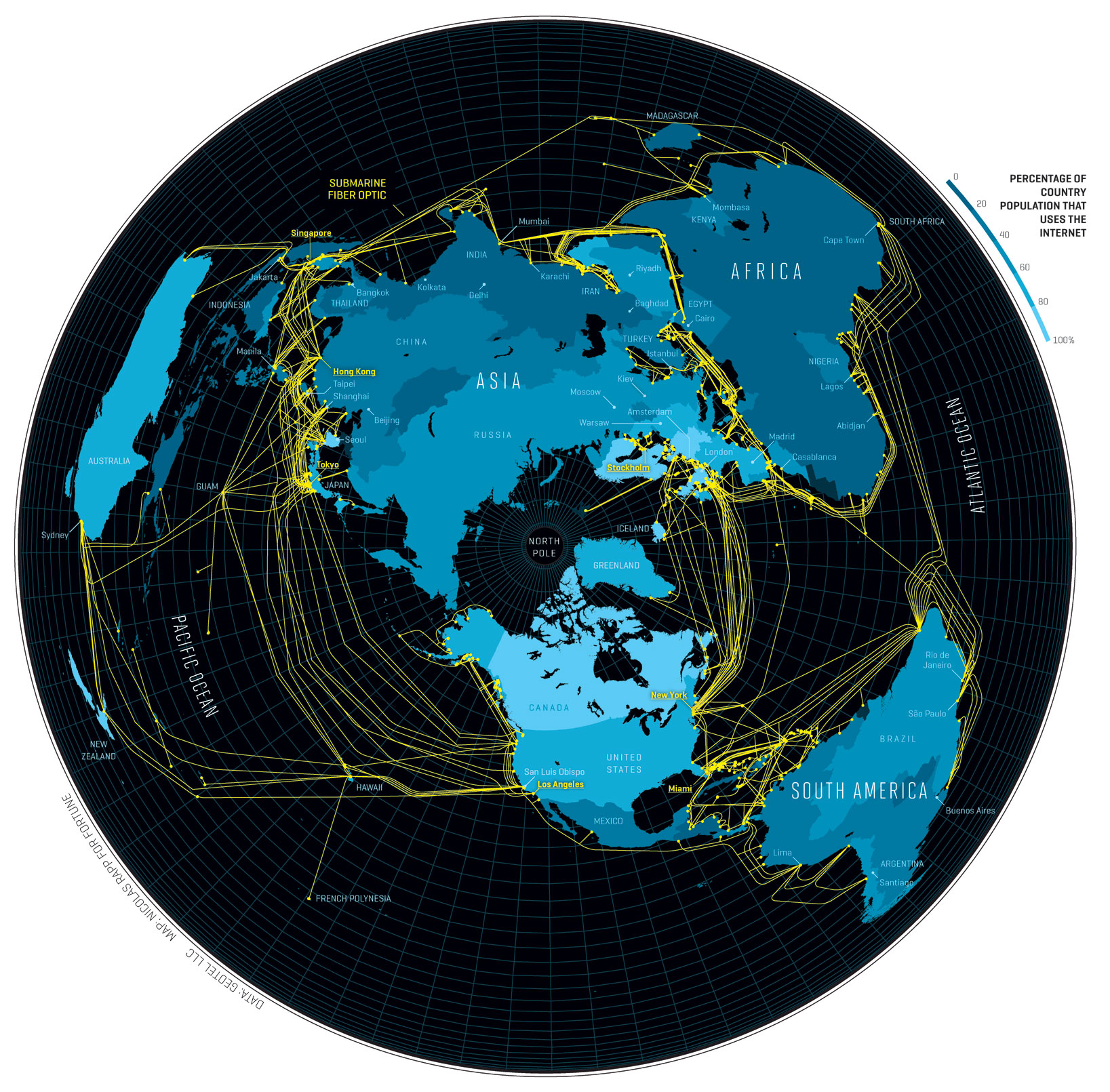
The Internet Underwater

Source: nicolasrapp.com

Posted in Infographics, Internet | Leave a comment

From the Archives: First Mention of Computer Programs?

Today in 1836, Charles Babbage wrote in his notebook: “This day I had for the first time a general but very indistinct conception of the possibility of making an engine work out algebraic developments. I mean without any reference to the value of the letters. My notion is that cards (Jacquards) of the Calc. engine direct a series of operations and then recommence with the first so it might perhaps be possible to cause the same cards to punch others equivalent to any given number of repetitions. But their hole [their holes?] might perhaps be small pieces of formulae previously made by the first cards.”  Continue reading

Posted in Computer history, Programming | Leave a comment