
Today in 1839, William Henry Fox Talbot showed his five-year old pictures at the Royal Society, 18 days after the Daguerreotype process was presented before the French Academy. Continue reading
-
Join 186 other subscribers
Categories
Archives
Today in 1839, William Henry Fox Talbot showed his five-year old pictures at the Royal Society, 18 days after the Daguerreotype process was presented before the French Academy. Continue reading
Sixty-five years ago (January 13, 1946), Chester Gould 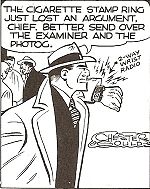 introduced in Dick Tracy’s 2-Way Wrist Radio, having drawn inspiration from a visit to inventor Al Gross. It became one of the strip’s most immediately recognizable icons, and was eventually upgraded to a 2-Way Wrist TV in 1964. Continue reading
“NOVELS have ever met with a ready reception into the Libraries of the Ladies, but this species of writing hath not been received with universal approbation: Futility is not the only charge brought against it — Any attempt, therefore, to make these studies more advantageous, has at least a claim upon the patience and candour of the publick. Continue reading
From Time cover story, January 18, 1982: “Says [Time reporter Steven] Holmes: ‘In most games and sports, you learn teamwork and how to adjust to the strengths and weaknesses of others, attributes that serve you well the rest of your life. Video games do not seem to produce any transferable skills.’ [Time reporter Peter] Ainslie disagrees: ‘While most people over 30 are somewhat intimidated by computers,’ he says, ‘the younger game players accept them as tools to be used, to be taken for granted, to be enjoyed. They are better prepared than we are for the computer revolution.’ [Time Contributor John] Skow, a cheerful skeptic, refuses to endow the phenomenon with any cosmic significance at all. His view: ‘It’s just another manifestation of human mania, our endearing quality of going relentlessly after absolutely pointless goals.'”
Last month, the Oxford English Dictionary published online a revised entry for the word “information.” The revision tells a lot about our evolving relations with reference information and the much-discussed accuracy of information on the Web as opposed to print (and information overload, and what the Internet is doing to our brains, etc., etc.). Continue reading
Today in 1956, the development of the Semi-Automatic Ground Environment (SAGE), is disclosed to the public. “Looking back at the development of the computers supporting the SAGE, the origins of many key computer innovations are readily apparent. Continue reading
Today in 2001, Wikipedia was launched. Since its creation, Wikipedia has grown rapidly into one of the largest reference websites, attracting nearly 78 million visitors monthly as of January 2010 about 80 million unique monthly visitors as of December 2010. There are more than 91,000 active contributors working on more than 17,000,000 articles in more than 270 languages. As of today, there are 3,528,909 articles in English. Continue reading

1910 New York Times advertisement for the wireless radio
Yesterday and today in 1910, opera was first heard on the radio in what is considered the first public radio broadcast. On January 12, Lee De Forest conducted an experimental broadcast of part of the live Metropolitan Opera performance of Tosca and, on January 13, Enrico Caruso and Emmy Destinn singing arias from Cavalleria Rusticana and I Pagliacci. Susan Douglas tells the story in Inventing American Broadcasting: Continue reading
Today in 1773, America’s first public museum,  The Charleston Museum, was established in South Carolina. Today, it is estimated that there are more than 17,000 museum in the United States. The Official Museum Directory, the most comprehensive directory of museums in the United States, lists more than 8,300 museums.
The Indian scholar Pingala (circa 5th–2nd centuries BC) developed mathematical concepts for describing prosody, and in so doing presented the first known description of a binary numeral system. Continue reading
 The Story of Information