PointCounterPoint: The Future of Libraries and Print

“In a digital landscape, the need to visit a library to obtain access to reference material is no longer necessary. Library spaces are increasingly used as public areas to work, discuss, present and share information and research.” –British Library, 2020 Vision

“[British Library Chief Executive] Dame Brindley said while Google was a significant research tool, printed matter remains the most precise research tool. ‘Google is great but there is no substitute for a library. The print world is far from dead and our print collection grows every year,’ she said.”

Posted in Libraries | Leave a comment

InfoStory Quotes: Passion for news

“‘If the news is that important, it will find me” — college student, quoted in L. Gordon Crovitz, “Now the News Finds You,” Wall Street Journal, September 20, 2010

“…instead of replacing traditional news platforms, Americans are increasingly integrating new technologies into their news consumption habits. More than a third (36%) of Americans say they got news from both digital and traditional sources yesterday, just shy of the number who relied solely on traditional sources (39%). Only 9% of Americans got news through the internet and mobile technology without also using traditional sources. The net impact of digital platforms supplementing traditional sources is that Americans are spending more time with the news than was the case a decade ago.” –The Pew Research Center for the People and the Press, September 12, 2010

β€œIn Poland, a newspaper subscription tends to satisfy purely intellectual needs and is regarded as somewhat of a luxury which the majority of the people can heroically forego; in the United States a newspaper is regarded as a basic need of every person, indispensable as bread itself.” –Henryk Sienkiewicz, Portrait of America, 1876.

Posted in Quotes | Leave a comment

Drug safety crowdsourcing

Researchers at Children’s Hospital Boston have developed a new iPhone application in collaboration with the University of North Carolina at Chapel Hill to engage health care practitioners and the general public in issues of drug safety and real-time pharmacovigilance. The application, “MedWatcher,” allows users to track the latest drug safety updates provided by official alerts from the Food and Drug Administration (FDA), as well as news from informal channels such as the media. It also enables users to report information about drug side effects and view reports of adverse events submitted to the application by patients and physicians.

Posted in eHealth | Leave a comment

This day in information: Birth of :-)

Today in 1982, Scott Fahlman became the first person to use πŸ™‚ in an online message.

Posted in Uncategorized | Leave a comment

InfoStory Quotes: Power of Information?

β€œA consideration of the effects of information storage and information transfer on physical, chemical biological, psychological, and sociological systems… may help in understanding and predicting many of the aspects of our universe” – American Scientist, 1950

β€œIf only a logic of information, rather than the logic of humanity, is taken into account, then all…other aspects remain invisible. And futurists, while raging against the illogic of humankind and the primitive preferences that lead it astray, will continue to tell us where we ought to go. By taking more account of people and a little less of information, they might instead tell us where we are going, which would be more difficult but also more helpful” – John Seely Brown and Paul Duguid, The Social Life of Information, 2000.

Posted in Quotes | Leave a comment

World Views, 2010 and 150

Hyperbolic map of the Internet, 2010

Marian Boguna, Fragkiskos Papadopoulos, and Dmiri Krioukov, Sustaining the Internet with Hyperbolic Mapping, Nature Communications

1482 map, depicting Ptolemy’s (AD 90 -168) description of the inhabited world.

Posted in Maps | 1 Comment

The first home computer: 1965

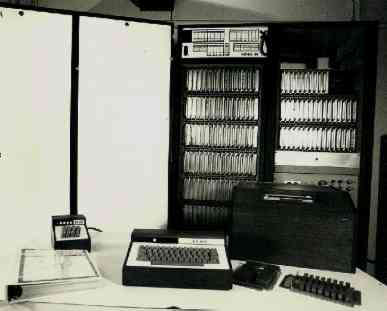
Built in 1965 by Westinghouse engineer James Sutherland, the ECHO IV was so big, “it looked more like the home was built to house the computer instead of the other way around.” In 1994, The IEEE Annals of the History of Computing reported thatΒ  “the accompanying photo from an early article on the machine shows Jim Sutherland at the console with his wife putting a raincoat on daughter Sally while Jay and daughter Ann look on. The food is supposed to symbolize how ECHO had the potential to track the groceries, and the raincoat was in case ECHO learned to predict changes in the weather, which it never did.”

There’s more on ECHO (Electronic Computing Home Operator) in Popular Mechanics and in Dr. Dobbs, including this pictureΒ 

Posted in PCs | 3 Comments

InfoStory Quote: “Paper is Power”

“In the modern world, as the Ottomans demonstrated, paper is power.” —Neil MacGregor, Director of the British Museum.

Is paper still power? or are we (finally) in a post-modern world where (blog, Facebook, Twitter) post is power?

Posted in Quotes | Leave a comment

Tim Berners-Lee on Google+Verizon

Berners-Lee: “We assume that when you look up a [web page], that you can get any page because that is the way it has always been and that is why the web has flourished… Of course a lot of companies would like to limit the pages you get.”

GoogVer and other companies busy constructing Web Chinese walls, should seriously consider whether they can make more money, not less (and benefit the world in the process – “doing well by doing good” or as it was recently rephrased, Do No Evil) by supporting and promotingΒ  an open Web. One area in which Berners-Lee vision has flourished is scientific research where open repositories allow scientists to collaborate globally and accelerate scientific progress. See, for example, the report on the Fifth International Conference on Open Repositories published in the new issue of D-Lib Magazine.

There’s money to be made by adding to, rather than subtracting from, the open Web. But when you stop innovating you resort to monopolistic practices.

Posted in Open Web | Leave a comment

Random access to information

In 1953, Arthur J. Critchlow, a young member of IBM’s advanced technologies research lab in San Jose, California, was assigned the task of finding a better information storage medium than punch-cards. Visiting a number of customers, Critchlow learned that punch-card equipment performed well when the processing of information could be done in batches or sequentially stored information but became problematic when random access was needed.

Inventory control was such an activity. In warehouse operations, for example, each order typically required several cards to be manually located, removed from a stack of cards, the inventory information updated, and the updated cards returned to their original locations. To facilitate this activity, drawers of cards were set out on work tables so that several people could access cards from the same file. This manner of organizing and processing information, widely known as the β€œtub file,” was time consuming and error-prone.

The IBM project’s staff evaluated every existing storage technology in an attempt to find the best technological solution to the loss of productivity and poor quality associated with β€œtub files.” In addition to superior capacity and reliability, the storage technology eventually selected, magnetic disks, could provide random access to information. A new method (encoded in software) for finding stored information when its physical location on the disk was unknown, ensured the success of the new way to store, organize, and share business records.

Announced on September 4, 1956, the IBM 350 Disk Storage Unit came with fifty 24-inch disks and a total capacity of 5 megabytes; its first customer was United Airlines’ reservations system. Incorporated (and announced ten days later) into the 305 RAMAC (Random Access Memory Accounting Machine), it promised, as the IBM press release said, β€œthat business transactions will be completely processed right after they occur. There will be no delays while data is grouped for batch processing. People running a business will be able to get the fresh facts they need, at once. Random access memory equipment will not only revolutionize punched card accounting but also magnetic tape accounting.” Later, it was exhibited in the 1958 Brussels World’s Fair, where visitors could query β€œProfessor RAMAC” using a keyboard and get answers in any of ten languages.Β  This public relations coup heralded a day when millions of people would access and retrieve information from the largest tub file ever assembled – the World Wide Web.

The RAMAC became obsolete within a few years of its introduction as the vacuum tubes powering it were replaced by transistors. But disk drives, invented more than 55 years ago in a search for faster access to information, are still used as the containers for almost all digital information today.

Posted in Information storage | 1 Comment