
-
Join 186 other subscribers
Categories
Archives
This day in information: Television
Today in 1927, Philo T. Farnsworth, 21, succeeded in transmitting through purely electronic means an image of a line with a device he called an “image dissector.” Today in 1957, the original version of the animated NBC peacock logo, used to denote programs “brought to you in living color,” made its debut at the beginning of “Your Hit Parade.” Quoting Wikipedia: “In a 1996 videotaped interview by the Academy of Television Arts & Sciences, available on YouTube, Elma Farnsworth recounts Philo’s change of heart about the value of television, after seeing how it showed man walking on the moon, in real time, to millions of viewers:
- Interviewer: The image dissector was used to send shots back from the moon to earth.
- Elma Farnsworth: Right.
- Interviewer: What did Phil think of that?
- Elma Farnsworth: We were watching it, and, when Neil Armstrong landed on the moon, Phil turned to me and said, “Pem, this has made it all worthwhile.” Before then, he wasn’t too sure.
Posted in This day in information, Uncategorized
Leave a comment
InfoStory Quote: Useless/Useful Information
“It is a very sad thing that nowadays 
there is so little useless information.” —Oscar Wilde
Is Data the future of information?
Posted in Quotes
Leave a comment
Nicholas Carr, June 2010
Nicholas Carr has a problem. “Over the past few years,” he says in his new book, The Shallows: What the Internet Is Doing to Our Brains, “I’ve had an uncomfortable sense that someone, or something has been tinkering with my brain. … “I’m not thinking the way I used to think. I feel it most strongly when I’m reading… my concentration starts to drift after a page or two.… My mind now expects to take in information the way the Net distributes it: in a swiftly moving stream of particles. Once I was a scuba diver in a sea of words. Now I zip along the surface like guy on a Jet Ski.”
The Carr solution? He moved from “a highly connected suburb of Boston to the mountains of Colorado,” disconnected himself from Facebook and Twitter, cut down drastically on e-mail, and wrote a book, expanding on his much discussed 2008 Atlantic Monthly cover story “Is Google Making Us Stupid?”
I live in a highly connected suburb of Boston, and although I recently increased my “social networking” activity—and my addiction to e-mail has hit an all-time high—I find all of these to be easily controlled drugs. I can still concentrate and enjoy reading books. Carr’s lucid prose and engaging writing style certainly helps, so I managed to get through the 276 pages of The Shallows and absorb its main points.
But as a service to readers suffering from heavy information overload, I picked up that ancient technology, the phone, and asked Carr: “Can you summarize the argument of the book in 140 characters?”
Nick laughed and said, “Ignoring the 140-character limit, the argument of the book is that our intellectual history has always been shaped by the technologies we use to gather, process, and share information. What neuroscience has told us recently is that the effects of those media are felt at the cellular level of the brain’s structure. When we do something—in particular do something over and over again—we alter the neural pathways in our brains. I think that’s happening with the Net, particularly as we come to use it as our all-purpose medium for gathering and sharing information in all imaginable forms. I think what we’re doing today is training our brains to be distracted, to take in information in lots of little bits and pieces with lots of distractions and interruptions. And as we do that, we begin to lose our ability for more sustained concentration, attentiveness, deep reading, and even deep thinking. If, like me, you think that attentiveness, deep thinking, and deep reading are really central to personal identity and also central to culture, I think you are right to be afraid of the damage that is being done today.
“In one sense, the Net is a continuation of a media trend we saw throughout the last century where the number of distractions supplied by media—whether it’s telephone, radio, TV, whatever—keeps ratcheting up and keeps making demands on our attention and distracting us. But I think the Net goes far beyond even anything we’ve seen before in its ability to prevent us from concentrating on one thing for more than a few seconds or minutes.”
But communications technologies of the past—as I continued to poke [Facebook reference intended] at Nick’s argument—were not a tool for building communities and providing social connections. Many people have become compulsive in their use of the Net, Nick says, because “they want to feel connected.” That’s a completely different dimension than reading and writing.
Nick agreed, up to a point. “It’s a different dimension, that’s true. But it’s also one of the reasons why we’re drawn to using the Web so much. As the Net becomes a means of instantaneous, continuous social attachment, it becomes ever harder to break away from the Net because we, as human beings, are extremely desirous of getting new information, particularly when it has social meaning. Certainly, we fear that there are interesting social interactions going on that we’re not a part of, so the rise of social networking has pushed us even further along in our dependence on the Internet, and as a result, pushed us ever further into the Net’s way of distributing information in very short, quick overlapping bursts. I think the effects are related, even though there is a lot going on, and it remains unclear how it’s all going to play out.”
That phrase, “There is a lot going on,” prompted me to bring up an ON magazine interview with Esther Dyson in 2007. When asked if she thinks people ever feel overwhelmed by information, Dyson replied, “Not just information, but choice.” She went on to describe the traditional way of life when you knew you might have a good life or a bad life, but you dealt with it. Now, everything is possible. It’s your fault if you don’t make the right career choice, if you don’t marry the right person. People both are and feel much more accountable. If their lives aren’t perfect, they can feel it’s their fault. “That’s a heavy burden,” Dyson said.
When I read The Shallows, I thought that Dyson’s perspective provided the larger context for what’s discussed in the book. I said to Nick: “Our modern culture is very open. It’s very mobile. It provides lots of choices and lots of opportunities.” And Nick concurred, saying, “And as a result, a lot of anxiety as well.”
Encouraged, I continued: “It’s interesting to look at the Internet in this context. It provides more opportunities to find information, more opportunities to connect, and even more opportunities to become famous overnight, out of nowhere. But the choices and the possibilities bring even more pressure: Should I blog? Should I Twitter? Maybe something is wrong with me if I don’t do that, or something is wrong with me if I do it and don’t become famous overnight.”
Nick continued this train of thought: “Even if you don’t become famous in a large group, the personalization of media through the Internet—where we’re all broadcasters of ourselves—does push the celebrity type of culture down to a very personal level. We’re constantly portraying ourselves in the media when we build a Facebook profile, when we send out a stream of texts or tweets. We’re creating a media persona for our self. It does, on the one hand, give us more choice and in some ways more power over the creation of our self, but in other ways it does produce a lot of anxiety and I think can also produce superficiality.”
What’s to be done?
Nick continued: “I blogged briefly about a cartoonist who decided that he was just going to cut off the Internet and get off it. What he noticed immediately was that a lot of the people he knows resented him for that because suddenly they said, ‘Gee, I have to call you?’ There’s growing social pressure to participate in these technologies, to be on Facebook and be on Twitter, and there is resentment when people try to distance themselves from it. It’s really becoming very much a social norm to present ourselves through these social networking services.”
So, other than moving to the mountains of Colorado, is there anything Nick would suggest as a medicine to cure what we are doing to our brains?
“I’ve tried to avoid prescriptions,” Nick added, “because I think it’s important just to describe the phenomenon. I don’t want to turn into some self-help person who tells you to spend three hours sitting quietly in a dark room every day, because I don’t think it’s that simple. I think this is a major technological shift that is also shifting norms of behavior and ultimately habits of thought. The furthest I’ll go on the prescription side is to underscore the fact that I think it’s pretty clear that richness of thinking is very tightly connected to a person’s ability to pay attention and to resist distraction. I think people need to be aware that if they lose that ability, that capacity to really pay deep attention to something, they’re going to lose ultimately an important part of their personality. My suggestion is not to give up that side of human thought—the more attentive, contemplative side of human thought—without at least some consideration of what you and society as a whole may be losing. But there’s no simple solution. The spark for this book was my own realization that even when I’m not at a computer, I’m finding it harder and harder to pay attention and to concentrate.”
Shortly after our phone conversation, Nick’s viewpoint got an indirect but strong endorsement from President Obama, who told the new graduates of Hampton University, “With iPods and iPads and Xboxes and PlayStations—none of which I know how to work—information becomes a distraction, a diversion, a form of entertainment, rather than a tool of empowerment, rather than the means of emancipation. So all of this is not only putting pressure on you, it’s putting new pressure on our country and on our democracy.”
As has happened many times before, I find myself disagreeing with the authorities. Isn’t it up to us to choose the degree of control we wish or don’t wish to exert over our lives? Nick has no patience with this argument. “In the end,” he writes in The Shallows, “we come to pretend that the technology itself doesn’t matter. It’s how we use it that matters, we tell ourselves. The implication, comforting in its hubris, is that we’re in control. … The computer screen bulldozes our doubts with its bounties and conveniences. It is so much our servant that it would be churlish to notice that it is also our master.”
[First published in ON magazine]
Posted in Interviews, Social Impact
1 Comment
Bob Metcalfe, October 2009
Bob Metcalfe has been involved—as a direct catalyst or a prominent observer—in a number of key milestones spanning the evolution of the IT industry: the birth of the Internet, the invention of Ethernet and local area networks, and the rapid adoption of the World Wide Web as the platform for linking information and people. Today, as a partner in Polaris Ventures, he invests in clean, low-cost energy solutions. Gil Press spoke to him at his office in Waltham, Massachusetts.
In the 20 years since the invention of the World Wide Web, what has surprised you most?
Bob Metcalfe: Tim Berners-Lee invented the URL, HTTP, and HTML standards. None of them is particularly impressive; so many high-tech people have found them to be in some way deficient. But Tim came up with three adequate standards that, when used together, ignited the explosive growth of the Web. The power of good standards is they leave you with no options. As we used to say about Ethernet, “anything which is not prohibited is mandatory.”
Think about that. We designed some plumbing at the lower levels of the hierarchy, and 17 years later Tim comes up with the World Wide Web, which Ethernet and TCP/IP carried just fine. That’s the surprise. What this has demonstrated is the efficacy of the layered architecture of the Internet. The Web demonstrates how powerful that is, both by being layered on top of things that were invented 17 years before, and by giving rise to amazing new functions in the following decades. Based on the artfulness of the design of the interfaces, you give rise to serendipity. In the design of his standards, Tim nailed down both expressive power and simplicity, allowing people to easily get started. It’s those three standards plus Mosaic, which added visual and graphical veneer, plus the evangelical verve of Tim Berners-Lee himself that were probably all pivotal in that early takeoff.
What has been a disappointment in the context of the World Wide Web—something you expected that didn’t pan out?
There’s no room for that. The Web has been so successful, there’s nothing disappointing about it. Tim Berners-Lee tells this joke, which I hasten to retell because it’s so good. He was introduced at a conference as the inventor of the World Wide Web. As often happens when someone is introduced that way, there are at least three people in the audience who want to fight about that, because they invented it or a friend of theirs invented it. Someone said, “You didn’t. You can’t have invented it. There’s just not enough time in the day for you to have typed in all that information.” That poor schlemiel completely missed the point that Tim didn’t create the World Wide Web. He created the mechanism by which many, many people could create the World Wide Web.
And the mechanism to connect not only information, as was his original vision, but now also connecting people with Web 2.0 applications. You recently started to use Twitter. Why?
I’m using Twitter because one of my partners, Mike Hirshland, accused me of having a generational problem. Young, hip people use social networks, and old farts don’t.
I used to be on the other side. I was helping to introduce LANs when there were all these old farts who thought that punch-cards were the way you did computing. The joke was that Ethernet would be adopted one funeral at a time. These people had to die. There was no way of changing their minds. So, I understand generational ossification. When my partner accused me of it, I decided to participate in this phenomenon so as to better understand it.
I’m beginning to find uses for Twitter. By tweeting my weight, I have involved my followers in a support group to help me lose weight. Knowing that I’m going to be tweeting my weight bears on my behavior. So there’s one application—the support group application.
My daughter is about to graduate from college, and she’s looking for a job. I have tweeted this fact, and I’m actually getting inquiries about my daughter from people who might want to see her résumé. So, that’s the job search application.
One of my hobbies is math puzzles, and I tweet them now and then. The most response I’ve ever gotten on Twitter was when I tweeted the fact that 111,111 squared equals 12,345,678,987,654,321. Then I noticed that in a lot of the re-tweets there was a tag that I was unaware of: number sign, nerd porn—this particular fact was considered nerd porn.
In the early 1990s, you argued in an InfoWorld column against wireless computing, advising readers to “wire up your homes and stay there.”
Let’s divide that into two discussions. I think that “wire up your home and stay there” is truer than ever. We’re at a time now where energy conservation is the next big thing, and one of the opportunities we have is the substitution of communication for transportation.
But you ask about one of my regrettable columns. In the early 1990s, there was a wireless bubble. There were a bunch of companies touting their modems and wireless mobility. But the modems didn’t work very well, and they were bigger than the computers. I said that wireless mobile PCs would be like porta-potties: Porta-potties are good and useful things, but as a general rule, the bathrooms that we use have pipes. So yes, there will be some wireless computers, but mostly we’ll use pipes because pipes have so much more capacity. I was right about it in 1993: That bubble burst, and all those mobile wireless companies went away.
I went on to say in my column that wireless computing will never be important. That’s where I went wrong, because along came Wi-Fi. When I was writing my column, I was often torn between being right and being interesting. Many columnists make the mistake of trying too hard to be interesting. You use various forms of hyperbole, like “There will never be anything like this.” Well, maybe there will be. But that’s not nearly as interesting as these hyperbolic comments.
I would like to point out that there is a figure of speech called hyperbole. It’s a Greek word. It’s been around for a long time, so I offer it in defense of some of my hyperbolic columns.
Around the same time, George Gilder coined the term “Metcalfe’s Law” to describe your idea that bigger networks are better. In the context of the layered architecture of the Internet, don’t you think one can apply “Metcalfe’s Law” to the layer of networking computers (the Internet), the layer of linking information (the Web), and finally, the layer of connecting people (Web 2.0)?
That’s a great point. I’d never thought of it that way. It wasn’t even called Metcalfe’s Law when I first used it. It was a slide in a 3Com sales presentation. The goal of the slide was to give people a rationale for building bigger Ethernets. I drew a picture that put the three-node network below a critical-mass point, arguing that you needed to get to some higher number to achieve critical mass. That was the diagram that I gave to George Gilder in 1993. He called it “Metcalfe’s Law,” for which I’m grateful. The value of the network grows as N-squared—“N” being the number of machines connected to the network.
Networking PCs was a novel idea at the time. So what did you tell people they could do with the network?
When Ethernet first came out, our sales proposition was PFMTS—Print, File, Mail, Terminal, Stubs.
You may remember the IBM PC XT that came out in 1982. It had a 10-megabyte disk on it. No one could imagine what you’d do with 10 megabytes on your disk. So the idea that you might want to buy one PC with a 10-megabyte disk on it, and then share it over the LAN with cheaper diskless PCs, had traction. The same thinking applied to laser printers that were new and expensive. So share the printer, share the disk.
I like to think about it as shifting gears. The second gear was LAN e-mail. The big e-mail carriers of the time, like AOL and MCI, didn’t consider it e-mail, because my e-mails never left the building. But already in the early days of the Internet, we observed heavy e-mail traffic between Internet nodes within the same building. We called it “incestuous traffic”; it was surprising, even embarrassing, because Internet e-mail was originally conceived for long-distance communications.
T stood for terminal. There were all these minicomputers and mainframes still around in those days. You couldn’t throw them out, and all of them had dumb terminals. People would have a dumb terminal on their desk, and then they would have a PC on their desk. That didn’t make any sense. So you’d just write software that allowed your PC to be a dumb terminal so you could access the minicomputer or the mainframe.
Stubs were the APIs for accessing the underlying networking functionality, opening connections, closing connections, etc. This is the serendipity idea again. One such new idea came from Novell, which used the stubs to share access—not to a file, but to a database. This led to the first use of multi-user accounting systems that ran on top of the LAN. That’s how NetWare got its foothold and eventually blew past 3Com’s operating system.
You have been drawing interesting analogies from your experience with Ethernet and the Internet to what you invest in and speak about nowadays: Energy or what you call the Enernet.
I’ve been on this Internet speaking tour, a two-year book tour without a book. I felt I had a valuable contribution to make, looking at how we built the Internet and extracting the lessons from that, and then applying them to energy so we could solve energy problems sooner, better, faster. I think there are a lot of lessons to be learned, such as the value of decentralization, designing for abundance, or over-reliance on Washington.
I used to defend that analogy. I’ve now come full circle: I believe that energy is the Internet’s next killer app. We did mail, we did telephone, we did commerce, we did publishing, we did newspapers (we’re about to kill newspapers), and now we, the Internet, is going to solve energy. For example, they talk about a smart grid. A smart grid is a bunch of folks out there who want to build new networks to solve energy and they call it the smart grid. But instead of building an entirely new network, another silo, why not use the Internet as the control plane for the smart grid?
But it’s even deeper than that. That is, the very structure of the energy network—the actual transmission and distribution—needs to be like the Internet. So, it needs to be de-synchronized. Right now, to put energy on the grid, you need to synchronize frequency and phase to get onto it because it clicks with this 60-hertz centralized clock.
What the Internet did for communications was to take the clock out and put the clock in the packet so there wasn’t a big global ticking clock. I sent you the clock, and you were able to tick the bits at the rate that I told you to, so we de-synchronized the Net. We will end up de-synchronizing the power switching network and end up with power packet switching, like the Internet.
What’s more, the other thing we did to telecom is we added storage. The original Internet had no storage in it. Then these geniuses came up with the packet switch, with core memory for storing packets. Then we added disks to our computers. If you look at the Internet now, there is storage everywhere. So we’re going to “storify” the energy network. Right now, they have no place to put energy, so when they have excess energy, they don’t know what to do with it. Also, if renewables such as solar and wind are going to play any role, you need storage. I think storage is going to be big in this new energy network we have to build.
What will the Web look like or should look like in 20 years?
Thinking about the future of the Web or the Internet, I came up with a three-by-three matrix. On one axis are the three new kinds of traffic that the Web has to deal with: video, mobile, and embedded. On the other axis are the next three societal applications that the Web has to solve: energy, healthcare, and education. I look in each of those nine boxes for companies, opportunities, and progress.
Those three kinds of traffic have started arriving, but we have a long way to go. Video is brand new on the Internet, as far as I’m concerned. The mobile Internet has arrived, but it’s still happening. Then there’s embedded traffic. Ten billion microcontrollers are shipped every year, and only a tiny fraction of those are networked. Then there are the three new killer apps—energy, healthcare, and education—just sitting there. The Web has got to solve all three of those problems.
What will the Web look like in 20 or 30 years? It will be comfortable with those three new modes of traffic, and it will be solving those three problems.
[First published in ON magazine]
Tim Berners-Lee, September 2009
In 1989, while a fellow at CERN, the European Particle Physics Laboratory in Geneva, Switzerland, Tim Berners-Lee invented the World Wide Web. Today he is 3Com Founders Professor of Engineering at the Massachusetts Institute of Technology (MIT), where he serves as director of the World Wide Web Consortium (W3C), an international standards body dedicated to leading the Web to its full potential. Sir Tim is the author of Weaving the Web. Jason Rubin and Gil Press spoke with him at his office in Cambridge, Massachusetts.
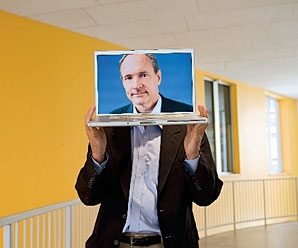
Photographer: Webb Chappell
Twenty years on, the World Wide Web has proven itself both ubiquitous and indispensible. Did you anticipate it would reach this status, and in this time frame?
Tim Berners-Lee: I think while it’s very tempting for us to look at the Web and say, “Well, here it is, and this is what it is,” it has, of course, been constantly growing and changing—and it will continue to do so. So to think of this as a static “This is how the Web is” sort of thing is, I think, unwise. In fact, it’s changed in the last few years faster than it changed before, and it’s crazy for us to imagine this acceleration will suddenly stop. So yes, the 20-year point goes by in a flash, but we should realize that, and we are constantly changing it, and it’s very important that we do so.
I believe that 20 years from now, people will look back at where we are today as being a time when the Web of documents was fairly well established, such that if someone wanted to find a document, there’s a pretty good chance it could be found on the Web. The Web of data, though, which we call the Semantic Web, would be seen as just starting to take off. We have the standards but still just a small community of true believers who recognize the value of putting data on the Web for people to share and mash up and use at will. And there are other aspects of the online world that are still fairly “pre-Web.” Social networking sites, for example, are still siloed; you can’t share your information from one site with a contact on another site. Hopefully, in a few years’ time, we’ll see that quite large category of social information truly Web-ized, rather than being held in individual lockdown applications.
You mentioned a “small community” of people who see the value of the Semantic Web. Is that a repeat occurrence of the struggle 20 years ago to get people to understand the scope and potential impact of the World Wide Web?
It’s remarkably similar. It’s very funny. You’d think that once people had seen the effect of Web-izing documents to produce the World Wide Web, doing likewise with their data would seem the next logical step. But for one thing, the Web was a paradigm shift. A paradigm shift is when you don’t have in your vocabulary the concepts and the ideas with which to understand the new world. Today, the idea that a web link could connect to a document that originates anywhere on the planet is completely second nature, but back then it took a very strong imagination for somebody to understand it.
Now, with data, almost all the data you come across is locked in a database. The idea that you could access and combine data anywhere in the world and immediately make it part of your spreadsheet is another paradigm shift. It’s difficult to get people to buy into it. But in the same way as before, those who do get it become tremendously fired up. Once somebody has realized what it would be like to have linked data across the world, then they become very enthusiastic, and so we now have this corps of people in many countries all working together to make it happen.
Do you see the Semantic Web as enabling greater collaboration between and among parties, as opposed to the point-to-point or point-to-many communication that seems more prevalent in the current Web?
The original web browser was a browser editor and it was supposed to be a collaborative tool, but it only ran on the NeXT workstation on which it was developed. However, the idea that the Web should be a collaborative place has always been a very important goal for me. I think harnessing the creative energy of people is really important. When you get people who are trying to solve big problems like cure AIDS, fight cancer, and understand
Alzheimer’s disease, there are a huge number of people involved, all of them with half-formed ideas in their minds. How do we get them communicating so that the half of an idea in one person’s head will connect with half of an idea in somebody else’s head, and they’ll come up with the solution?
That’s been a goal for the Web of documents, and it’s certainly a goal for the Web of data, where different pieces of data can be used for all kinds of different things. For example, a genomist may suspect that a particular protein is connected to a certain syndrome in a cell line, search for and find data relating to each area, and then suddenly put together the different strains of data and discover something new. And this is something he can do with the owners of the respective pieces of data, who might never have found each other or known that their data was connected. So the Web of data will absolutely lead to greater collaboration.
Is your vision of the Semantic Web one in which data is freely available, or are there access rights attached to it?
A lot of information is already public, so one of the simple things to do in building the new Web of data is to start with that information. And recently, I’ve been working with both the U.K. government and the U.S. government in trying not only to get more information on the Web, but also to make it linked data. But it’s also very important that systems are aware of the social aspects of data. And it’s not just access control, because an authorized user can still use the right data for the wrong purpose. So we need to focus on what are the purposes for accessing different kinds of data, and for that we’ve been looking at accountable systems.
Accountable systems are aware of the appropriate use of data, and they allow you to make sure that certain kinds of information that you are comfortable sharing with people in a social context, for example, are not able to be accessed and considered by people looking to hire you. For example, I have a GPS trail that I took on vacation. Certainly, I want to give it to my friends and my family, but I don’t necessarily wish to license people I don’t know who are curious about me and my work and let them see where I’ve been. Companies may want to do the same thing. They might say, “We’re going to give you access to certain product information because you’re part of our supply chain and you can use it to fine-tune your manufacturing schedule to meet our demand. However, we do not license you to use it to give to our competition to modify their pricing.”
You need to be able to ask the system to show you just the data that you can use for a given task, because how you wish to use it will be the difference in whether you can use it. So we need systems for recording what the appropriate use of data is, and we need systems for helping people use data in an appropriate way so they can meet an ethical standard.
Ultimately, what is one of the most significant things the Semantic Web will enable?
One thing I think we’ll be able to do is to write intelligent programs that run across the Web of data looking for patterns when something went wrong—like when a company failed, or when a product turned out to be dangerous, or when an ecological catastrophe happened. We can then identify patterns in a broad range of data types that resulted in something serious happening, and that will allow us to identify when these patterns recur, and we’ll be better able to prepare for or prevent the situation.
I think when we have a lot of data available on the Web about the world, including social data, ecological data, meteorological data, and financial data, we’ll be able to make much better models. It’s been quite evident over the last year, for example, that we have a really bad grasp of the financial system. Part of the reason for that might be that we have insufficient data from which to draw conclusions, or that the experts are too selective in which data they use. The more data we have, the more accurate our models will be.
After 20 years, what about the Web—either its current or future capabilities—excites you the most?
One of the things that gets me the most excited are the mash-ups, where there’s one market of people providing data and there’s a second layer of people mashing up the data, picking from a rich variety of data sources to create a useful new application or service. A classic example of a mash-up is when I find a seminar I want to go to, and the web page has information about the sponsor, the presenter, the topic, and the logistics. I have to write all that down on the back of an envelope and then go and put it in my address book; I have to put it in my calendar; I have to enter the address in my GPS—basically, I have to copy this information into every device I use to manage my life, which is inefficient and time-consuming. This is because there is no common format for this data to become integrated into my devices.
Now, the vision of Semantic Web is that the seminar’s web page has information pointed at data about the event. So I just tell my computer I’m going to be attending that seminar and then, automatically, there is a calendar that shows things that I’m attending. And automatically, an address book I define as having in it the people who have given seminars that I’ve attended within the last six months appears, with a link to the presenter’s public profile. And automatically, my PDA starts pointing towards somewhere I need to be at an appropriate time to get me there. All I need to do is say, “I’m going to that seminar,” and then the rest should follow.
The Web is such a mélange of useful, noble content and stuff that runs the gamut from the mundane to the grotesque. Do you think humanity is using this incredible invention of yours appropriately?
Yes. The Web, after all, is just a tool. It’s a powerful one, and it reconfigures what we can do, but it’s just a tool, a piece of white paper, if you will. So what you see on it reflects humanity—or at least the 20 percent of humanity that currently has access to the Web.
As a standards body, the W3C is not interested in policing the Web or in censoring content, nor should we be. No one owns the World Wide Web, no one has a copyright for it, and no one collects royalties from it. It belongs to humanity, and when it comes to humanity, I’m tremendously optimistic. After 20 years, I’m still very excited and extremely hopeful.
[First published in ON magazine]
Posted in Interviews, World Wide Web
6 Comments
Tom Davenport and Andy McAfee, June 2008
On June 18, 2007, at the Enterprise 2.0 Conference in Boston, Andrew McAfee, who coined the term in 2006, debated the merits of Enterprise 2.0 with Tom Davenport. Jason Rubin and Gil Press revisited the debate with them a year later at Tom’s office in Babson College.
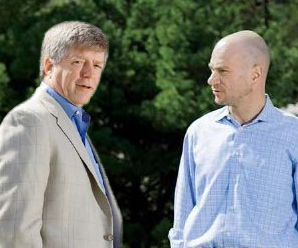
Photographer: Leah Fasten
When people talk about Enterprise 2.0, are they all talking about the same thing?
Andy McAfee: One of the things I tried to do early on was nail down what I hoped would be a tight definition for Enterprise 2.0. Other people are trying to use the same phrase to mean everything interesting that’s happening with IT. For me, Enterprise 2.0 represents the use of emergent social software platforms. Here’s what I mean. If I send Tom an e-mail, you don’t know about it and you can’t access its contents; it doesn’t add up to anything valuable at the enterprise level. A platform, on the other hand, is a digital environment where the content persists and grows over time, and can be consulted by the rest of the organization. Social means that the information is contributed by people as opposed to being generated automatically. And emergent implies that these systems are trying hard to not dictate structure or workflow so users experience it as being fairly close to a blank slate, but the structure does appear over time.
Tom Davenport: Well, I guess the only real difference I have regarding definition is the question of whether this is all completely new or just part of a continuum. There have always been tools with which to create, share, and store information. There are certainly more now, and it’s easier to do it now, so to me, it’s a matter of degree and not a matter of difference. I’m interested in emergence, too, and there are certainly some organizational information environments that should be managed in an emergent way. But there also are information environments that need curation and editing.
What is the potential of these technologies to change organizations?
Tom: I’ve always felt that Andy was pretty responsible as far as talking about how this is going to transform organizations. But there are people who are overstating the impact of these technologies, saying that social networks, by themselves, can build better customer relationships, increase business opportunities, transform service delivery, flatten silos, and on and on. I find these “techno-utopians” and their sweeping statements very troubling. I’m not saying not to add social networks to your portfolio, but don’t think that they’re a panacea for whatever information challenges your organization is facing.
Andy: I’m just old enough to remember the first wave of the Internet and the hype that accompanied that. I remember going to conferences and presentations where people would put up things like Porter’s Five Forces diagram and say, “This doesn’t apply anymore. All these rules are off.” That’s just not true. The only technologies that are powerful enough to get rid of those kinds of existing structures are nuclear weapons. Still, I am a little more bullish than Tom on the ability of some new technologies to effect operational changes even without an accompanying organizational push from the top.
How can an organization be sure its Enterprise 2.0 deployments are creating value rather than just providing employees with a virtual sandbox to play in?
Andy: I was at a conference with Wikipedia founder Jimmy Wales, and I asked him if he was an inclusionist or a deletionist. And he did a brilliant job of answering the question. He said, “I’m an eventualist, and I think that eventually the Wikipedia community is going to get these kinds of issues right.” I think that applies to Enterprise 2.0 deployments as well, and I appreciate that, in a lot of companies, the initial experiments are not necessarily going to be successful right away. But that doesn’t mean they won’t be eventually.
Tom: I agree with that, and I think the way we will succeed with this technology, or frankly, with any collaboration-oriented technologies, is to be fairly rigorous in looking at what works and what doesn’t. I’ve been giving a new talk that I call, “The Science of Collaboration,” which says the companies that are really successful using the Web are very scientific about it. They look very carefully at blogs and try to understand what works. We need to approach collaboration with that level of discipline.
What’s your vision for Enterprise 2.0 over the next five years?
Andy: My optimistic vision is that a professional services firm, for example, would deploy some level of toolset that makes it extremely easy for them to find the colleague elsewhere in the company who’s the best person to help them with Problem X. I think of a tool that allows me to broadcast my experience and my knowledge within the firm and makes it very easy for people to find me and ping me. It also makes it very easy for me to build a network of people I respect or trust for various reasons and exploit that network.
Tom: Well, we’ve been talking about expertise, networks, and directories in professional services firms for a long time. I think it is an interesting illustration of emergent organization of information versus top-down taxonomy. Years ago the firm I was working in tried to create an expertise directory, and I was always frustrated by the fact that the top-down taxonomies couldn’t capture anything I knew about. On the other hand, the terms I used to describe myself were not necessarily what somebody else was searching for. You really need some mix of the two.
Andy: I’d like to have a couple of people employed in the company who are the new style of corporate librarian, what wiki fans call a “gardener.” These are the people who go in and add to the structure of these more emergent environments.
One of the things that makes me optimistic is the number of senior executives who are starting to say, “I sense something happening here. I see my kids on Facebook. I see how hard it is to attract and retain young people. I sense this different energy happening. And I feel like there’s some train leaving the station and I’d rather be on it than off it.”
Tom: Well, I certainly hope they do. And if they do it because of these technologies as opposed to the last generation of technologies, fine with me. But I guess I’m pessimistic because they didn’t do it when all this stuff was being described years ago for knowledge management. Certainly these technologies make some aspects of it easier. But I never really thought it was the technology that was holding companies back before. I hope I’m wrong.
[First published in ON magazine]
Posted in Interviews, Social Networks
1 Comment
Jim Champy, March 2009
In Outsmart!, consultant and best-selling author Jim Champy profiles nine high-growth companies that are leveraging the global IT infrastructure and new business models to redefine existing markets and create new ones. Gil Press and Chris Kane spoke with Champy in his office in Boston.

Photographer: Asia Kepka
Gil Press: What’s the central theme of the book?
Jim Champy: The underlying idea is that there really isn’t a lot new in management, but there’s a lot new in business. What Peter Drucker wrote in the mid-1950s is still valid, still the basic principle by which we run companies and should run companies. However, because of the rise of the global IT infrastructure, there are many companies that are achieving success by operating in fundamentally different ways. When you look today at companies that outsmart their competitors, it’s a lot about how they’re executing. The classical strategist doesn’t believe that how you do work can be a competitive advantage. Their assumption is someone can easily copy that. I’ve never believed that.
Gil: Can you put the book in the context of your previous work, especially Reengineering the Corporation?
Jim: When I look back now, I see that my prior work was preparatory. Reengineering is still valid and important, but it’s not enough. Businesses need to adopt fundamentally different business models, encompassing not only what you deliver to customers but also how it’s delivered. We see today an active redefinition of what’s being sold and how.
Chris Kane: Sonicbids is a good example.
Jim: Absolutely. Sonicbids is a Web-based company that matches musicians with promoters who need to hire talent for events like weddings and reunions. The individual transactions are small-which means large agencies wouldn’t handle them because they couldn’t make any money at it. But cumulatively, it’s a $13 billion market. Sonicbids figured out how to use technology to serve that fragmented market. It’s a whole new business model. But what they’re doing today, you couldn’t have done efficiently even five or 10 years ago. When we wrote the reengineering book, there was no free information technology infrastructure.
Gil: What is different about today’s IT infrastructure?
Jim: Today’s infrastructure allows money, information, products, and services to all moves in fundamentally different ways. It means that all markets are global, no matter how big or small you are. That’s a huge move.
The new IT infrastructure also allows smart companies to evolve quickly. One young guy told me, “The Internet is a 20-year-old’s best friend.” That’s because you can put out a product or service and almost immediately determine whether or not it’s working. You can learn from your mistakes much faster than people in business have ever learned. And a 20-year-old knows as much about the Internet and how to use it as a 50-year-old-maybe more.
Chris: A number of the companies have built their businesses around gaps and dysfunctions in an industry.
Jim: One of the common traits in the leaders we talked to is their ability to see an opportunity where no one else does. Sometimes you’re so deep in an industry, you don’t see the dysfunction. Healthcare is a good example. It took an entrepreneur to create MinuteClinic, which is based on a retail model that many clinicians would find problematic. MinuteClinic provides a set of basic health services seven days a week at low cost in kiosks located in retail stores. It’s a very convenient and cost-effective way for people to get treated for common ailments like sinus infections and allergies. But the company faced a lot of resistance from the medical establishment.
Gil: When you wrote the reengineering book, the corporation was very clearly defined. Now, with the help of the Internet, there is no clear boundary between a company and its partners. What are the ingredients needed for successful partnerships?
Jim: Transparency, trustworthiness, and standardization are crucial. Whenever you see contention between partners, it’s typically because one of those elements is missing. All these companies are very transparent, very open. Nobody once said to me they had a secret that they wouldn’t disclose.
Trust is also critical. My sense with all the people I spoke with is that they are highly ethical and trustworthy and want the same thing of their partners. Third is this element of standardization. People assume that standardization means commoditization, but it isn’t the same thing. Standardization is what allows you to achieve scale.
Gil: In quite a few cases, companies were able to marshal their partners to standardize around a common way of doing business.
Jim: Yes. Partsearch is a good example. They provide an online catalog that lets consumers and repair people search and order eight million parts for more than 560 brands of major appliances and consumer electronics. One of the keys to their success is that they were able to convince all these different manufacturers who had labeled their parts in different ways to switch to a single data format.
By the way, after I did that case, I started seeing the need every day. The same with Shutterfly. I was struck by how many of the Christmas cards I got this year were Shutterfly cards. Their CEO expanded what had been a traditional photo processing company into an Internet-based “social expressions” and personal publishing service. Coincidentally, for our 29th anniversary, my son gave my wife and me a book of pictures from our honeymoon that he created using Shutterfly. It cost him something like $15 to create, but it was a wonderful gift.
Chris: You talk about Shutterfly’s success at integrating commerce and community.
Jim: Yes. I think companies that just build on community without providing any other product or service are problematic from a business perspective. In my view, community should be about how you move a real product or service. It’s a whole new dynamic that the infrastructure allows.
For my next book, I interviewed the CEO of a company that makes a very unique product based on a traditional cooking technology. You won’t see advertisements for it, but really serious chefs know this product, largely through word of mouth. On the company’s website, 400 or 500 people are exchanging information daily about how to cook on this thing, which is helping popularize and globalize the cooking technique as well as the product itself.
Gil: Outsmart is not prescriptive in the way many management books are. I find that refreshing.
Jim: Every time I’ve written a book and tried to be prescriptive at a general level, I never felt that it was authentic because I would say, “But this doesn’t apply to everybody.” The argument breaks down.
Gil: Still, an intelligent person can learn lessons from these very detailed case studies. When I read the epilogue, where you summarized the common behaviors you saw, it was really a description of entrepreneurial behavior, as opposed to the behavior of what you call incumbent companies run by managers who are risk averse. What I like about the example of Smith & Wesson, whose CEO reignited their brand and expanded their product line, is that it shows you can create a startup-like environment even if you run a 130-year-old company.
Jim: Exactly. People ask me, “Is the book for entrepreneurs, or is it for large companies?” Well, it’s for both.
[First published in ON magazine]
Posted in Interviews
Leave a comment
 The Story of Information