First 3-D Movie in Color from a Major Studio

Houseofwax60 years ago today, Warner Bros.’s House of Wax premiered nationwide. The film was the first 3-D color feature from a major American studio, and premiered just two days after Columbia Pictures’s Man in the Dark, the first 3-D feature released by a major studio. It followed the very successful premiere months earlier of the independent production, Bwana Devil, both sparking the 3-D film boom of the 1950s.

Posted in Film | Leave a comment

First 3-D Movie from a Major Studio

Man_in_the_Dark_(1953_film)_poster60 years ago today, Columbia Pictures premiered the first 3-D movie produced and released by a major studio, Man in the Dark, at the Globe Theater in New York City. The unexpected success of the previous year’s Bwana Devil in 3-D sparked a stampede from the major studios to release their own 3-D films. Columbia Pictures rushed a current project into production and completed it in 11 days.

Posted in Film | Leave a comment

Disk Drive Manufacturers: And Then There Were Three…

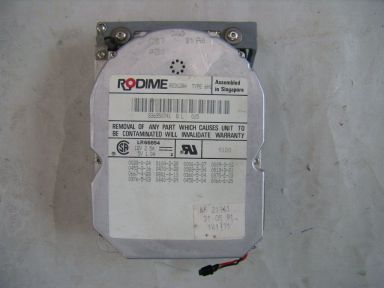
Rodime, based in Scotland, introduced the world's first 3.5-inch drive in 1983

Rodime, based in Scotland, introduced the world’s first 3.5-inch drive in 1983

storagenewsletter.com has assembled a list of 218 manufacturers of hard disk drives (HDD) that have entered this market since the disk drive was introduced by IBM in 1956. Today, only three remain: Seagate, Toshiba and Western Digital.

Posted in Computer history, Information storage, The Information Business | Leave a comment

Netscape Launched

Netscape-logoToday in 1994, Jim Clark and Marc Andreessen founded Mosaic Communications Corporation. Their mission was “to be the premier provider of open software that enables people and companies to exchange information and conduct commerce over the Internet and other global networks.” The company’s first product was a web browser, the Mosaic Netscape 0.9, released on October 13, 1994. This browser was subsequently renamed Netscape Navigator, and the company was renamed Netscape Communications Corporation on November 14, 1994, to avoid trademark ownership problems with NCSA, where the initial Netscape employees had previously created the NCSA Mosaic web browser.

Tim Berners-Lee, the inventor of the World Wide Web (never mentioned in Mosaic’s Who We Are/Our Story section where only “the Internet” is discussed), wrote in Weaving the Web:

Marc [while at NCSA] maintained a near-constant presence on the newsgroups discussing the Web, listening for features people were asking for, what would make browsers easier to use. He would program these into the nascent browser and keep publishing new releases so others could try it. … Marc was not so much interested in just making the program work as in having his browser used by as many people as possible. This was, of course, what the Web needed.

The resulting browser was called Mosaic. … It troubled me in a way that NCSA was always talking about Mosaic, often with hardly a mention of the World Wide Web. Perhaps it was just pure enthusiasm.

Posted in Computer history, World Wide Web | Leave a comment

First Mobile Phone Call, 1973

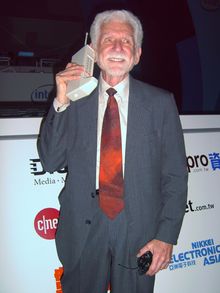
FirstMobileCallForty years ago today (April 3, 1973), Martin Cooper made a phone call from a prototype Dyna-Tac handheld cellular phone.  The phone, which weighed about 2.5 lb, connected Cooper to Dr. Joel S. Engel, head of research at Bell Labs.

Update: From “8 Guys, 6 Weeks: How the Cell Phone Was (Finally) Invented,” The Atlantic

On April 3, 1973 — 40 years ago today — Cooper took an early model of Motorola’s DynaTAC phone (a brick phone weighing 2.5 pounds, measuring 9 inches long and 5 inches deep, and featuring about 20 minutes of battery life) to the streets of New York City. He pressed the phone’s “off hook” button. And he made a call to the land line of Bell Labs, where he was connected to his counterpart, and chief rival, Joel Engel. “Joel, this is Marty,” Cooper said, gleefully. “I’m calling you from a cell phone, a real handheld portable cell phone.”

Cooper, in doing all this, made quite a scene. Telephones, at that point, were not things you could just carry around with you as you walked. (Cooper liked to joke that the DynaTAC’s limited talk time wasn’t technically a problem — since “you couldn’t hold that phone up for that long.”) So a guy strolling around near Radio City Music Hall, talking animatedly into a large hunk of plastic, was a spectacle. Even for a city that was used to spectacles. “As I walked down the street while talking on the phone,” Cooper would later recall, “sophisticated New Yorkers gaped at the sight of someone actually moving around while making a phone call.”

And that, of course, was the point. “We wanted to do a dazzling demonstration,” Cooper said. The team’s goal wasn’t just to invent something; it was to let the world know, in as striking a way as possible, that the something had been invented. The demo would end, appropriately, with the technologist processing to the Midtown Hilton, where a gaggle of reporters were assembled for a press conference. Cooper would hand his phone to one of those reporters so she could call her mother in Australia.

Cooper, in other words, enjoyed — and exploited — the moment. “I made numerous calls,” he remembered, “including one where I crossed the street while talking to a New York radio reporter — probably one of the more dangerous things I have ever done in my life.”

Posted in consumer electronics history, Mobile, Telephone, This day in information | Leave a comment

First General-Purpose Computer Proposed

ENIACSeventy years ago today (April 2, 1943), John Mauchly and J. Presper Eckert of the Moore School at the University of Pennsylvania submitted a proposal for building an “electronic calculator” to the U.S. Army’s Ballistics Research Laboratory. The contract was signed on April 9 and the result was the ENIAC, the first electronic general-purpose computer, unveiled on February 14, 1946.

See also This Day In Information: ENIAC DedicatedThis Day In Information: Giant Brains; and When Mauchly Met Atanasoff: Creating the Digital Computer

Posted in Computer history | 3 Comments

Phototransistor Invented

PhototransistorToday in 1950, the invention of the phototransistor was announced by Bell Telephone Laboratories.  This was a transistor operated by light rather than electric current, invented by Dr. John Northrup Shive.

Last year,, Bob Metcalfe reviewed a new history of Bell Labs, The Idea Factory, by Jon Gertner, taking issue with Gertner’s romanticized “view of the place,” and arguing that “trusting research to corporate monopolies is problematic in two ways. First, their money comes from overcharging customers by using monopoly power…. Second, a corporate monopoly has little motivation to disrupt a market that it already dominates.

Instead, Metcalfe–the recipient of the Alexander Graham Bell Medal, among many other honors–suggested investing in research universities, concluding that “Today we have many budding Silicon Valleys world-wide similarly forming around one or more research universities, our best ‘idea factories.’ Among Mr. Gertner’s stories is one of a professor and his hearing research at Boston University. Alexander Graham Bell invented the telephone and raised venture capital to start AT&T, and that gave us Bell Labs.”

Posted in Computer history, consumer electronics history, Innovation, This day in information, Transistor | Leave a comment

The Surui Cultural Map: Digital Preservation

The Surui Cultural Map shows the Surui tribe of the Amazon’s vision of their forest, including their territory and traditional history. To create this map, Surui youth interviewed their elders to document and map their ancestral sites, such as the site of first contact with western civilization in 1969, places where the tribes battled with colonists in the 1970s, as well as places of interest, like sightings of jaguars, capybaras and toucans. To preserve their forest and their livelihood, the Surui are entering the Carbon Credit marketplace with software called Open Data Kit to measure carbon and monitor any illegal logging in their forests using Android smartphones.

Posted in Digitization, Maps, Mobile, Preservation, Social Impact | Leave a comment

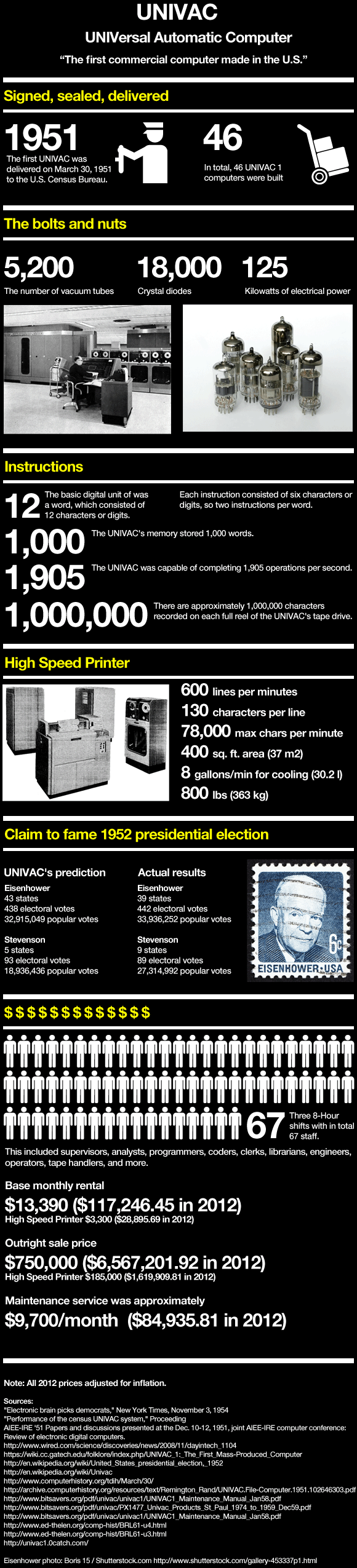
UNIVAC (Infographic)

univac-pingdom-thumb-580x2550-39994


Source: ReadWrite

Posted in Computer history | Leave a comment

The ‘Best Map Ever of the Universe’

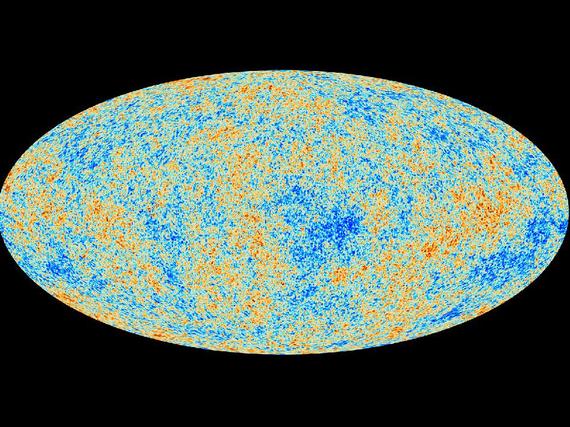
Map-Of-Universe


The Atlantic:

What does the universe look like?

It looks, it turns out, a little something like the image above — a map that details what NASA is calling “the oldest light in our universe.” That light, the Cosmic Microwave Background, or CMB, was imprinted on the sky when the universe was young (it was, essentially, the glowing aftermath of the Big Bang). And it has now been detected with the greatest precision ever achieved by a collaboration among Earth’s science agencies.

See also Preserving Astronomy’s Photographic Legacy and World Views, 2010 and 150

Posted in Astronomy, Lost and Found, Maps | Leave a comment