Lord Byron and the Luddites

Frame Breaking

Frame Breaking

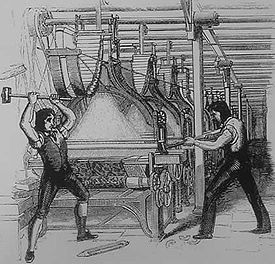
Today in  1812, Lord Byron gave his first address as a member of the House of Lords, in a parliamentary debate on the Frame Breaking Act. Byron told his peers: “During the short time I recently passed in Nottingham, not twelve hours elapsed without some fresh act of violence; and on that day I left the the county I was informed that forty Frames had been broken the preceding evening, as usual, without resistance and without detection.

“Such was the state of that county, and such I have reason to believe it to be at this moment. But whilst these outrages must be admitted to exist to an alarming extent, it cannot be denied that they have arisen from circumstances of the most unparalleled distress: the perseverance of these miserable men in their proceedings, tends to prove that nothing but absolute want could have driven a large, and once honest and industrious, body of the people, into the commission of excesses so hazardous to themselves, their families, and the community.

“They were not ashamed to beg, but there was none to relieve them: their own means of subsistence were cut off, all other employment preoccupied; and their excesses, however to be deplored and condemned, can hardly be subject to surprise.”

Continue reading

Posted in Computer history, Social Impact, This day in information | Leave a comment

The Encyclopedia of Life Launched

EOLToday in 2008, the Encyclopedia of Life was launched. From the Website: “The Encyclopedia will be an online reference and database on all 1.9 million species currently known to science and will stay current by capturing information on newly discovered and formally described species. The Encyclopedia of Life will help all of us better understand life on our planet.

“Currently, data and information can be found across the globe, in many scattered databases, books, and journals. Even smart searchers are often overwhelmed by lists of sites found by search engines or by lack of easy access to libraries, museums, and other storehouses of knowledge. There is currently no single place where consumers of information can turn to for scientifically authenticated information about every known species on Earth. Encyclopedia of Life will provide this ‘one-stop shopping’.

“Many people have dreamed about having all information about species brought together in one place. In the 1990s, Chris Thompson (Smithsonian Institution) and Daniel Janzen (University of Pennsylvania and INBio, Costa Rica) were among the first to envision on-line species pages and several projects were started around the globe to develop such pages for limited groups of organisms. E.O. Wilson of Harvard University articulated the idea for an encyclopedia of all life in a widely read essay published in 2003 and has been one of the leading proponents of the Encyclopedia of Life. Wilson’s contributions have been the inspiration for our current efforts.”

2008 was the 250th anniversary of the publication of the 10th edition of Systema Naturaeby Carl Linnaeus, marking the starting point of zoological nomenclature. Today, the Encyclopedia of Life has more than 1.7 million images and more than a million pages.


Posted in Biology, Knowledge compilations, This day in information | Leave a comment

Erin McKean (Wordnik) @TED: The Joy of Lexicography

Posted in Dictionaries, Language | Leave a comment

China Vs. the U.S.: Using Technology in the Classroom


China vs. The U.S.: Meeting Students’ Technology Needs

Posted in Education | Leave a comment

Inventing New Media

L'OrfeoToday in 1607, the first performance of Monteverdi’s L’Orfeo took place in the ducal palace in Mantua, before the members of the Accademia degli Invaghiti. Silke Leopold writes in his notes to John Eliot Gardiner’s recording (Archiv) of the opera: “It appears paradoxical that L’Orfeo, which is constantly referred to as the ‘first true opera in the history of music,’ was presented in Mantua in a way that did not correspond at all to contemporary notions of ‘theater.’ None of the surviving sources… refers to a production that was in any sense staged… But in fact it was precisely the freedom from all the usual circumstances surrounding staged performance… that gave Monteverdi the chance to draft a specifically musical concept for the new genre of opera which united its different strata–the text, the stage, the music–in that perfect synthesis. … L’Orfeo was given before a select audience of connoisseurs, not as a spectacular musical-cum-theatrical court entertainment but almost, rather, as an academic exercise, as a model for opera to follow, at a date when the genre was still wide open for discussion.”

Today in 1711,  Handel’s Rinaldo premiered, the first Italian language opera written specifically for the London stage. Aaron Hill, the manager of the Queen’s Theatre was determined “to exploit to the full the opportunities for lavish spectacle afforded by the theatre’s machinery.” The staging was full of special effects, including thunder and lightning, sirens and a dragon. From the notes by Charles Dupechez to David Daniels’ Handel Arias CD: “Opera written on the Italian model, already fashionable in the capitals of continental Europe, was still a novelty in London, and its establishment resulted from a long struggle against the adherents of a strictly national opera.”

Today in 2010, “a day that lives in social-media history,” Conan O’Brien (at the time he was banned from TV by his separation agreement with NBC) sent his first tweet: “Today I  interviewed a squirrel in my backyard and then threw to commercial. Somebody help me.”

Posted in music, This day in information, Twitter | Leave a comment

History of Sales Technology (Infographic)

The History of Sales Technology Infographic

Source: http://www.lattice-engines.com/resource-center/knowledge-hub

Posted in Big Data, Computer history, eCommerce, Facebook, Google, Retail | Leave a comment

The First Telephone Directory

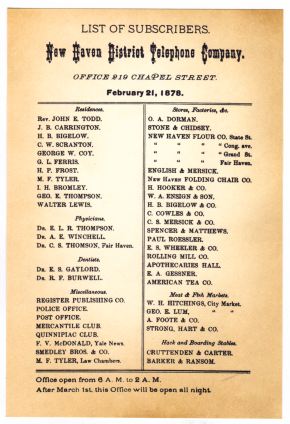
firstTelephoneDirectoryToday in 1878, George Willard Coy and a group of investors from the District Telephone Company of New Haven published the world’s first telephone directory, a single sheet with only 50 names. Yes, another thing we don’t have because of technology. Here’s a sample of what people had to say about it since 1878:

“Telephone books are, like dictionaries, already out of date the moment they are printed….”―Ammon Shea, The Phone Book: The Curious History of the Book That Everyone Uses But No One Reads

“I would rather be governed by the first two thousand people in the Boston telephone directory than by the two thousand people on the faculty of Harvard University”–William F. Buckley, Jr.

“The telephone book is full of facts, but it doesn’t contain a single idea”–Mortimer Adler


Posted in Books, Quotes, Telephone, This day in information | Leave a comment

50 Things We Don’t Do Anymore Because of Technology (Infographic)

50 Things We Don't Do Anymore Due to Technology
Courtesy of: Mozy
Posted in Infographics, Social Impact | 3 Comments

IDC: IT Industry in 2013 (Infographic)

Source: Uploaded by user via IDC on Pinterest

Posted in Big Data, Infographics, Mobile, Stats | Leave a comment

United States Postal Service Created

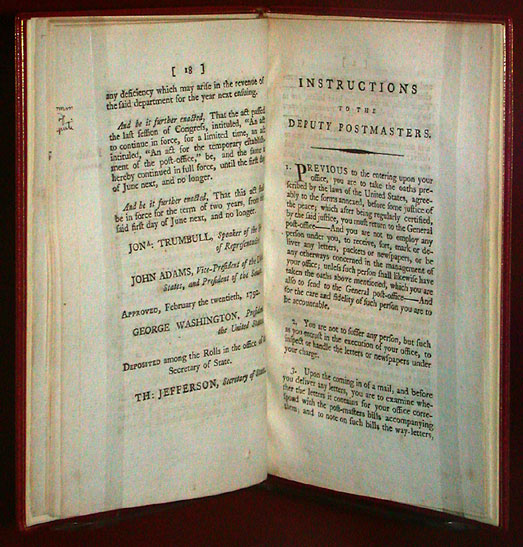
PostalAct_1972Today in 1792, George Washington signed the Post Office Act, creating the United States Postal Service. Under the act, newspapers would be allowed in the mails at low rates to promote the spread of information across the states. To ensure the sanctity and privacy of the mails, postal officials were forbidden to open any letters in their charge unless they were undeliverable. Finally, Congress assumed responsibility for the creation of postal routes, ensuring that mail routes would help lead expansion and development instead of only serve existing communities.

Richard John, in Spreading the News: “After 1792, [the American postal system] rapidly transformed into a dynamic institution that would exert a major influence on American commerce, politics, and political thought … The steady flow of information [delivered by the postal service] helped to introduce a widely scattered population to two key ideas: that the boundaries of the community in which they lived extended well beyond the confines of their individual locality, state, or region, and coincided more or less with the territorial limits of the United States; and that the central government might come to shape the pattern of everyday life.”

In its fiscal year 2012, the USPS delivered 159.9 billion pieces of mail, down from 202 billion in 2008.

Posted in Post Office, This day in information | Leave a comment