Preserving and Digitizing Timbuktu’s Medieval Manuscripts

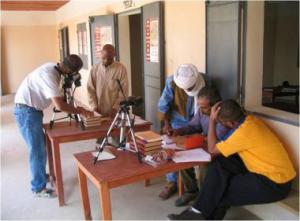
Researchers at work, Timbuktu

Researchers at work, Timbuktu

Sarah Laskow in The Boston Globe:

Though today Timbuktu is a remote and dusty city of 54,000 at the edge of the Sahara, 500 years ago it was a major commercial crossroads and a great center for scholarship. Copied onto [the disks that were smuggled out of Timbuktu] were scanned versions of some of the world’s most important surviving medieval manuscripts, texts on Islam, politics, math, and science that illuminate the city’s past as a center of learning. In the last decade, Timbuktu’s libraries have been working with partners in the United States, South Africa, and France to create digital archives of its crumbling documents. Expensive scanners and digital cameras have been ferried up the slow Niger River or along the long road to the isolated city to capture these texts electronically and in some cases to post them online, making them widely available to scholars for the first time.

Posted in Digitization, Libraries, Preservation | Leave a comment

First Feature-Length 3-D Film in Color

Bwanadevil_first3DMovie60 years ago today, Bwana Devil opened in New York.  The film was advertised as the “the world’s first feature length motion picture in natural vision 3 dimension: The Miracle of the Age!!! A LION in your lap! A LOVER in your arms!”

The audience at the premiere of Bwana Devil, photographed by J. R. Eyerman for Life magazine

The audience at the premiere of Bwana Devil, photographed by J. R. Eyerman for Life magazine

Posted in Film, This day in information | 1 Comment

Boston Computer Society Established

BostonComputerSocietyToday in 1977, 13-year-old Jonathan Rotenberg established the Boston Computer Society (BCS), an organization for personal computer users which will eventually grow into the largest such organization in the world. Four people attended the first meeting of this group, which, at its peak, reached thirty thousand members from all 50 states and over forty other countries. Apple, IBM, Lotus Software, and other computer companies made major product announcements at BCS meetings. With the rise in sophistication of PC users and the advent of the World Wide Web, the organization’s membership have shrunk considerably and BCS closed down in 1996.

The New York Times in 1987:

Jonathan Rotenberg, president of the Boston Computer Society, tells a story about the day he met Steven Jobs, co-founder of Apple Computer. They were riding in a cab in Boston when Mr. Jobs abruptly warned that the computer society would not survive another few years. Mr. Rotenberg asked why. ”Jobs said,” Mr. Rotenberg recalled, ” ‘We’re making computers as easy to use as clothes dryers. And have you ever heard of a Maytag users group?’ ”

”Well, that was 1981,” Mr. Rotenberg adds. ”Steve Jobs was soon out of a job, but the B.C.S. is doing just fine.”

Posted in Computer history, User groups | Leave a comment

The First Social Network

Today in 1978, the first public dial-up Bulletin Board System, the Computerized Bulletin Board System, or CBBS, went online.

It was developed by Ward Christensen and Randy Suess and reportedly connected more than 250,000 callers before it was finally retired with the rise of the World Wide Web. According to Wikipedia, “Ward Christensen coined the term ‘Bulletin Board System’ as a reference to the traditional cork-and-pin bulletin board often found in entrances of supermarkets, schools, libraries or other public areas where people can post messages, advertisements, or community news.

“Early BBSes were often a local phenomenon, as one had to dial into a BBS with a phone line and would have to pay additional long distance charges for a BBS out of the local calling area. Thus, many users of a given BBS usually lived in the same area, and activities such asBBS Meets or Get Togethers, where many users of the board would gather and meet face to face, were common.”

Today, a BBS (PTT) is the largest online forum in Taiwan, with more than 1.5 million registered users.

Posted in Community, Computer history, Social Networks | Leave a comment

Does Texting Hurt Your Grammar?

A study has found that texting may impact students’ grammar.

Continue reading

Posted in Education, Infographics, Reading, Social Impact | Leave a comment

Preserving Astronomy’s Photographic Legacy

From FierceBigData.com: “In a 2009 paper called ‘Preserving Astronomy’s Photographic Legacy: Current State and Future of North American Astronomical Plates,’ Wayne Osborn, department of physics at Central Michigan University, and Lee Robbins, department of astronomy at the University of Toronto, took up the effort to preserve more than three million photographs of star fields housed in North American institutions. The goal was not only to preserve them but to use them for study, a task made easier by today’s big data technology.”

Posted in Astronomy, Big Data, Digitization, Preservation | 1 Comment

The Future of Liabraries (Infographic)

“The internet has already had a major impact on how people find and access information, and now the rising popularity of e-books is helping transform Americans’ reading habits. In this changing landscape, public libraries are trying to adjust their services to these new realities while still serving the needs of patrons who rely on more traditional resources. In a new survey of Americans’ attitudes and expectations for public libraries, the Pew Research Center’s Internet & American Life Project finds that many library patrons are eager to see libraries’ digital services expand, yet also feel that print books remain important in the digital age.”–Pew Internet, “Library Services in the Digital Age

Continue reading

Posted in Forecasts, Infographics, Libraries, Predictions, Quotes, Stats | Leave a comment

The Future of the Password (Infographic)

Is your password obsolete?

Continue reading

Posted in Infographics, Security | Leave a comment

First Integrated Circuit Patent Application

Jack Kilby with his lab notebook open at his first solid circuit drawing

Jack Kilby with his lab notebook open at his first solid circuit drawing

Today in 1959, Jack Kilby filed a patent application for the Integrated Circuit, titled: “Method of making miniaturized electronic circuit.” Harold Evans in They Made America: “The University of Illinois gave him only average grades in electrical engineering, a disappointment to his father, who ran an electrical company, and he failed to get into MIT.” In 2000, Kilby was awarded the Nobel Prize in Physics for “his part in the invention and development of the integrated circuit, the chip. Through this invention microelectronics has grown to become the basis of all modern technology.”

Posted in Computer history, Patents | Leave a comment

First U.S. “Calculating Machine”

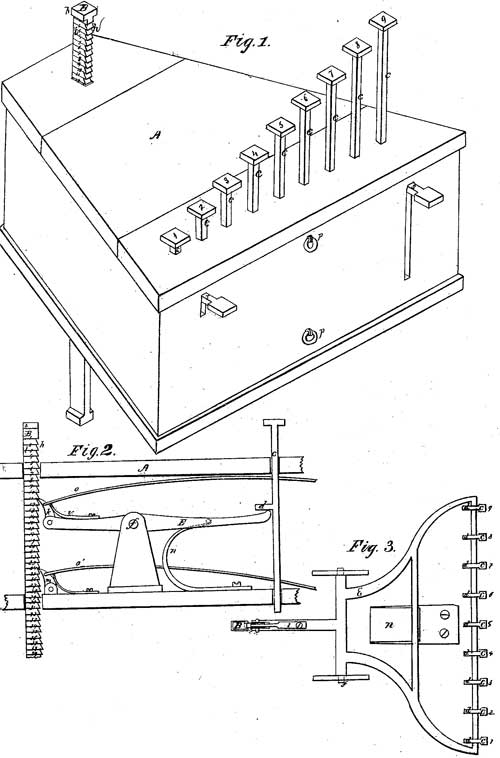
ParmeleeToday in 1850, the first US patent (US No. 7,074) for a push-key operated adding machine is issued to Dubois D. Parmelee of New Paltz, New York. The first commercially successful calculator will be invented forty years later by William Burroughs.

Posted in Computer history, Patents | Leave a comment