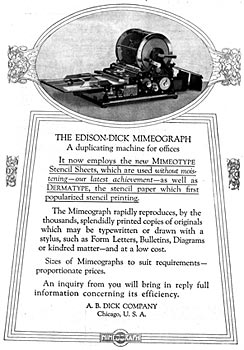
 Today in 1876, Thomas Edison received a patent for a “method of preparing autographic stencils for printing.” The term “mimeograph” to describe this duplicating machine was first used by Albert Blake Dick when he licensed Edison’s patents in 1887.
Hillel Schwartz in The Culture of the Copy: “The revolution in copying, taken broadly, had begun in the 1920s, when copying was already in the air. In the airwaves–as the Radio Corporation of America in 1926 began transatlantic radio facsimile service for transmitting news photos. In the rarefied air of national libraries and archives–as the Library of Congress, British Library, and Bibliotheque Nationale used photostat cameras to acquire rare materials or create catalogs, and as scholars and curators microfilmed manuscripts for research or preservation. In the most rarefied air, out past Saturn, around that new planet, Pluto, located in 1930 near the star o-Geminorum, close upon the stars named Castor and Pollux–where the A. B. Dick Company of Chicago saw ‘NEW WORLDS TO CONQUER’ for their Mimeograph machine: ‘Anything that can be written, typewritten or drawn in line, it reproduces at the rate of thousands every hour.'” Continue reading →


 The Story of Information