


-
Join 186 other subscribers
Categories
Archives
A Brief Visual History of American Innovations

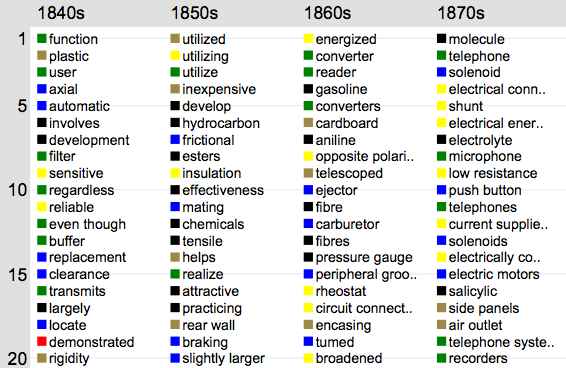


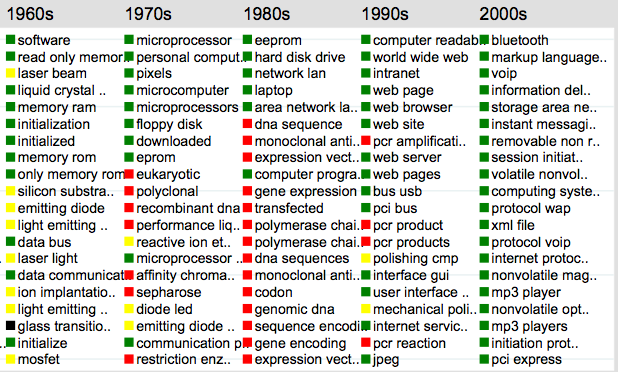
In a series of papers studying the history of American innovation, Packalen and Bhattacharya indexed every one-word, two-word, and three-word phrase that appeared in more than 4 million patent texts in the last 175 years. To focus their search on truly new concepts, they recorded the year those phrases first appeared in a patent. Finally, they ranked each concept’s popularity based on how many times it reappeared in later patents. Essentially, they trawled the billion-word literature of patents to document the birth-year and the lifespan of American concepts, from “plastic” to “world wide web” and “instant messaging.”
Sources: Derek Thompson, “‘From Atoms to Bits’: A Brilliant Visual History of American Ideas“; Mikko Packalen, Jay Bhattacharya, “New Ideas in Invention“
Posted in Innovation, Patents
Leave a comment
Google Maps Mapping the World 2005-2015

Google Maps, February 8, 2005
Liz Gannes in re/code:
Ten years ago today, Google Maps launched to the world.
When it was born, it was a paper atlas in living form, with no pages to turn. Instead of online mapping leader MapQuest’s printable list of directions, navigation routes were overlaid on top of the map itself. And Google Maps loaded map tiles in a Web browser without any special software so you could explore the world without refreshing, a technical feat that had never been seen before.
In 2005, nobody really knew what would come of online maps, or how they would become such a crucial aspect of daily lives in the Internet-connected world.

An early Street View van
How Google would partner with Apple to bring online maps to their true home, smartphones, but the alliance would fall apart.
How Google Maps would have more than a billion users and become Google’s second-largest property after its search engine.
Nobody had any idea, least of all Google.
From Ten Years of Google Maps, From Slashdot to Ground Truth
Posted in Digitization, Google, Maps
Leave a comment
The idea of a computer you could put in your pocket was just science fiction
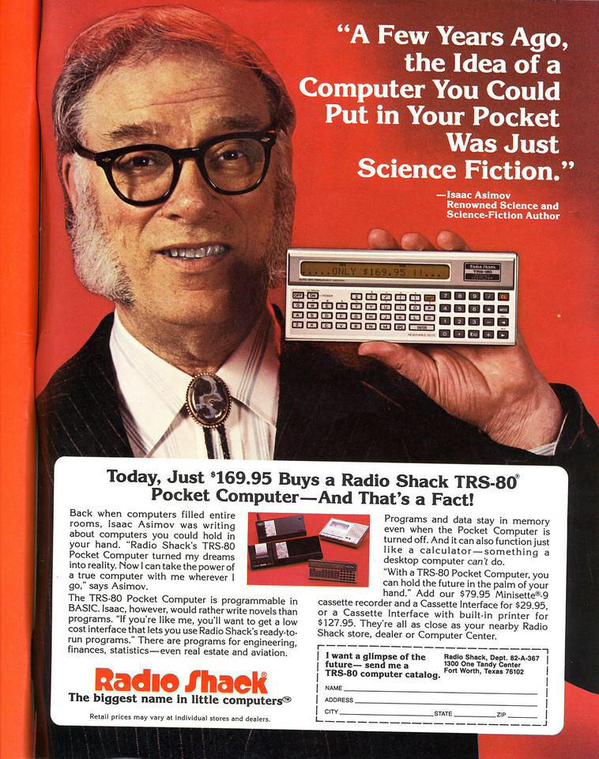
1982 advertisement for the TRS-80 Pocket Computer with Isaac Asimov.
Posted in Computer history, Mobile, PCs
Leave a comment
Remembrances of Things Past
                When Shannon was a river
                   and Turing was a car
                When Banyan was a tree
                   and buses travelled far

                dBase was where you ran to
                   after you hit the ball
                Often we were ANSI
                   RISC aversive not at all

                Windows were for looking out of
                   in a Tandem, two could take a spin
                Bridges were for crossing
                   a frame was to keep pictures in

                A semi-conductor was a maestro
                   not in the big time yet
                A port you sought in a storm
                   fishermen used a net

                Woody Guthrie sang of "My LAN"
                   WAN was a despairing mood
                LATAs were for high places
                   menus featured food

                If a cursor used four letter words
                   a sensor cut them out
                The sight of a mouse in an office
                   was sure to raise a shout

                Haloid perfected photocopying
                   and thereby made a hoard
                Then came Japanese competition
                   and its "ox" was gored

                Frequency was measured in cycles
                   Hertz referred to multiple pain
                Modem was a harvesting command
                   for bringing in the grain

                Modelling was at fashion shows
                   bauds were ladies of the night
                Prompting was helping actors
                   contesting for resources, a fight

                Walking and chewing gum concurrently
                   requires considerable skill
                We called it multi-tasking
                   and by gosh we always will

                We had no electronic calculators
                   just slide rules by Keuffel & Esser
                I am still a true believer
                   Keufel & Esser war besser

                Chips were used for gambling
                   von Neuman was a pup
                Monte Carlo a place to visit
                   squaring the circle ... well, we gave up

                A Sprint was less than 880
                   a relay was a team
                Greene was just a color
                   breaking up AT&T a dream

                Coherent was applied to speech
                   not a spectral line excited
                Multi-media meant prose and song
                   and Noel Coward was knighted

                Cerf was found at the beach
                   a Rose was a Rose was a Rose
                Jobs were to look for
                   and Gates were to close

                "2B" was an elementary school class
                   and "D" a failing grade
                A router was a tool
                   a server was a maid

                Lotus was a flower
                   adobe was a brick
                Postscript was an afterthought
                   joy a popsicle stick

                We called a plotter a CAD
                   a token ring a sham
                A buffer was for buffing
                   a male goat was a ram

                The best noise supressor was ... ssh
                   we knew little of egos and ids
                For archival storage and encryption
                   we looked to the pyramids

                Now in accordance with Greenfield's Law
                   in voice both loud and clear
                Here's to exponential growth in memory
                   & operating speed next year.


Published by Stanley R. Greenfield as RFC 1300 in February 1992
Posted in Uncategorized
Leave a comment
 The Story of Information