Earliest Surviving Motion Picture

1888-roundhaygardenscene1888

Today in 1888, Louis Le Prince shot Roundhay Garden Scene, the earliest surviving motion picture.  It features Adolphe Le Prince, Sarah Whitley, Joseph Whitley and Harriet Hartley walking around in the garden of Oakwood Grange, the home of Joseph and Sarah Whitley in Roundhay, a suburb of Leeds, United Kingdom. In 1930 the National Science Museum in London produced photographic copies of the remaining parts from the 1888 filmstrip.

Posted in Film, This day in information | Leave a comment

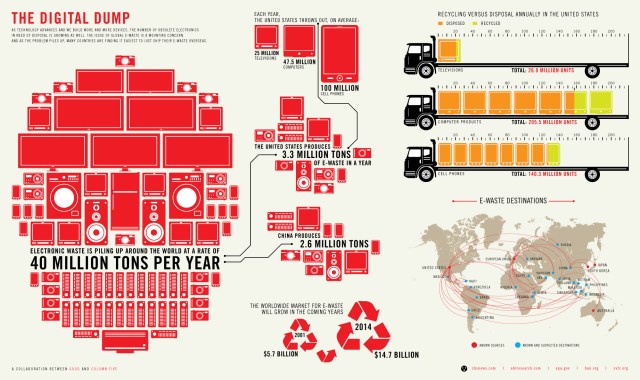
The Growing Digital Dump (Infographic)

eWaste


Source: Good magazine

Posted in Digitization, Infographics, Social Impact | Leave a comment

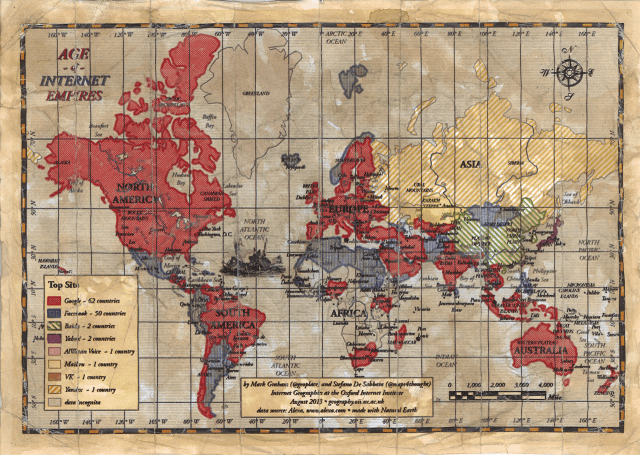
Age of Internet Empires: Google and Facebook Vie for Dominance

Age_of_Internet_Empires_final

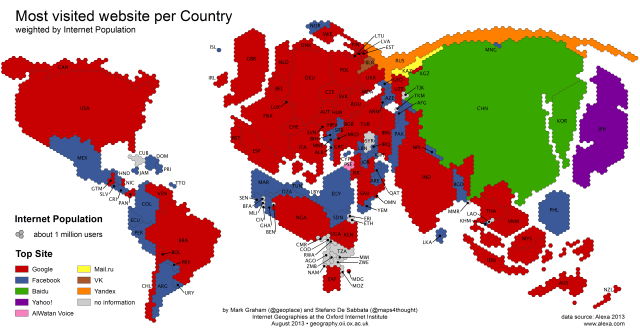
TopSitePerCountry_InternetPopulation

The Oxford Internet Institute published recently a map illustrating the most visited website in each country. It concluded:

The supremacy of Google and Facebook over any other site on the Web is clearly apparent. We also see an interesting geographical continuity of these two “empires”. Google is the most visited website in most of Europe, North America, and Oceania. Facebook, in contrast, is the most visited website in most of the Middle East and North Africa, as well as much of the Spanish-speaking Americas.

The situation is more complex in Asia, as local competitors have been able to resist the two large American empires. Baidu is well known as the most used search engine in China, which is currently home to the world’s largest Internet population at over half a billion users. At the same time, we see a puzzling fact that Baidu is also listed as the most visited website in South Korea (ahead of the popular South Korean search engine, Naver). We speculate that the raw data that we are using here are skewed. However, we may also be seeing the Baidu empire in the process of expanding beyond its traditional home territory.

The remaining territories that have escaped being subsumed into the two big empires include Yahoo! Japan in Japan (in join venture with SoftBank) and Yahoo! in Taiwan (after the acquisition of Wretch). The Al-Watan Voice newspaper is the most visited website in the Palestinian Territories, the e-mail service Mail.ru is the most visited in Kazakhstan, the social network VK the most visited in Belarus, and the search engine Yandex the most visited in Russia…

We are likely still in the very beginning of the Age of Internet Empires. But, it may well be that the territories carved out now will have important implications for which companies end up controlling how we communicate and access information for many years to come.

Posted in data visualization, Facebook, Google, Information Visualization, Internet, Internet access, Internet Economy, World Wide Web | Leave a comment

Birth of the American Library Association

Chicago Public Libraries from the ALA's digital archives, Sjoerd Koopman Library Postcard Collection

Chicago Public Libraries from the ALA’s digital archives, Sjoerd Koopman Library Postcard Collection

Today in 1876, during the Centennial Exposition in Philadelphia, 103 librarians, 90 men and 13 women, responded to a call for a “Convention of Librarians” to be held October 4-6 at the Historical Society of Pennsylvania. At the end of the meeting, according to Ed Holley in his essay ALA at 100, “the register was passed around for all to sign who wished to become charter members,” making October 6, 1876 to be the American Library Association’s birthday. Today it has about 58,000 members. From the 2011-2012 Annual report: “Facing fiscal challenges on all sides—local, state, and federal—public libraries strive to meet the expanding technology needs of their communities. Public computer and wifi use increased last year at more than 60 percent of libraries. Nationwide, more than 62 percent of libraries report offering the only free Internet access in their community. More than 90 percent of public libraries now offer formal or informal technology training.”

Posted in Libraries, This day in information | Leave a comment

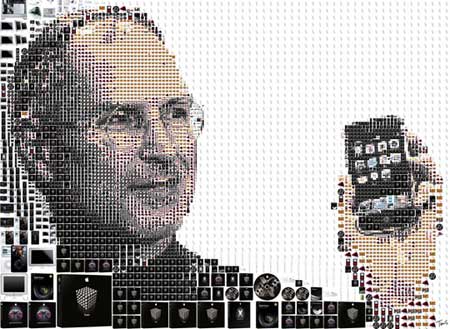
What Has Steve Jobs Wrought?

steve-jobs-mosaic

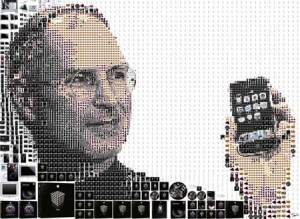
[First published October 12, 2012] Steve Jobs had an insanely great ride on the waves of digitization that have transformed the way we work and play over the last few decades. But taking a cursory look at the hundreds of tributes published to commemorate the anniversary of his passing, I was surprised to find lots of trees but not a single forest. The pig picture view of Jobs’ life is sorely missing.

We hear about a lot of specific things that he did or stimulated: He was “a genius toymaker,” a “genuine human being,” a “patent warrior.” He invented this, pushed for that, and denounced the other thing. All true. But wasn’t there something bigger that connected all the dots besides his creativity and drive?

I think we may have the clue in the summing up of Jobs’ work (and life) by his biographer Walter Isaacson, a year ago: “Some leaders push innovations by being good at the big picture. Others do so by mastering details. Jobs did both, relentlessly. He revolutionized six industries: personal computers, animated movies, music, phones, tablet computing and digital publishing. You might add a seventh: retailing, which Jobs did not quite revolutionize but did re-imagine. Along the way, he produced not only transforming products but also, on his second try, a lasting company, endowed with his DNA.” This statement is reflected in one way or another in many of the current tributes. Wired’s Mat Honan, for example, writes that Jobs “didn’t simply shake up industries; he fundamentally traumatized them.”

This was the big picture Jobs was so good at? “Revolutionizing” or “traumatizing” a number of industries? Maybe. It’s possible that the only thing that drove him was the desire to play the rebel, toppling the established order one industry domino after the other. But maybe there was an even bigger arc to his vision. Maybe he revolutionized industries because he saw a world without them, because he understood what digitization has wrought.

What has God wrought” was the first message sent by telegraph and with it Samuel Morse had launched the Electronic Century. This was the pre-history of digitization, using electronic means to alter our previous notions of time and space and to provide new means of delivering news, information, and entertainment. It has spawned a number of industries (telegraph, telephone, radio, TV, film, recorded sound and music) and vast academic empires in economics and anti-trust law. Based on distinct analog technologies, the pre-digital era trained everybody—in government, business, academia, the press—to perceive the economy as divided along the lines of “industry” segments and to hold the entrenched belief that each industry has unique “competitive forces” and requires unique skills and experience.

One hundred and one years after Morse sent his message, John von Neumann published “A First Draft of a Report on the EDVAC,” called by historians Martin Campbell-Kelly and William Aspray “the technological basis for the worldwide computer industry.” We have arrived at the practical application of digitization, of turning all information into ones and zeros, and the new Digital Century. But what we got for the next thirty plus years was yet another “industry.”

Steve Jobs, the rebel that he was, ignored the rigidity and perceived boundaries of “industries” and instead has bet on the digitization of all industries producing and transmitting content: publishing, film, music, radio, TV… Especially after he came back to Apple in 1997, at the time when the invention of another rebel, Tim Berners-Lee, has taken the world by storm. The Web (not “the Internet”) was the glue and the catalyst that would speed up the spread of digitization to all analog devices and channels for the creation, communications, and consumption of information.

The waves of digitization sweeping all these industries, the shift from analog to digital, was Steve Jobs’ big picture and he rode each wave successfully. In 2002, digital storage surpassed non-digital storage for the first time, according to Martin Hilbert and Priscila Lopez. By 2007, 94% of storage capacity in the world was digital, a complete reversal from 1986, when 99.2% of all storage capacity was analog. On January 9, 2007, Jobs announced that Apple Computer, Inc. would from that point on be known as Apple Inc., because computers were no longer the main focus of the company. Jobs has created a company (which became the most valuable company in the world five years later) that did not fit anymore into any specific “industry” pigeonhole.

Jobs is gone but digitization continues its relentless march. The current wave is all about “things”—your car, house, electrical grid, even cows. And companies like FedEx and P&G and GE are leading indicators for the next big digitization wave: All businesses will be digitized.

What we want to know is Who will ride the next wave of digitization, Who will be the next Steve Jobs? It may well be someone who is still in high-school or college today, but Grace Ching votes for Amazon’s Jeff Bezos. I agree. But again, not because of all the things she enumerates—Amazon’s warehouses, the expansion beyond books, the Kindle—but because of the vision driving them, the big picture. In yet another example of how difficult it is for even astute observers of the tech scene to get over the “industry” mind-set, Steven Levy asked Bezos last year: “Was it difficult to turn yourself from a retail company into a consumer electronics company?”

Bezos answered: “It’s not as different as you might think. A lot of our original approaches and techniques carried over very well. For example, we’ve always focused on reducing the time between order and delivery. In hardware, it’s the same principle. An example is the time between when we take delivery on a processor to when it’s being used in a device by a customer. That’s waste. Why would we own a processor that’s supposed to go into a Kindle Fire that’s not actually in a customer’s hands? That’s inventory management.”

Bezos is bothered by waste the same way Steve Jobs was bothered by lack of imagination or bad aesthetics. Product design was the core of Steve Jobs’ strategy to ride the digitization waves. Delivery, the speed of delivery, is the core of Bezos’. Jobs has applied the same design principles across a range of previously separate and distinct devices; Bezos is applying the same management principles across a range of previously separate and distinct business activities.

Bezos, channeling the big wave of digitization which has destroyed “industry” boundaries, sees the big picture of analog turning into 1s and 0s, successive waves of big data that helps apply the same principles to selling goods, to offering services, to storing, discovering and consuming information, to coordinating work and leisure, to creating content.

Just like Steve Jobs.

Posted in Apple, Digitization, This day in information | Leave a comment

First Solar-Powered Phone Call

Bell Labs solar battery, 1954

Bell Labs solar battery, 1954

Today in 1955, the first field trial of a rural telephone system making use of transistors and the Bell Solar Battery was held in Americus, Georgia. Today, 1.5 billion people, one quarter of the world’s population, live solar-powered-samsungwithout electricity, and solar-powered mobile phones dominate their long-distance communications.

Posted in Mobile, Telephone, This day in information, Wireless | Leave a comment

A Brief History of Content Marketing (Infographic)

Posted in Infographics, Marketing | Leave a comment

Plan to Make Radio Household Utility

David Sarnoff, 1922

David Sarnoff, 1922

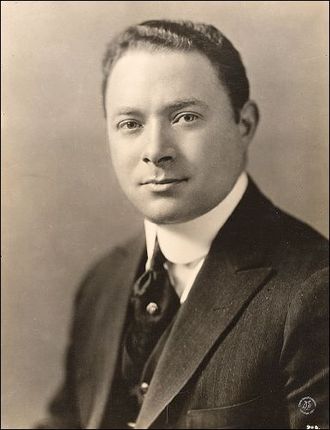
Today in 1915*, David Sarnoff, Chief Inspector for The Marconi Wireless Telegraph Company of America wrote to his superiors: “I have in mind a plan of development which will make radio a ‘household utility’ in the same sense as the piano or phonograph… The idea is to bring music into the home by wireless. The receiver can be designed in the form of a simple ‘Radio Music Box,’ placed on a table in the parlor or living room… The same principle can be extended to numerous other fields as, for example, receiving lectures at home which be made perfectly audible; also events of national importance can be simultaneously announced and received. Baseball scores can be transmitted in the air by the use of one set installed at the Polo Grounds. The same would be true of other cities. This proposition would be especially interesting to farmers and others living in outlying districts removed from cities. By the purchase of a ‘Radio Music Box’ they could enjoy concerts, lectures, music, recitals, etc., which may be going on in the nearest city within their radius. While I have indicated a few of the most probable fields of usefulness for such a device, yet there are numerous other fields to which the principle can be extended….”

*It is not clear whether this was indeed written in 1915, or 1916, or 1920, or even later. But it is clear that by 1916, Lee De Forest and others were broadcasting news and transmitting music over the wireless to multiple recipients.

See also Birth of Public Radio Broadcasting and Commercial Radio Born

Posted in Radio, This day in information | 1 Comment

Microsoft Word’s 30th Birthday

Microsoft Word 1Thirty years ago today, Microsoft released it’s first full-featured application, a word processor called Word for MS-DOS 1.00. Microsoft provided a free demonstration copy with every copy of PC World magazine. It’s the first time in history a magazine has included a floppy-disk.


Posted in Computer history, Microsoft, This day in information | Leave a comment

Bill Gates Explains control-alt-delete


Reactions here and here

Posted in Computer history, IBM, Microsoft | Leave a comment