On Books and eBooks

“Few technological victories are ever complete, and in the case of books this will be especially true. Bookstores will not disappear but will exploit digital technologies to increase their virtual and physical inventories, and perhaps become publishers themselves. So will libraries, whose vast and arcane holdings will soon be available to everyone everywhere. E-books have been aggressively marketed for five or six years in the United States. Yet despite rapidly acquiring market share they show no sign of displacing actual books, with which they will comfortably coexist in the digital future.

Today’s publishers, still entangled in the dying Gutenberg age, will, one hopes, spin off their talented editors as semi-autonomous units and gradually disencumber themselves of their obsolete infrastructure. Barring a nuclear disaster, life will go on as it always has: past, present, and future all at once. “–Jason Epstein
Posted in Books, Digitization, Quotes, Social Impact | Leave a comment

Grace Hopper and Other Programmers

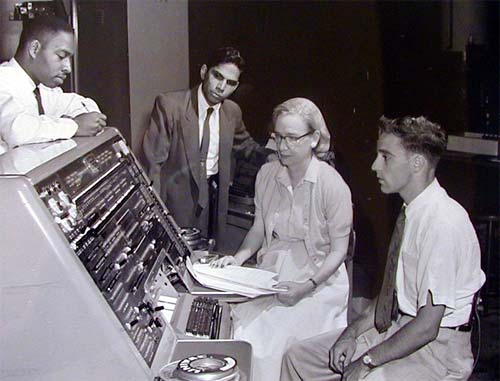
Grace Hopper with UNIVAC-1 and a few human colleagues in 1957

Nathan Zeldes writes about Grace Hopper: “…whenever I see this photo, I am reminded vividly of Dr. Susan Calvin, Robopsychologist at U.S. Robots and Mechanical Men Corporation, as featured in Isaac Asimov’s I, Robot…. Calvin is a strict, prim, spinsterish lady who clearly feels more at home with robots than among humans, whom she treats with a dispassionate aloofness most of the time. She is also the smartest human in the book, by a large margin; an ultimate Geek, in fact.”

My favorite Hopper quote: “Programmers… arose very quickly, became a profession very rapidly, and were all too soon infected with certain amount of resistance to change.”

Well, here’s another favorite: “Life was simple before World War II. After that, we had systems.”

Posted in Computer history, Programming, Quotes | 1 Comment

On the History of Information

Ann Blair in Salon:  “The history of information has developed especially in the last 10 years. It is a subset of intellectual and cultural history, which is a subset of general history. “Information” today typically refers to all the stuff we find on the web and there is so much of it that we have become especially aware of the need to select and manage information. But information management has been practiced for a very long time, even if it wasn’t called that. Looking back in the past to ancient Rome, the Middle Ages or the emergence of printing in the early modern period, historians have started to ask new questions about how earlier periods accumulated and managed information. Information took many forms in the past, as it does today, but the forms that have survived down to us are mostly textual – descriptions, examples, anecdotes written down and transmitted through copying or the survival of the original texts.

The history of information offers a new way of looking at texts that intellectual historians have often studied before, by emphasizing how a text was consulted, read and used in the past. For example, back in the first century of the Common Era, the Roman naturalist Pliny boasted that he had collected 20,000 facts from 2,000 authors in his 38-volume “Natural History.” That text became a key source of information for medieval encyclopedias and all kinds of texts about the natural world up to the 18th century. Historians of information look at the forms in which the text circulated and was presented, to see how the information was made accessible in different times, through alphabetical indexing or adding marginal keywords or through the way the text was laid out on the page.”

Posted in Books, Information Overload, Knowledge compilations, Quotes | Leave a comment

DNA Structure Described

Today in 1953, James Watson and Francis Crick published in Nature a 1-page article titled “Molecular structure of nucleic acids: a structure for deoxyribose nucleic acid.” Their description of the double helix structure of DNA will earn them (with Maurice Wilkins) a Nobel Prize in 1962. In 2001, Peter Denning said: “With the discovery of DNA, biology became an information science.” And Dave Barry opined: “The information encoded in your DNA determines your unique biological characteristics, such as sex, eye color, age, and Social Security number.”

Posted in Biology, This day in information | Leave a comment

Birth of Satellite TV

50 years ago today, the era of satellite television began with the first television image transmitted by a communication satellite. The transmission was orchestrated by MIT’s Lincoln Laboratory station in Camp Parks, California, with sponsorship from the Air Force. The message was received at Milestone hill in Westford, Massachusetts, 2,700 miles away. Ten years later, in November 1972,  the first commercial North American satellite to carry television, Canada’s geostationary Anik A1,  was launched.


Posted in MIT, Satellite, Television, This day in information | Leave a comment

First public school in the U.S.

Today in 1635, the Boston Latin School was established, the first public school and the oldest existing school in the United States. In 2012, the school was ranked 38 out of the top 100 high schools in the United States  by U.S. News & World Report. 

Posted in Education, This day in information | Leave a comment

Earliest Intact European Book Now Digitized

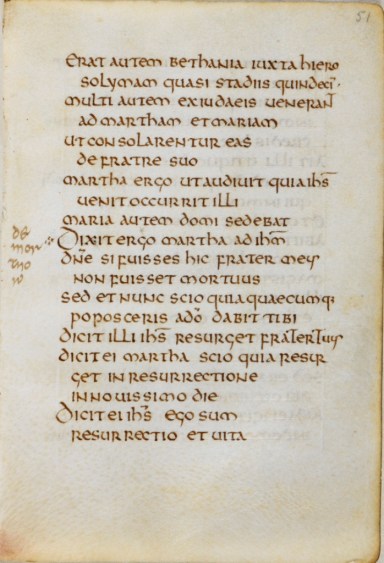
A page from the St Cuthbert Gospel relating part of the story of Lazarus, with a contemporary marginal note reading "de mortuorum", marking out a page to be read at masses for the dead (London, British Library, MS Additional 89000, f. 51r).

The British Library has announced that it has successfully acquired the St Cuthbert Gospel, a miraculously well-preserved 7th century manuscript that is the oldest European book to survive fully intact and therefore one of the world’s most important books.  The £9 million purchase price for the Gospel has been secured following the largest and most successful fundraising campaign in the British Library’s history. The manuscript has recently been fully digitized.  The manuscript, which is a copy of the Gospel of St John, was created in the late 7th century in the north-east of England and placed in St Cuthbert’s coffin, apparently in 698. It was discovered when the coffin was opened in Durham Cathedral in 1104 on the occasion of the removal of Cuthbert’s body to a new shrine.

Posted in Books, Digitization, Libraries, Preservation | Leave a comment

One Billion Hard Drives and Counting

Today in 2008, Seagate Technology announced that it was the first hard drive manufacturer worldwide to have shipped 1 billion hard drives. The 1 billion hard drives Seagate has delivered equates to approximately 79 million terabytes, able to store 158 billion hours of digital video or 1.2 trillion hours of your favorite music. In 2008,  Seagate was shipping 111,600 Terabytes each day–over one Terabyte of storage every  second–and expected to ship its next billion hard drives in less than five years. Continue reading

Posted in Data growth, Digitization, Information storage, This day in information | Leave a comment

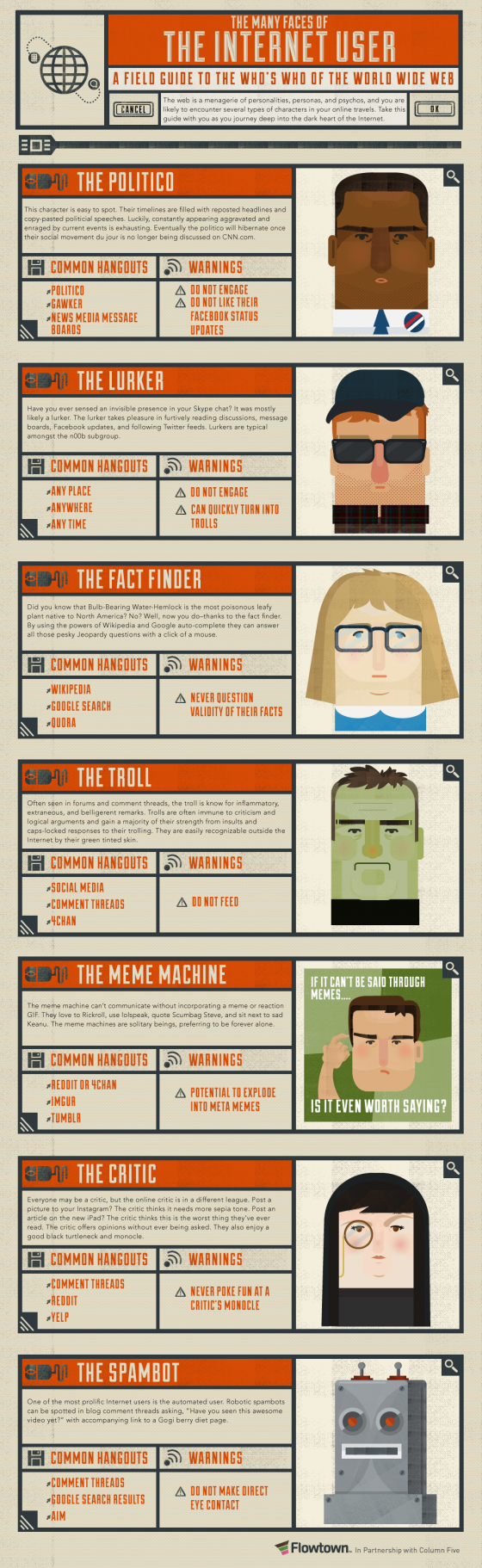
The Who’s Who of the World Wide Web

Source: Flowtown

Posted in Social Impact, World Wide Web | Leave a comment

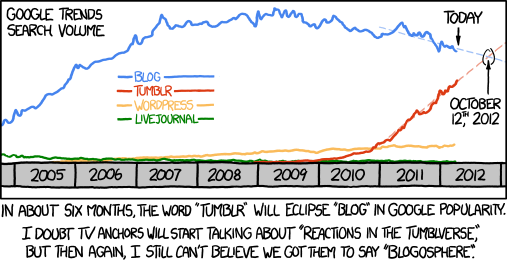
The Coming Tumblverse

Source: XKCD

Posted in Predictions | Leave a comment