First Broadcast by Ham Radio Operator

Today in 1909, Einar Dessau of Denmark used a shortwave transmitter to converse with a government radio post about six miles away in what is believed to have been the first broadcast by a ‘ham’ radio operator. Continue reading

Posted in Radio, This day in information | Leave a comment

Just the Facts, Ma’am

“Chock them so damned full of ‘facts’ they feel stuffed, but absolutely ‘brilliant’ with information. Then they’ll feel they’re thinking, they’ll get a sense of motion without moving.”—Ray Bradbury, Fahrenheit 451

“What people really intend when they speak of ‘information’ is ‘meaning,’ not ‘facts.’ Undoubtedly, we’re bombarded with too many facts—isolated bits of data without context.”—Michael Crichton

“Facts are collected indiscriminately by the naive empiricist, who lives in fear of missing the one fact that will give meaning to the rest. His fear is justified; that fact will never be found.”—Evan Eisenberg, The Recording Angel (quoted by Nick Carr)


Posted in Quotes | Leave a comment

Only Connect: One in Five People Worldwide on Social Networks

According to eMarketer, there will be 1.43 billion social network users in 2012, a 19.2% increase over 2011.

Social Network User Penetration Worldwide, 2011-2014 (% of population)

Continue reading

Posted in Forecasts, Social Networks, The InfoStory Quant, World Wide Web | Leave a comment

Sic transit gloria mundi

The first edition of the Encyclopaedia Britannica was published in 1768 in Edinburgh, Scotland. In the Preface to the Encyclopaedia, William Smellie, the 28-year-old editor (and author of many of the entries), expressed his hope that this new kind of encyclopaedia or dictionary, containing not just short definitions but also lengthy essays and systematic treatment of all arts and sciences, would benefit a great number of people: “We will … venture to affirm, that any man of ordinary parts, may, if he chuses, learn the principles of Agriculture, of Astronomy, of Botany, of Chemistry, etc., etc., from the Encyclopaedia Britannica.”  Continue reading

Posted in Dead media, Knowledge compilations, Print | Leave a comment

Moving Pictures: Zoopraxiscope

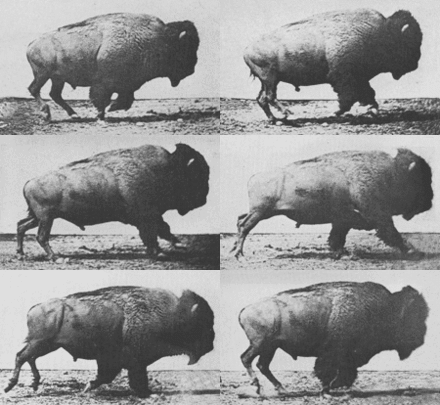
American bison cantering – set to motion using photos by Eadweard Muybridge

Today in 1882, Eadweard Muybridge lectured at the Royal Institution in London in front of a sellout audience, demonstrating the Zoopraxiscope, a device for projecting motion pictures that pre-dated the flexible perforated film strip. An 1878 experiment by Muybridge in the United States using 24 cameras produced a series of stereoscopic images of a galloping horse, and is arguably the first “motion picture,” though it was not called by this name at the time.

Posted in Film, Photography, This day in information | Leave a comment

Meaningless Information

“The fundamental problem of communications is that of reproducing at one point either exactly or approximately a message selected at another point. Frequently the message has meaning… these semantic aspects of communication are irrelevant to the engineering problem”–Claude Shannon, in Shannon and Weaver, The Mathematical Theory of Communications, 1963 [1949], p. 31. Continue reading

Posted in Quotes | Leave a comment

Race Against the Machine Watch

Today in 1811, the first Luddite attack in which knitting frames were actually smashed occurred in the Nottinghamshire village of Arnold. Kevin Binfield, Writings of the Luddites: “The grievances consisted, first, of the sue of wide stocking frames to produce large amounts of cheap, shoddy stocking material that was cut and sewn rather than completely fashioned and, second, of the employment of “colts,” workers who had not completed the seven-year apprenticeship required by law.”

Today’s Boston Globe reports that “the city has trimmed its fleet of parking officers and installed new card-friendly meters that have made it easier for drivers to pay.” Continue reading

Posted in Automation, Race Against the Machine, This day in information, Transportation | Leave a comment

Video Games and (Artificial) Intelligence

“[Video games are] just another manifestation of human mania, our endearing quality of going relentlessly after absolutely pointless goals.”–John Skow, Time Magazine, January 18, 1982

“From AI-designed games to realistic virtual worlds and social physics, gaming is changing our world view.” In a series of articles, New Scientist (March 2012) “explores the state of this many-sided art.”

One of the articles, “AI designs its own video game” should be of interest for anyone planning to attend a video game design school: “Software that generates video-game artwork, music or even whole levels is not new, but [Artificial Intelligence system] Angelina takes it a step further by creating a simple video game almost entirely from scratch…. So should game designers be worried? ‘I like to think that Angelina won’t steal anyone’s job, I think it will actually be a really positive force for designers,’ says [Imperial College computer scientist and Angelina developer Michael] Cook, suggesting that developers could use a system like Angelina as a collaborative tool for designing games. For example, a developer who creates a new power-up for a game could ask Angelina to design a level that would teach the player how to use their new ability.”


Posted in Artificial Intelligence, Quotes, Video Games | 1 Comment

Koomey’s Law: Computers’ Energy Efficiency Doubles Every 18 Months

Much of computer technology’s progress has occurred because of developments described by Moore’s law, which says that the number of transistors that can be placed on an integrated circuit doubles about every two years.

In today’s era of battery-powered mobile devices, computing is being driven as much by energy efficiency as by performance. Research by Stanford University associate professor Jonathan Koomey discovered that since the 1940s, computers’ energy efficiency has doubled about every year and a half.

Posted in Energy | Leave a comment

If You Can’t Beat Them, Join Them

Today in 2002, the lawsuit that was filed by Random House against e-book publisher Rosetta Books for acquiring titles directly from authors, was decided in favor of Rosetta Books. The court’s decision paved the way for authors to publish their work electronically, independent of their print publishers.

In 2011, e-book sales more than doubled to $970 million. And according to today’s Wall Street Journal, the U.S. Justice Department has “warned Apple Inc. and five of the biggest U.S. publishers that it plans to sue them for allegedly colluding to raise the price of electronic books.”

Posted in Apple, Books, ebooks, This day in information | Leave a comment