Commercial Radio Born

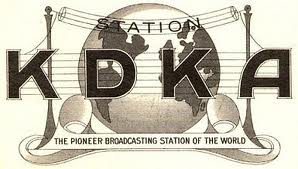
Today in 1920, Westinghouse established the first commercial radio station, KDKA in Pittsburgh, Pennsylvania. When Harry P. Davis, a Westinghouse executive, saw an ad for amateur radio apparatus describing concerts broadcasts by Frank Conrad, an amateur wireless radio operator, he realized: “The efforts that were then being made to develop radio telephony as a confidential means of communication were wrong… instead its field was one of wide publicity, in fact, the only means of instantaneous communication ever devised.” Susan Douglas in Inventing America Broadcasting: “[Davis] now comprehended that… the amateurs were a simply the forerunners of a much larger market for radio receivers.”  By 1923, 500 radio stations operated in the United states. In 2010, there were 11,202 commercial radio stations in the U.S., up from 10,257 in 1996. According to this handy guide from the FCC, digital radio is “the sound of the future.” But radio advertising is projected by MagnaGlobal to grow worldwide from 2011 to 2016 by only 4.1% annually, better than newspapers (1.7%), but far less than TV (12.1%), Mobile (19.4%) or online video (19.6%).

 

Posted in Digitization, Radio, This day in information | 1 Comment

The Internet Goes Live

Today in 1969, the first message was sent over the ARPANET, the predecessor of the Internet, between a network node at UCLA and another one at SRI. Leonard Kleinrock: “At the UCLA end, they typed in the ‘l’ and asked SRI if they received it; ‘got the l’ came the voice reply. UCLA typed in the ‘o’, asked if they got it, and received ‘got the o’. UCLA then typed in the ‘g’ and the darned system CRASHED! Quite a beginning. On the second attempt, it worked fine!”

Posted in Computer history, This day in information | 2 Comments

The Counter-Computer Culture B.S.J.

“Ready or not, computers are coming to the people.”–Stewart Brand, 1972

Posted in Computer history, Quotes, Yesterday's Futures | Leave a comment

Launching Higher Education in the Western Hemisphere

Today in 1538, The Universidad Santo Tomás de Aquino was created by the Papal Bull In Apostolatus St Thomas Aquinas Culminates. With this act by Pope Paul III, it became the first university in the Western Hemisphere. It was officially recognized by Royal Decree in 1558. It was closed in 1832, but was reopened and renamed The Universidad Autónoma de Santo Domingo (UASD) in 1914, becoming the public university system in the Dominican Republic. Continue reading

Posted in This day in information, Universities | Leave a comment

Birth of Online Advertising

Today in 1994, the first banner display ads went live on hotwired.com. The first advertisers were MCI, Volvo, Club Med, 1-800-Collect, AT&T and Zima. Advertisers spent over $6 billion on display advertising in the U.S. in 2010, out of a total spending on online advertising of $26 billion.

Posted in Advertising, This day in information | Leave a comment

iPod at 10: A Computer in Your Pocket

Today in 2001, Steve Jobs introduced the iPod at a special event at Apple’s headquarters, telling the assembled reporters “This is a major, major breakthrough.” There were other music players on the market at the time but they were conceived as a digital Walkman. The iPod was designed as a pocket computer, with an operating system, a 5 gigabytes hard drive, and 32 megabytes of memory. The unusual amount of memory for devices of this kind at the time, helped extend the battery life to ten hours. The user interface had no equals. And as the first iPod used a high-speed Firewire cable, downloading 1,000 songs from the Mac (the only computer the first version worked with) took only 10 minutes, as opposed to the very slow USB connections of competing devices.  “Plug it in. Whirrrrrr. Done,” Jobs told Fortune. Continue reading

Posted in Apple, Computer history, Innovation, music, Recorded sound, This day in information | Leave a comment

First Killer App

Today in 1979, the first production copy (version 1.37) of VisiCalc was shipped. Wikipedia: “Conceived by Dan Bricklin, refined by Bob Frankston, developed by their company Software Arts, and distributed by Personal Software in 1979 (later named VisiCorp) for the Apple II computer, it propelled the Apple from being a hobbyist’s toy to a useful tool for business.” And: “VisiCalc went on to become the first “killer app“, an application that was so compelling, people would buy a particular computer just to use it.”  Continue reading

Posted in Computer history, This day in information | Leave a comment

Thomas Edison and Steve Jobs, Creating New Industries

Today in 1931, Thomas Edison died. He will be remembered as the most prolific inventor in U.S. history, having registered 1,093 U.S. patents over the course of his lifetime. Harold Evans in They Made America: “Hundreds of his 1,093 patents were for improvements on inventions already in operation–but that is the essence of the innovative process…if his methods of invention seemed haphazard from time to time, his method of innovation, the creation of new industries, was systematic and complete…. In Robert Conot’s vivid analogy, he was a discoverer of new continents where prevailing opinions held none existed…. No doubt if he had concentrated on one innovation like electricity, he would have approached [the scale of Ford or U.S. Steel], but we can be glad he was the starting point for at least three industries–electricity, motion pictures and musical entertainment–each generating billions of dollars. ” Continue reading

Posted in Apple, Computer history, Innovation, This day in information, Yesterday's Futures | 2 Comments

From recording sounds to projecting moving pictures

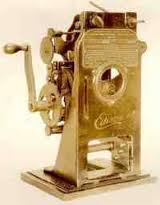
Today in 1888, Thomas Edison filed a patent for the first movie projector, the “Optical Phonograph,” which projected images just 1/32-inch across.  Steven Lubar in InfoCulture: “Thomas Edison was thinking about the phonograph when he decided to invent a moving picture machine. He was used to working by analogy with earlier inventions: the movie camera and projector would just be a phonograph for pictures. The phonograph had recorded sound vibrations on tracks around the edges of a cylinder, and Edison thought that the pictures could be recorded in the same way. In his early drawing he suggested ways of putting a series of tiny photographs onto a cylinder recording. ‘I am experimenting upon an instrument which does for the Eye what the phonograph does for the Ear,’ he wrote in a patent caveat.”

Posted in Film, Recorded sound, This day in information | 1 Comment

Dennis Ritchie, 1941-2011

Today in 1973, Dennis Ritchie and Ken Thompson presented their first paper on Unix at the fourth ACM Symposium on Operating Systems Principles (SOSP) held October 15 – 17 at Purdue University. Continue reading

Posted in Computer history, This day in information | Leave a comment