Groupon Changes Everything?

It turns out Groupon is indeed worth at least $6 billion. But Leo Laporte and Jeff Jarvis “don’t get it” (they think it’s because they are men and don’t understand shopping). Paul Kedrosky insists Groupon cannot scale. John Battelle gets it, but he covers too much ground IMHO. Let me simplify the argument: Groupon changes everything. Continue reading

Posted in Information Economy, World Wide Web | Leave a comment

Lost and Found and Digitally Preserved: The Cairo Genizah

A hundred years ago today, The New York Times Sunday Magazine published an article titled “Important Jewish Manuscript Older than Gospel.” It tells of the debate between two scholars regarding the meaning of a fragment of a Hebrew manuscript: Continue reading

Posted in Libraries, Lost and Found, Preservation | 1 Comment

Why the Ball Drops in Times Square?

According to Wikipedia, every year up to one million people gather in Times Square to watch the ball drop, and an estimated 1 billion watch the video of the event, 100 million of them in the United States. According to Richard John in Network Nation, this New York tradition harks back to the Western Union building (1875), one of the first skyscrapers in the world, which had “an elaborate time-keeping device atop its clock tower which was known as a time ball. to help mariners calibrate the chronometers they relied on to calculate the longitude, as well as anyone else who wished to know the time, this ball was automatically released every day precisely at noon on a signal from the the Untied States Naval Observatory in Washington, which maintained a highly accurate clock.”

Posted in Time Keeping | Leave a comment

Lost and Found: Civil War Coded Message

News from the Museum of Confederacy in Richmond, Virginia: “A glass vial stopped with a cork during the Civil War has been opened, revealing a coded message to the desperate Confederate commander in Vicksburg on the day the Mississippi city fell to Union forces 147 years ago.” –AP

Posted in Lost and Found | Leave a comment

InfoStory Quant: Information Wants to be Paid For

According to a new Pew Internet report, 65% of internet users have paid to access or download some kind of digital content. Music and software are the most common kinds of content purchased. A typical user pays about $10 per month for online content. 23% of internet users pay for subscription services, versus downloading an individual file (16%), or accessing streaming content (8%).

Posted in The InfoStory Quant | Leave a comment

This Day In Information: First Transmission of Opera in HD

Today in 2006, the first transmission of live HD broadcast from the Met Opera, to 100 movie theaters across North America plus others in Britain, Japan and one in Norway. The 12 transmissions of the 2010-2011 will be presented live in 1500 theaters in 46 countries.  During the previous 2009-2010 season, a record-breaking number of more than 2.4 million Live in HD tickets were sold worldwide for nine transmissions.

Posted in This day in information | Leave a comment

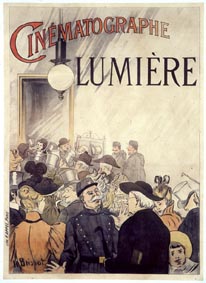
This Day in Information: First Movie Screening

Today in 1895, the first public screening of films at which admission was charged was held by the Lumiere brothers at the Salon Indien du Grand Café in Paris. It featured ten short films, including their first film, Sortie des Usines Lumière à Lyon (Workers Leaving the Lumière Factory). Each film was 17 meters long, which, when hand cranked through a projector, ran approximately 50 seconds. By 1900, the Lumieres had produced 1,299 short movies. For the World Fair that year, they developed their new Lumiere Wide format which, at 75 mm wide, has held the record for over 100 years as the widest film format.

Posted in Film, This day in information | 1 Comment

This Day In Information: First Feature Film

Today in 1906, the world’s first full-length feature film, The Story of the Kelly Gang, is shown at the Melbourne Town Hall in Australia. The film traces the life of the legendary bushranger Ned Kelly (1855–1880). In 2007, the film was added to UNESCO’s Memory of the World Register.

Posted in Film, This day in information | Leave a comment

TDII Extra: Digital Tipping Points for Notebooks/Desktops/Smartphones

Today in 2008, market research firm iSuppli estimated that shipments of notebook computers have exceeded shipments of desktop computers in the third quarter of 2008 for the first time in history. Matthew Wilkins, principal analyst for computer platforms at iSuppli, said that “this marks a major event in the PC market because it marks the start of the age of the notebook.” Earlier this month, iSupply stated that shipments of tablet devices such as the iPad are forecast to outstrip sales of desktop computers by 2013, while smartphone sales will exceed total computer sales (desktops plus notebooks),

Posted in Mobile, PCs, This day in information | Leave a comment

This Day In Information: Phonograph Patent Application

Today in 1877, Thomas Edison applied for a patent for a Phonograph that uses tin foil cylinders to write and playback music. Steven Lubar in InfoCulture: “With the invention of the phonograph, music had changed. It had become a commodity, something to be bought and sold. And music had become an ‘industry.’… [by the 1920s] The Edison phonograph sounded old-fashioned. Indeed, all recorded music sounded old-fashioned compared to the  radio. In 1924 radio sales boomed, while record sales fell from over 100 million in 1927 to only 6 million in 1932….Sales would not rise again until the industry began seeing radio as an ally rather than a foe.”

Posted in music, Radio, This day in information | Leave a comment