The InfoStory Quant: 20% of US population playing social games

According to NPD, 20% of the US population (56.8 million) reports having played a game on a social network. This is good news, according to a new study claiming video gamers make faster and more accurate decisions.

Posted in The InfoStory Quant, Video Games | Leave a comment

This day in information: Birth of the disk drive

Today in 1956, IBM announced the 305 RAMAC (Random Access Memory Accounting), the first disk storage product. It came with fifty 24-inch disks for a total capacity of 5 megabytes, weighed 1 ton, and could be leased for $3,200 per month ($25,785 in today’s dollars). Today you can buy from Seagate a 3 terabyte 3.5-inch disk drive, the size and weight of a small book, for $250.

The 305 RAMAC created an industry that is expected to ship, according to iSupply, 674.6 million disk drives in 2010, for total revenues of $27.7 billion.  And it created other new industries as well, as Seagate’s Mark Kryder reminded us in 2006:  “Instead of Silicon Valley, they should call it Ferrous Oxide Valley. It wasn’t the microprocessor that enabled the personal video recorder, it was storage. It’s enabling new industries.”

Posted in Information storage, This day in information | 1 Comment

This day in information: Film

Today in 1898, the Reverend Hannibal Goodwin was granted a patent for his invention (in 1887) of a method for making transparent, flexible film.

Posted in This day in information | Leave a comment

This day in information: Lascaux cave

Seventy years ago today, four French teenagers and their dog, Robot, discovered the 17,000 year-old cave paintings at Lascaux.  In 1947, LIFE’s Ralph Morse went to Lascaux, and became the first photographer to ever document the paintings.

Posted in Uncategorized | Leave a comment

Starting information businesses: 1979, 2009

At Startup Bootcamp today, two presenters represented two different eras and two different approaches to starting an information technology business. Before Bob Metcalfe started 3Com, he met, one by one, with all the VCs on the West Coast (going through the directory of the regional VC association), interviewing them about starting a business. (He learned that there were three reasons why startups fail: the ego of the founder; lack of focus; lack of funding.)  When he founded 3Com in 1979, he had a product and a business plan (and made sure to hire an experienced executive as CEO rather than insisting on running the company himself).  Thirty years later, Bill Clerico and Rich Aberman started WePay, and spent almost a year presenting their idea to VCs, trying to get funding. After burning through $50,000 of their own money, they realized that what they should have done first is develop a product. They did (with help from Y Combinator) and met with immediate success.

Posted in Information Economy, Startups | 1 Comment

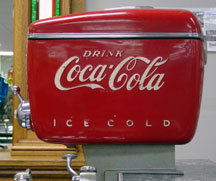
The Internet of Things: From Soda to Data Fountain

“[Coca-Cola’s new soda fountain] Freestyle keep table on its supplies via an RFID inventory system….it also comes with Wi-Fi, which it uses ti send Coca-Cola headquarters in Atalanta both inventory and marketing data.” IEEE Spectrum, September 2010

Soda Fountain 1947

Data Fountain 2010

Posted in Data growth, Internet of things | Leave a comment

Rapid spread of information vs. behavior change

MIT’s Damon Centola: “The networks that make information spread more quickly actually make behavior spread more slowly.” The “Strength of weak ties” (i.e., random networks) does not impact people’s behavior. Conclusion: Twitter good for rapid information dissemination and Facebook good for making people buy products?

Posted in Information diffusion, Social Networks | Leave a comment

InfoStory Quotes: What technology does or doesn’t do to us

“It’s technology, not business or government, that’s the real driving force behind large-scale societal shifts.” —Sean Parker, quoted in David Kirkpatrick, “With a Little Help from His Friends,”  Vanity Fair, October 2010

“The invention of new communications technologies—especially the Internet—is transforming the human capacity to speak, perhaps as monumentally as the invention of the printing press in the 15th century.” —Lee Bollinger, “Journalism Needs Government Help,” The Wall Street Journal, July 14, 2010

“People should not mistake the means of civilization for the end. The steam engine and the telephone depend entirely for their value on the use to which they are put … The value of the telephone is the value of what two people have to say.” —Oscar Wilde

Posted in Quotes | Leave a comment

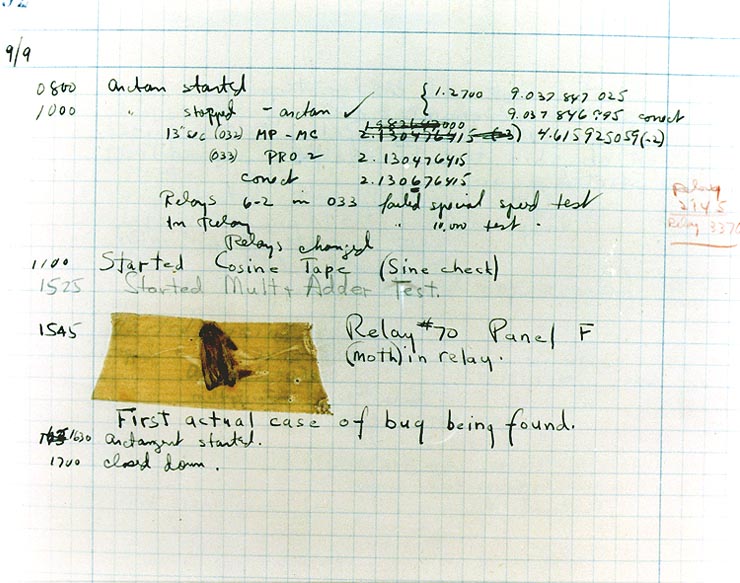
This day in information: Software bugs

Today in 1947,  operators of the Mark II traced the cause of the computer’s malfunction to a moth caught in a relay and wrote in their logbook “First actual case of bug being found.”

Posted in This day in information | 1 Comment

InfoStory Quotes: Dog mail

“Sniffing a fire hydrant or a tree along a route popular with other dogs… becomes a means of keeping abreast of current events. That tree serves as a large canine tabloid containing the latest news items in the dog world. It may not contain installments of classic canine literature, but it certainly has a gossip column and the personals section of the classified ads.”

— Stanley Coren, How Dogs Think, 2004

“You know how some dogs, mine included, sniff each bush and hydrant when taking a walk? We refer to it as ‘reading their pee-mail.'”

— Jennifer Arnold, Through a Dog’s Eyes, 2010

Posted in Quotes | 1 Comment