The Integrated Circuit: Bringing Mass Production to the Computer Industry

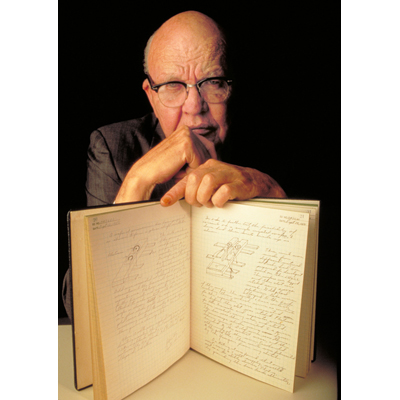
Jack Kilby with his lab notebook open at his first solid circuit drawing

Jack Kilby with his lab notebook open at his first solid circuit drawing

Today in 1958, Jack Kilby sketched a rough design of the first integrated circuit in his notebook. By the early 1960s, some computers had more than 200,000 individual electronic components–transistors, diodes, resistors, and capacitors–and connecting all of the components was becoming increasingly difficult. From Texas Instruments’ website:

Engineers worldwide hunted for a solution. TI mounted large-scale research efforts and recruited engineers from coast to coast, including Jack Kilby in 1958. At the time, TI was exploring a design called the “micromodule,” in which all the parts of a circuit were equal in size and shape. Kilby was skeptical, largely because it didn’t solve the basic problem: the number of transistor components.

While his colleagues enjoyed a two-week summer hiatus, Kilby, a new TI employee without any accrued vacation time, worked alone on an alternative in his TI lab.

TI had already spent millions developing machinery and techniques for working with silicon, so Kilby sought a way to fabricate all of the circuit’s components, including capacitors and resistors, with a monolithic block of the same material. He sketched a rough design of the first integrated circuit in his notebook on July 24, 1958.

Two months passed before Kilby’s managers, preoccupied with pursuing the “micromodule” concept, gathered in Kilby’s office for the first successful demonstration of the integrated circuit.

Kilby’s invention made obsolete the hand-soldering of thousands of components, while allowing for Henry Ford-style mass production.

In February of 1959, Kilby filed for a patent on his invention.

Posted in Computer history, This day in information | Leave a comment

The Rise and Fall of Typewriters

typographerToday in 1829, William Austin Burt, a surveyor from Mount Vernon, Michigan, received a patent for the typographer, the earliest forerunner of the typewriter. Fifty-two years ago this month (July 31), IBM introduced the IBM Selectric, replacing typebars and the moving carriage with a spherical printing element. IBM selectric

In 2006, a Boston Globe article described the fate of typewriters today: “When Richard Polt, a professor of philosophy at Xavier University, brings his portable Remington #7 to his local coffee shop to mark papers, he inevitably draws a crowd. ‘It’s a real novelty,’ Polt said. ‘Some of them have never seen a typewriter before … they ask me where the screen is or the mouse or the delete key.’”

TypewriterWithScreenIn 2011, Dangerous Prototypes reported  on the “brainchild of Jack Zylkin, a Philadelphia-based electrical engineer who has designed a kit” with which anyone with a passion for hands-on projects can “repurpose old manual typewriters as keyboards for computers or iPads, using an Arduino as the intermediary.”

Posted in Typewriters, Writing | 1 Comment

History of The Home Theater (Infographic)

Posted in consumer electronics history, Infographics, Television | Leave a comment

Who Runs the Internet? (Infographic)

Posted in Infographics, Internet, World Wide Web | Leave a comment

The Board of Longitude Collections Digitized

The archives of the Royal Greenwich Observatory, held in Cambridge University Library, include the complete run of the surviving papers of the Board of Longitude through the eighteenth century until its abolition in 1828. These papers throw a vivid light on the role of the British state in encouraging invention and discovery, on the energetic culture of technical ingenuity in the long eighteenth century, and on many aspects of exploration and maritime travel in the Pacific Ocean and the Arctic.

This project, a partnership between Cambridge University Library, the National Maritime Museum and the AHRC-funded Board of Longitude Project, presents fully digitised versions of the complete archive and associated materials, alongside detailed metadata, contextual essays, video, educational resources and hundreds of links through to relevant objects in the National Maritime Museum’s online collections.

Board of Longitude Collection:

  • 48,596 images
  • 162 volumes
  • 304 ships
  • 1337 people
  • 777 places
Posted in Business history, Digitization, Knowledge compilations, Maps, Navigation, Time Keeping, Transportation, Travel | Leave a comment

America’s First Television Theatre

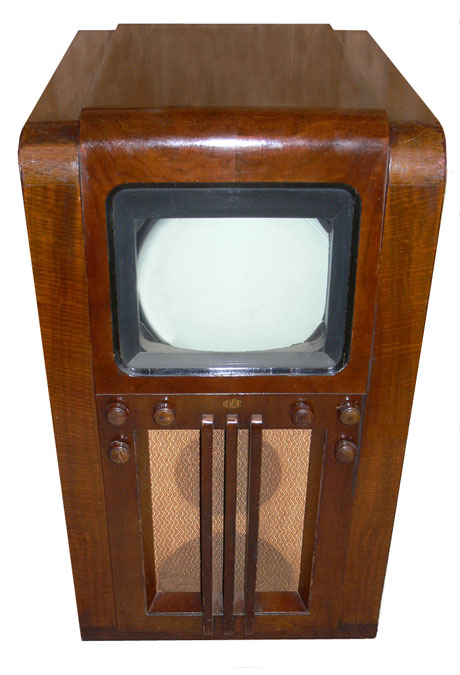
1938 DuMont Television

1938 DuMont Television

Today in 1938, musical performances in an upstairs area at 568 Commonwealth Avenue, Boston, were screened on a television display in the auditorium below, seating 200 patrons paying 25 cents each. The studio and auditorium were linked by cable. About two weeks later, Time magazine reported:

Among the automobile showrooms and tire and accessory shops where Boston’s Commonwealth Avenue runs into Kenmore Square, gaudy posters proclaim TELEVISION. A PREVIEW OF TOMORROW. SENSATIONAL, ENTERTAINING, EDUCATIONAL. The sensation belongs to the Massachusetts Television Institute, licensed by the city authorities to operate America’s first television theatre.

M. T. I. is not in the broadcasting entertainment business. It is a television technology training school. Behind its garish façade it has distinguished advisers —Inventors Dr. Greenleaf Whittier Pickard, Philo Taylor Farnsworth. M. I. T. treasurer is Socialite Sam Batchelder, onetime Harvard football and hockey star. The Institute built its own television equipment, uses a 9 in. by 12 in.-screen English receiver manufactured by Baird Television Ltd. Originally intended for student demonstrations the equipment drew so many curious visitors to the school’s converted automobile showroom that M. I. T. President Porter Henderson Evans last week arranged regularly scheduled evening performances, obtained a Boston theatre license, charged admission (adults, 25¢, children, 15¢).

Holding no television broadcasting license. Educator-Entrepreneur Evans carries his pictures from M. I. T.’s second-story studio to its street-level showroom by wire. Amateur talent on the first show included Boston’s Mayor Maurice Joseph Tobin. Professional performers will be hired only if the box office take is large enough to pay salaries. President Evans does not expect his theatre to survive Boston’s first curiosity to see television pictures. Said he: “I’ve always practiced the reduction of ideas to practice.”

Note that after the first mention of “M.T.I.” (for Massachusetts Television Institute), the text refers a number of times to “M.I.T.” Challenges of digitization?

Posted in Television, This day in information | Leave a comment

The Day the NSA Started Using Computers

96-year-old Samuel Snyder inducted into the NSA Hall of Honor, 2007

96-year-old Samuel Snyder inducted into the NSA Hall of Honor, 2007

Today in 1950, Samuel S. Snyder, a cryptographer at the Armed Forces Security Agency (AFSA–the forerunner to the NSA), met with Dr. A. Sinkov, then Technical Director in Communications Security (COMSEC), and his deputy. In a 1973 declassified paper (PDF, released in 2007), Snyder recalled the purpose of the meeting: “They described an emergency requirement in COMSEC for production and checking of several hundred ‘involutory matrices.'”

Jack Levine and H. M. Nahikian in The American Mathematical Monthly, April 1962: “The construction of involutory matrices has a practical application in algebraic cryptography. The use of involutory matrices X=X-1  has the cryptographic advantage that, for example, the same cipher machine can be used for enciphering and deciphering. Such a machine has, in fact, been patented by Weisner and Hill (U.S Patent 1,845,947)” in 1929.

In the declassified paper, titled “Earliest Applications of the Computer at NSA,” Snyder wrote: “NSA’s earliest successful application of electronic computers began in July 1950, before we had any computer. At that time, the only electronic computer in operations in this country was SEAC [Standards Eastern Automatic Computer], recently completed at the National Bureau of Standards… Our experience in using SEAC seems, in retrospect, to have been a combination of frustration, exhilarating sense of accomplishment, and participation in making history.” Although allowed to use SEAC only at the midnight shift or Sunday afternoons (the rest if the time was “monopolized” by NBS engineers and programmers) and despite the challenges related to the “misbehaving” SEAC memory, Snyder and his colleagues printed out and delivered to Dr. Sinkov 900 matrices after five or six visits to the SEAC.

Synder published the History of NSA General-Purpose Electronic Digital Computers in 1964. He was inducted into the NSA Hall of Honor in 2007, shortly before he passed away, aged 96.

Posted in Computer history, NSA, This day in information | Leave a comment

First (?) Mention of Computer Programs

Charles Babbage in the London Illustrated News, 1871

Charles Babbage in the London Illustrated News, 1871

Today in 1836, Charles Babbage wrote in his notebook: “This day I had for the first time a general but very indistinct conception of the possibility of making an engine work out algebraic developments. I mean without any reference to the value of the letters. My notion is  that cards (Jacquards) of the Calc. engine direct a series of operations and then recommence with the first so it might perhaps be possible to cause the same cards to punch others equivalent to any given number of repetitions. But their hole [their holes?] might perhaps be small pieces of formulae previously made by the first cards.”

This passage, says Brian Randell in The Origins of Digital Computers, “puts beyond doubt the fact that Babbage had thought of using the Analytical Engine to what would today be described as ‘computing its own programs.’”

In The Information: A History, A Theory, A Flood, James Gleick quotes Edgar Allan  Poe on Babbage’s machine: “What shall we think of an engine of wood and metal which can… render the exactitude of its operations mathematically certain through its power of correcting its possible errors?” and Oliver Wendell Holmes: “What a satire is that machine on the mere mathematician! A Frankenstein-monster, a thing without brains and without heart, too stupid to make a blunder; which turns out results like a corn-sheller, and never grows any wiser or better, though it grind a thousand bushels of them!”

Says Gleick: “They all spoke as though the engine were real, but it never was. It remained poised before its own future.”

Posted in Analog, Computer history, Programming, Software | Leave a comment

Inventing the Modern Pencil

Nicolas-Jacques Conté

Nicolas-Jacques Conté

From Maria Popova’s Brain Pickings, quoting John D. Barrow’s  100 Essential Things You Didn’t Know You Didn’t Know: Math Explains Your World 

“The modern pencil was invented in 1795 by Nicholas-Jacques Conte, a scientist serving in the army of Napoleon Bonaparte. The magic material that was so appropriate for the purpose was the form of pure carbon that we call graphite. It was first discovered in Europe, in Bavaria at the start of the fifteenth century; although the Aztecs had used it as a marker several hundred years earlier. Initially it was believed to be a form of lead and was called ‘plumbago’ or black lead (hence the ‘plumbers’ who mend our lead water-carrying pipes), a misnomer that still echoes in our talk of pencil ‘leads’. It was called graphite only in 1789, using the Greek word ‘graphein’ meaning ‘to write’. Pencil is an older word, derived from the Latin ‘pencillus’, meaning ‘little tail’, to describe the small ink brushes used for writing in the Middle Ages.”

From Wikipedia: Conté invented the modern pencil lead at the request of Lazare Nicolas Marguerite Carnot. The French Republic was at that time under economic blockade and unable to import graphite from Great Britain, the main source of the material. Carnot asked Conté to create a pencil that did not rely on foreign imports. After several days of research, Conté had the idea of mixing powdered graphite with clay and pressing the material between two half-cylinders of wood. Thus was formed the modern pencil. Conté received a patent for the invention in 1795, and formed la Société Conté to make them.

Posted in Writing | Leave a comment

Bipolar Junction Transistor Announced

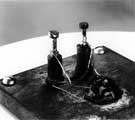
First junction transistor

First junction transistor

Today in 1951, the bipolar junction transistor was announced by its inventor, William Shockley. It was an improvement over the bipolar point-contact transistor which was invented four years earlier by John Bardeen and Walter Brattain and became the device of choice in the design of discrete and integrated circuits for the next three decades.

See PBS’s website on the history of the transistor and the website of the Transistor Museum

Posted in Computer history, This day in information, Transistor | Leave a comment