Alan Turing 1912-1954

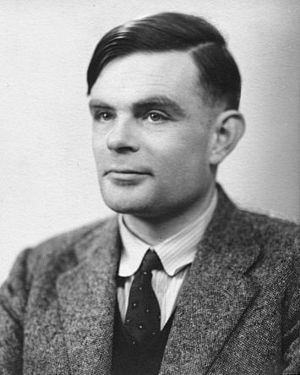
Turing_photoToday in 1954, Alan Turing died from cyanide poisoning. An inquest determined that his death was suicide; his mother and some others believed his death was accidental. Turing is widely considered to be the father of computer science and artificial intelligence.  Check out the CAPTCHA  (Completely Automated Public Turing test to tell Computers and Humans Apart) exhibit at the Jerusalem Museum of Science in honor of Alan Turing and the talk by the curator of the exhibition, Nathan Zeldes.  See also the Turing Google Doodle and the ACM Turing Centenary celebration.

Posted in Artificial Intelligence, Computer history, The Year in Information, Turing | 2 Comments

Print’s Last Stand: Reading to a Child

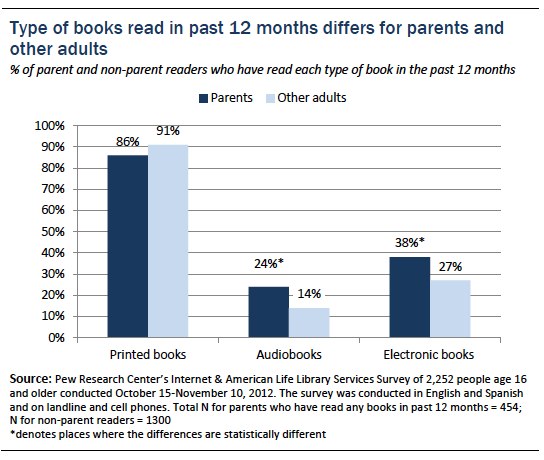
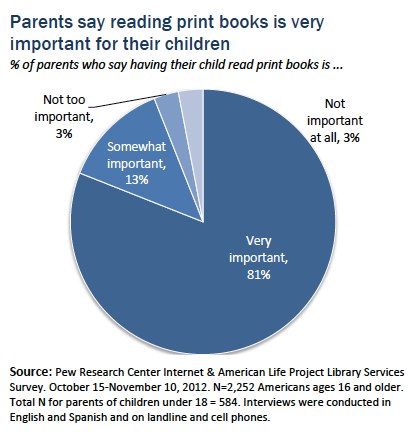
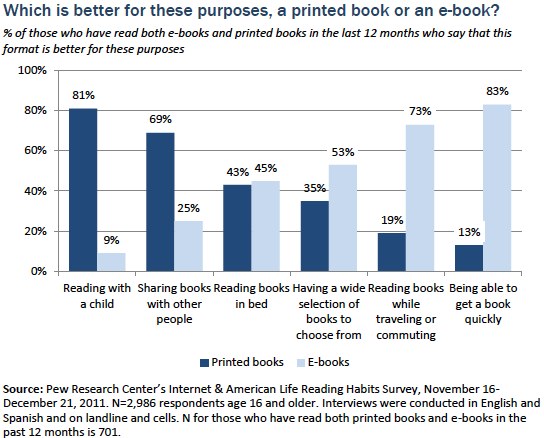
Pew Internet: Parents who have minor children at home are a relatively tech-savvy group. They are more likely than other adults to have computers, internet access, smartphones, and tablet computers. (This relatively high tech use may be due to the fact that parents with minor children living at home tend to also be younger than other adults.) They are also more likely than adults without children to read e-books. But as parents adopt new reading habits for themselves on electronic devices, the data show that print books remain important when it comes to their children…. When it comes to sharing books or reading with a child, most Americans adults (not just parents) who have read both print and e-books think that print books are the better option.

books-read_type_Pew


books_Print-important

Books_reading_Pew

Posted in Books, Digitization, ebooks, Reading | Leave a comment

Lovelace and Babbage Meet, Fly on Imagination’s Wings

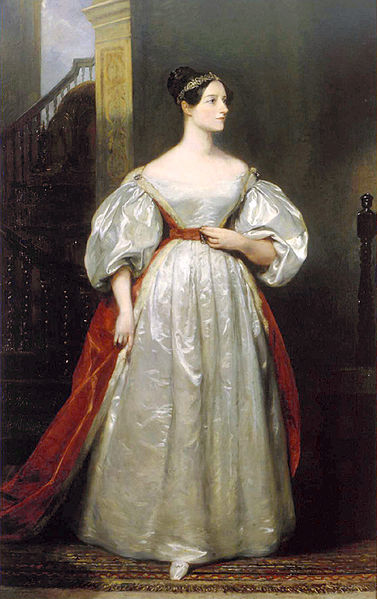
Ada_LovelaceOne hundred eighty years ago today (June 5, 1833), Ada Byron (later Countess Lovelace) met Charles Babbage when visiting his house to see a portion the Difference Engine, or what her mother, Lady Byron, called his “thinking machine.” James Gleick writes in The Information: A History, A Theory, A Flood:  “Babbage saw a sparkling, self-possessed young woman with porcelain features and a notorious name, who managed to reveal that she knew more mathematics than most men graduating from university. She saw an imposing forty-one-year-old, authoritative eyebrows anchoring his strong-boned face, who possessed wit and charm and did not wear these qualities lightly. He seemed a kind of visionary–just what she was seeking. She admired the machine, too.”

With the Analytical Engine, Babbage imagined the modern computer. Gleick quotes Ada on imagination, from an essay she wrote in 1841: “It is that which penetrates into the unseen worlds around us, the worlds of Science. It is that which feels & discovers what is, the real which we see not, which exists not fir our senses. Those who have learned to walk the threshold of the unknown worlds… may then with the fair white wings of Imagination hope to soar further into the unexplored amidst which we live.”

In this she anticipated Albert Einstein’s much-quoted observation: “Imagination is more important than knowledge. For knowledge is limited to all we now know and understand, while imagination embraces the entire world, and all there ever will be to know and understand.”

See here the comic book version of the Lovelace and Babbage story.

Posted in Computer history, InfoStory Meetings, This day in information | Leave a comment

The Birth of International Television

queen-coronation-1--aSixty years ago today (June 3, 1953), The New York Times declared the “birth of international television.” From Broadcast Engineering:

Satellite coverage of the wedding of Prince Charles and Lady Diana Spencer enabled the largest audience ever, an estimated 750 million people worldwide, to watch the fairytale spectacle playout in real time. The challenge of that broadcast was a far cry from the one faced by CBS and NBC news departments when some years earlier, during those Byzantine-era presatellite days, the networks struggled to provide same-day coverage of the coronation of Queen Elizabeth II in London.

In order to provide the first same-day coverage of an event on another continent, the networks undertook a planning and logistics nightmare. The year was 1953, the introduction of videotape was still several years away, and film and kinescope capture ruled. The networks sent production teams to London, chartered aircraft with seats removed to make room for film processing and editing equipment, and the race was on between CBS and NBC to see who could air the first coronation footage. One of the more comical episodes, although I am sure not comical to those involved, occurred at the conclusion of the coronation when the taxi rushing the CBS film and crew to London’s Heathrow Airport ran out of gas!

Interestingly, although it was NBC who edged out CBS by just minutes to be first on-air with coronation footage, it was the Canadian Broadcasting Corporation (CBC) that had actually trumped both of the U.S. television networks.

The CBC aired film that had been flown from London to Goose Bay, Canada; Goose Bay to Labrador, Canada, by jet aircraft; on to Montreal by Canadian fighter jets and then helicoptered to the CBC network facility. Determining in the final minutes that CBS was about to beat them, after several frantic phone calls, NBC secured the lines and the OK to pick up and air the CBC’s coverage. A hollow NBC victory at best, it was CBS that aired its own shot and edited film report of the coronation during its evening broadcast and earned plaudits in the following day’s “New York Times.” The June 3 edition of the “Times” reported that CBS’ coverage of the coronation was the “birth of international television.”

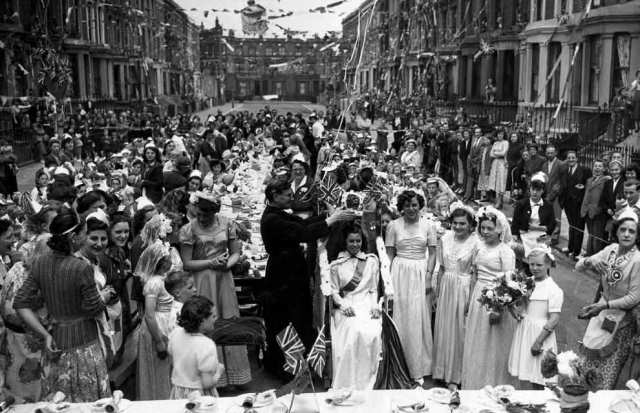
Up and down the land, her subjects celebrated at street parties complete with their own queen. At this one in Kensington, London, 14-year-old Maureen Atkins was 'crowned'  by the local vicar. Some 253 children attended enjoying a magic show, clowns and cake. They were later given a 15 shilling savings certificate.

Up and down the land, her subjects celebrated at street parties complete with their own queen. At this one in Kensington, London, 14-year-old Maureen Atkins was ‘crowned’ by the local vicar.
Some 253 children attended enjoying a magic show, clowns and cake. They were later given a 15 shilling savings certificate.

Posted in Television, This day in information | Leave a comment

Speech Transmission Over Wires Conceived

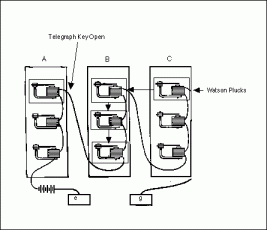
Diagram of the experiment

Diagram of the experiment

Today in 1875, during an experiment conducted by Alexander Graham Bell and his assistant Thomas Watson, a receiver reed failed to respond to the intermittent current supplied by an electric battery. Bell told Watson, who was at the other end of the line, to pluck the reed, thinking it had stuck to the pole of the magnet. Mr. Watson complied, and to his astonishment Bell heard a reed at his end of the line vibrate and emit the same timbre of a plucked reed, although there was no interrupted on-off-on-off current from a transmitter to make it vibrate. A few more experiments soon showed that his receiver reed had been set in vibration by the magneto-electric currents induced in the line by the motion of the distant receiver reed in the neighborhood of its magnet. The battery current was not causing the vibration but was needed only to supply the magnetic field in which the reeds vibrated. Moreover, when Bell heard the rich overtones of the plucked reed, it occurred to him that since the circuit was never broken, all the complex vibrations of speech might be converted into alternating currents, which in turn would reproduce the complex timbre, amplitude, and frequencies of speech at a distance.

Edwin S. Grosvenor and Morgan Wesson write in Alexander Graham Bell: The Life and Times of the Man Who Invented the Telephone:

The same day, the two men drew up designs for telephone transmitter that would use a membrane to respond to the vibrations caused by words spoken into it… Bell wrote of his insight to his parents–“I think the transmission of the human voice is much more at hand than I had supposed”–and to Gardiner Hubbard–“I have accidentally made a discovery of the very greatest importance in regard to the Transmitting Instruments… I have succeed today in transmitting signals without any battery whatsoever!” Though today historians see this discovery as a major step on the road to telephones, Bell’s parents were not impressed, and Hubbard dismissed it altogether, gently guiding his inventor back toward multiple telegraphy.

Posted in Telegraph, Telephone, This day in information | Leave a comment

Napster Released

napsterToday in 1999, Napster released its file sharing service, letting people swap music stored on their computers. Wikipedia: “On June 1, 1999, Fanning released a preliminary beta program of Napster and soon, hundreds of college students at Northeastern were up and trading music furiously.” On April 3, 2008, the iTunes Store surpassed Wal-Mart as the biggest music retailer in the US. Between 2006 and 2011, worldwide recorded music revenues went down from $36 billion to $34.7 billion while worldwide digital music revenues went up from $2.9 billion to $14.8 billion.

Posted in Copyrights, music, This day in information | Leave a comment

Theory of the Internet Born

Leonard-Kleinrock-and-IMP1Today in 1961, Leonard Kleinrock submitted his MIT PhD thesis proposal, “Information Flow in Large Communication Nets, (PDF)” establishing, in his words, “the underlying principles of data networks that are the basis of the Internet.” (PDF)

See also The Internet Goes Live

Posted in Computer history, Internet | 1 Comment

The History of Programming Languages (Infographic)

Source

Posted in Infographics, Programming, Software | 3 Comments

AP Launched

Moses Yale Beach

Moses Yale Beach

Today in 1846, The New York Sun carried the first dispatches from the Mexican War, marking the birth of the Associated Press. Moses Yale Beach (1800-68), publisher of The New York Sun, established a pony express to deliver news of the Mexican War, joining with The Journal of Commerce, The Courier and Enquirer, The New York Herald, and The Express.  Telegraphic communications between Washington and New York were established on June 5; the New York-Boston line went into operation on June 27; and by summer’s end, the telegraph extended from New York to Albany and Buffalo, and from Philadelphia west to Harrisburg, creating a telegraph network.

Posted in Information diffusion, Newspapers, Telegraph, This day in information | Leave a comment

Writing Systems of the World Today

WritingSystemsoftheWorld6

Wikipedia: A writing system is an organized regular method (typically standardized) of information storage and transfer for the communication of messages (expressing thoughts or ideas) in a language by visually (or possibly tactilely) encoding and decoding (known as writing and reading) with a set of signs or symbols, both known generally as characters (with the set collective referred to as a ‘script’). These characters, often including letters and numbers, are usually recorded onto a durable medium such as paper or electronic storage/display, although non-durable methods may also be used, such as writing in sand or skywriting.

Posted in Information diffusion, Information storage, Reading, Writing | Leave a comment