First Photograph of a Solar Eclipse

eclipse_sun_langenheim_1857Today in 1854, William and Frederick Langenheim made eight sequential photographs of the first total eclipse of the sun visible in North America since the invention of photography. Although six other daguerreotypists and one calotypist are known to have documented the event, only these seven daguerreotypes survive. In the northern hemisphere, the moon always shadows the sun from right to left during a solar eclipse; these images therefore seem odd because they are, like all uncorrected daguerreotypes, reversed laterally as in a mirror.

Posted in Photography, This day in information | Leave a comment

First World Wide Web Conference

WWW_logo_by_Robert_Cailliau.svgToday in 1994, the First International WWW Conference was held at CERN, Geneva. Tim Berners-Lee in Weaving the Web: “It was the first time the people who were developing the Web were brought together with all sorts of people who were using it in all sorts of ways. The connections were electric…. The conference marked the first time that the people who were changing the world with the Web had gotten together to set a direction about accountability and responsibility, and how we were actually going to use the new medium.”

Posted in This day in information, World Wide Web | Leave a comment

“What Has God Wrought?”: A Love Story

Samuel Morse 1840

Samuel Morse 1840

Today in 1844, Samuel Morse sent the the message “What Has God Wrought” to officially open the first telegraph line, between Washington, D.C. and Baltimore, launching an industry and ending a rocky journey that began with the 1837 resolution by the U.S. House of Representatives requesting the Treasury Secretary to recommend how “a system of telegraphs for the United States” should be established.

As Wikipedia (and many other sources) reports, “Annie Ellsworth chose these words from the Bible (Numbers 23:23); her father,  Henry Leavitt Ellsworth, [the first commissioner of the U.S. patent office (1835-1845)] had championed Morse’s invention and secured early funding for it.”

Continue reading

Posted in Information diffusion, Telecommunications, Telegraph, This day in information | Leave a comment

New York Public Library Dedicated

NYC_Public_Library_Research_Room_Jan_2006Today in 1911, the New York Public Library was officially dedicated. The ceremony was presided over by President William Howard Taft and was attended by Governor John Alden Dix and Mayor William J. Gaynor. The following morning, New York’s very public Public Library officially opened its doors. The response was overwhelming. Between 30,000 and 50,000 visitors streamed through the building the first day it was open. One of the very first items called for was N. I. Grot’s Nravstvennye idealy nashego vremeni (Ethical Ideas of Our Time), a study of Friedrich Nietzsche and Leo Tolstoi. The reader filed his slip at 9:08 a.m. and received his book six minutes later.

Today the Library includes four scholarly research centers–focusing on the humanities and social sciences; the performing arts; black history and culture; and business and industry–and a network of 87 neighborhood libraries throughout the Bronx, Manhattan, and Staten Island. Research and circulating collections combined total more than 50 million items, among them materials for the visually impaired. The Library serves some 18 million patrons who come through its doors annually; in addition, the Library’s website, www.nypl.org, receives 28 million visits annually from more than 200 countries.


Posted in Libraries, This day in information | Leave a comment

Bob Metcalfe Gave Birth to the Ethernet 40 Years Ago

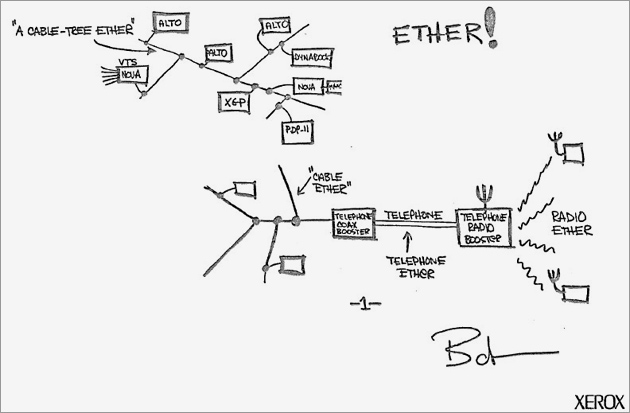
MetcalfeForty years ago today (May 22, 1973), twenty-seven-year-old Bob Metcalfe turned on his IBM Selectric, “pulled out a wad of Ko-Rec-Type, snapped on an Orator ball, and banged out the memo inventing Ethernet,” as he recalled in Internet Collapsesat Xerox Palo Alto Research Center (PARC).  Metcalfe explained to Scott Kirsner years later in a Wired interview: “That is the first time ethernet appears as a word, as does the idea of using coax as ether, where the participating stations, like in AlohaNet or Arpanet, would inject their packets of data, they’d travel around at megabits per second, there would be collisions, and retransmissions, and back-off.” ethernet_whiteBoardXerox

Today, Metcalfe is Professor of Innovation and Murchison Fellow of Free Enterprise at the University of Texas at Austin and hundreds of millions of Ethernet ports are shipped annually (counting WiFi).

Live streaming of the Ethernet 40th anniversary celebration May 22 & May 23, 2013 here

See also Bob Metcalfe, October 2009Bob Metcalfe, May 2011This Day in Information: Ethernet PatentFirst Internet Domain Name and a New Era for ITVC65: Funding Innovation.

Posted in Computer history, Computer Networks, Innovation | Leave a comment

The IBM 701 and Software-as-a-Service

IBM701Today in 1952, the IBM 701 was formally announced.  Its official name was the Defense Calculator, “specifically selected to appeal to the patriotism of the older Watson and to avoid the use of the unacceptable word, computer,” according to Emerson Pugh in Building IBM. The 701 was IBM’s first commercially available scientific computer and the first IBM computer in which programs were stored in an internal, addressable, electronic memory. A month earlier, at the IBM shareholders’ meeting on April 29, Thomas Watson Sr. said: “Our progress in electronics convinced us one year ago that we had in our company the ability to create for the Defense Department, and the defense industries, a computer of advanced design which could be of major service to our national defense effort. We began planning and building such a machine, which we believe will be the most advanced, most flexible high-speed computer in the world. It is built not for one special purpose but as a general purpose device, and two days after it was announced on a limited confidential basis we had orders for ten.”

A complete list of the 701 customers is here. The first production model of the 701 was installed at IBM’s headquarters in New York in March 1953, operating “as a Technical Computing Bureau for organizations having problems involving mathematical computations.” In other words, the Computing Bureau delivered hardware and software as a service to those organizations in need of rapid mathematical calculations who could not afford the $11,900 monthly rental or $96,000 in today’s dollars.


Posted in Computer history, IBM | Leave a comment

World Metrology Day

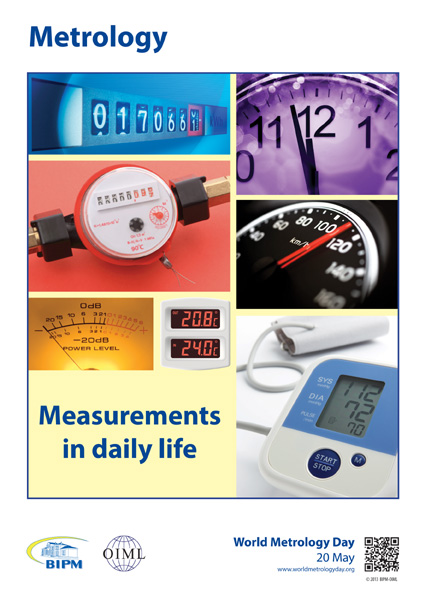
MetrologyDay_posterToday is World Metrology Day. This year’s theme is “Measurements in daily life.” Christopher Joseph says in his introduction to A Measure of Everything: “Measurement, in one form or another, is one of mankind’s oldest and most vital activities…. The earliest historical record of a unit of measurement is the Egyptian cubit, in around 3000 B.C.E., decreed to be equal to the length of a forearm and hand… plus the width of Pharaoh’s palm… by 2500 B.C.E., the necessary leap forward had been taken. The complicated and rather imprecise definition had been simplified drastically: a cubit was the same length as the prototype cubit, stored safely from harm. This was the ‘royal master cubit,’ a black marble rod some 52 cm in length–and the size of the user’s forearm was no longer an issue. From this simple model it becomes possible to measure many things: distances, areas, volumes, even masses.”

Following the 1790 decrees by the French National Assembly, the Convention of the Metre (Convention du Mètre) was signed in Paris in 1875 by representatives of seventeen nations, creating the International Bureau of Weights and Measures (BIPM). The BIPM “acts in matters of world metrology, particularly concerning the demand for measurement standards of ever increasing accuracy, range and diversity, and the need to demonstrate equivalence between national measurement standards.”

Posted in Measurement | Leave a comment

Moving Pictures by Phone

VisiophoneToday in 1924, AT&T demonstrated long distance telephotography, now known as fax, with the transmission of pictures over telephone wires between Cleveland and New York. Commercial service began in a handful of cities the following year. For many decades, telephotography had one major use — sending photos of distant events for use by newspapers. Also today, in 1932, John Logie Baird demonstrated the Visiophone in Paris, France, a telephone capable of transmitting both audio and video.

Posted in Photography, Telephone, This day in information | Leave a comment

First Patent Application for a Rotary Dial Telephone

RotaryphoneToday in 1923, Antoine Barnay filed the first patent application for a rotary dial telephone in France.

From The Aesthetic:

The old phones have an aesthetic that new phones sorely lack. They ring, for one thing, with real bells. All that chirping, beeping and buzzing from the new phones gets pretty annoying, after all.

The phones are heavy-duty, as well. All that black plastic and metal. They don’t slide around your desk. When you hold the receiver to your head, it feels like you’re actually holding something. Drop an old phone, and it won’t crack. It might crack whatever it hits on the way down, but it won’t suffer any damage.

And then there’s that rotary dialing. Patented in 1923 by Frenchman Antoine Barnay, it’s wonderfully mechanical. No tones, no computer chip. Sure, it takes a little longer to place a long distance phone call, but hey, what’s the rush anyway? The rotary dialer forces you to consider what you’re doing, not rush things so. All that, and they look pretty cool on your desk too.

Posted in Patents, Telephone | Leave a comment

International Telegraph Union (ITU) Established

ITU_1865Today in 1865, the first International Telegraph Convention was signed in Paris by the 20 founding members, and the International Telegraph Union (ITU) was established to facilitate subsequent amendments to this initial agreement.

Today, the ITU is the leading United Nations agency for information and communication technology issues, and its membership includes 193 Member States and more than 700 private-sector entities ans academic institutions. The ITU published recently a concrete list of indicators to monitor the 10 World Summit on Information Society (WSIS) targets, which range from connecting villages, schools, and health centers to developing online content and providing people with access to information technology. The ITU collects and posts detailed statistics on information and communications technologies worldwide. For example:

In 2013, there are almost as many mobile-cellular subscriptions as people in the world, with more than half in the Asia-Pacific region (3.5 billion out of 6.8 billion total subscriptions).

2.7 billion people–almost 40% of the world’s population–are online.

Mobile-broadband subscriptions have climbed from 268 million in 2007 to 2.1 billion in 2013. This reflects an average annual growth rate of 40%, making mobile broadband the most dynamic ICT market.

Posted in Telecommunications, Telegraph, Telephone, This day in information | Leave a comment