
See also my interview with Nicholas Carr about his book The Shallows: What the Internet is Doing to Our Brains
Here are iTunes stats, compiled by Time: Continue reading
See also my interview with Nicholas Carr about his book The Shallows: What the Internet is Doing to Our Brains

Founding Prospectus
Today in 1946, more than twenty members of the Tokyo Telecommunications Research Institute, founded by Masaru Ibuka in the previous year, attended the inauguration ceremony which officially established the Tokyo Telecommunications Engineering Corporation. Ibuka’s father-in-law, Tamon Maeda was appointed president of the new company. In his speech at the ceremony, Maeda said: “Today our small company has made its start. With its superior technologies and spirit of perfect unity, the company will grow. As it does so, we can certainly make a contribution to society.”
In 1958, the company changed its name to Sony Corporation.
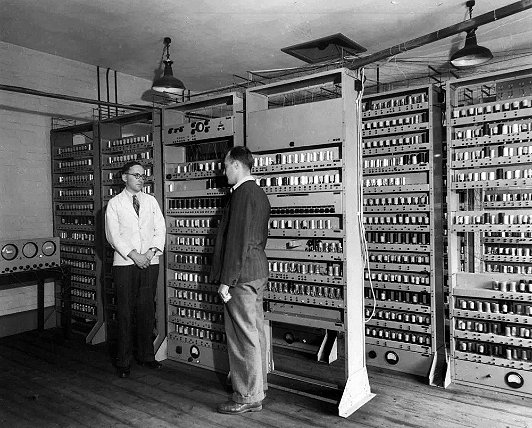 Today in 1949, the Electronic Delayed Storage Automatic Computer (EDSAC), the first practical stored-program computer, ran its first program and performed its first calculation.
“… a thin ribbon of paper containing the program [to print a table of the squares of the integers] was loaded into the computer; half a minute later the teleprinter sprang to life and began to print 1, 4, 9, 16, 25…. The world’s first practical stored-program computer had come to life, and with it the dawn of the computer age,” Martin Campbell-Kelly and William Aspray recount the moment in Computer: A History of the Information Machine.
Maurice Wilkes, who was the head of the team that designed and assembled the EDSAC at the University Mathematical Laboratory at Cambridge University, wrote in his 1985 Memoirs of a Computer Pioneer about the origins of the EDSAC: “In the middle of May 1946 I had a visit from L. J. Comrie who was just back from a trip to the United States. He put in my hands a document written by J. von Neumann on behalf of the group at the Moore School and entitled ‘Draft Report on the EDVAC.’ Comrie… obligingly let me keep it until the next morning. Now, I would have been able to take a xerox copy, but there were then no office copiers in existence so I sat up late into the night reading the report. In it, clearly laid out, were the principles on which the development of the modern digital computer was to be based: the stored program with the same store for numbers and instructions, the serial execution of instructions, and the use of binary switching circuits for computation and control. I recognized this at once as the real thing, and from that time on never had any doubt as to the way computer development would go.” Continue reading
Press Freedom Day–celebrations around the world
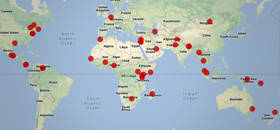
Twenty years ago today, May 3rd was proclaimed by the UN General Assembly as World Press Freedom Day, “a date which celebrates the fundamental principles of press freedom; to evaluate press freedom around the world, to defend the media from attacks on their independence and to pay tribute to journalists who have lost their lives in the exercise of their profession. ” Here’s a map of celebrations around the world.
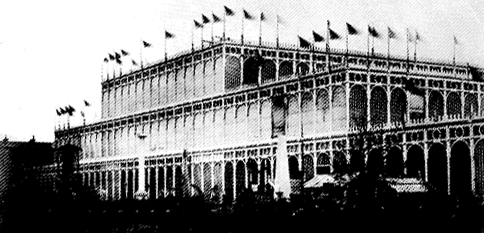 Today in 1851, the Great Exhibition of the Works of Industry of all Nations or The Great Exhibition, opened in London. It was the first in a series of World’s Fair exhibitions continuing to the present day.
Burton Benedict writes in The Anthropology of World’s Fairs, “The Great exhibition, like the many international expositions or world’s fairs that followed it, was a phenomenon of industrial capitalism. Mass producers sought international mass markets for their goods, and world’s fairs provided display cases reaching millions of potential customers. But the fairs were not only selling goods, they were selling ideas: ideas about the relations between nations, the spread of education, the advancement of science, the form of cities, the nature of domestic life, the place of art in society. They were presenting an ordered world.”
William Makepeace Thackeray published in The Times on May 1, 1851, a poem on the exhibition which read in part:
A peaceful place it was but now,
And lo! within its shining streets
A multitude of nations meets;
A countless throng
I see beneath the crystal bow,
And Gaul and German, Russ and Turk,
Each with his native handiwork
And busy tongue.

To prove to skeptical New York World’s Fair visitors that no trickery was involved in creating television images, a special order was made to RCA’s engineering wing to build a transparent version of Vassos’ TRK-12 cabinet. The cabinet was constructed from DuPont’s new Lucite plastic, giving viewers a clear picture of the set’s inner workings.
Today in 1939, the 1939 New York World’s Fair, “Building the World of Tomorrow,” had its grand opening, with 206,000 people in attendance. The April 30 date coincided with the 150th anniversary of George Washington’s inauguration as President in New York City. President Franklin D. Roosevelt gave the opening day address and his speech was broadcast not only over the various radio networks but also televised in what would be the first of only two appearances he made on television. RCA-owned NBC used the event to inaugurate regularly scheduled television broadcasts in New York City. The service aired two hours of programs a week in order to “to make the art of television available to the public.” By the end of the year, a thousand receivers were sold in the U.S. The RCA receivers cost several hundred dollars and their screens were only about five inches across.

The Souls of the MV/8000 (Wired, December 2000)
Today in 1980, Data General (DG) introduced the Eclipse MV/8000 at the Roosevelt Hotel in New York City. Known internally as Project Eagle, the 2-year development of the 32-bit “super-minicomputer,” the engineers working on it, and the parallel (and eventually, failed) development of a competing DG product, became the subject of Tracy Kidder’s Pulitzer-prize winning The Soul of a New Machine, published in 1981. In 1996, a study of the development of the MV/8000 and its aftermath, concluded: “In 1981… the Eclipse MV/8000 produced 10% of revenue, and was [DG’s] only area of improvement. … DG crawled out of the 80s, alive only because of the Eclipse MV line, which sold very well in 1983 and 1984. Data General grew to 17,700 people on the strength of those years. Then came the crunch, as micro-computers ended DG’s office automation strategy, and workstations took over the technical and engineering marketplace. Government contracts, and business purchasers, began to demand non-proprietary systems.”
The writer of DG’s 1988 Annual Report found an interesting way to explain the gap between the annual growth of proprietary systems (5-7% at the time) and the growth of systems based on industry standards (20-30%). Under the heading “The Economics of Writing in Arabic,” the Report says: “The award-winning novelist who writes in English is likely to be more commercially successful than Nobel Prize winner Naguib Mahfouz, the Egyptian novelist who writes in Arabic, simply because of the customer base. Economics compel the application writer to write for operating systems used by the largest number of customers. … In [today’s] market, the superior price/performance of the computer system and long-term cost of ownership that has been Data General’s hallmark, counts for little if it doesn’t come with the right applications.”
In 2000, Evan Ratliff published a great retrospective of the story told in The Soul of a New Machine. The article is full of wonderful quotes; here’s a sample:
Tom West, the project leader: “I think I remember the story [as told in the book] more than the event. Most events happen and I file them away. This one happened over and over again.”
And: “To be an entrepreneur, you have to be interested in networking, even with fools.”
Carl Alsing, a member of the Eagle team: “People expect their company to do the right thing, and usually they’re disappointed. Tom expected the company to do the wrong thing, and he wasn’t disappointed at all. When your company doesn’t do the right thing, you manipulate it until it does.”
Eric Schmidt (CEO of Novell in 2000): “It was the first book to describe the inner workings of the technology groups, and it did a good job of getting into the psychology of leadership. The corporate maneuvering was both fascinating and abhorrent to me.”
A 1988 unpublished history of Data General argues that “Both author and company took risks as the book and computer project developed. Neither fully understood what the other’s project was about or how it would turn out. One risk to Data General was that the book or excerpts of it might be published or leaked before Eagle landed and the MV/8000 announced… On the other hand, Kidder was concerned that the book be kept clear of any taint of Data General sponsorship or commercialism.”
And it goes on to describe a book-promotion event arranged by the publisher: “[It was held] on a Saturday morning at the DEC Marlboro (Ma.) plant’s main lunch hall where both Kidder and West spoke. The hall was mobbed for the event with standing-room only. Although little advance notice of the meeting was made, every computer designer or electrical engineering student in New England was there or tried to get there. Since neither Kidder or West were practiced public speakers and both of them felt uncomfortable in directly promoting a ‘commercial’ publication, a format was decided on that got both off the hook: they would have a conversation that everyone would listen to; later, questions would be taken from the floor.
“A sample exchange at the meeting illustrated the friendly tension between parties – Kidder: ‘Had I known that ‘Eagle’ would turn out to be such a successful computer, I might have done some things differently in the book.’ West: ‘Had we known your book would be so successful, we might have done a few things differently, too.’
“Someone asked West at the meeting if he had read the text of the book before publication. West said: ‘Yes, I did, but my hands trembled a lot.’”
In the Wired article, which calls the book “the original nerd epic,” West sums it up this way: “It’s got a Zen characteristic. It’s not a cookbook for building computers. It’s not a cookbook for good management strategies. Why did this book strike a chord with such discordant people? I’m not sure I know. Tracy can’t tell you. It has something to do with work, and dreams, and why people do it.”

Sales of iTunes songs, 2003—2010
Today in 2003, Apple launched the iTunes Music Store. The store sold more than 1 million tracks in its first five days and became the biggest music vendor in the U.S. five years later.
Here are iTunes stats, compiled by Time: Continue reading
 The Story of Information