The Birth and Growth of Scientific Journals

journal_des_scavans_1665Today in 1665, the first issue of the Journal des sçavans (later renamed Journal des savants), was published in Paris. It is widely regarded as the first scientific journal but a more apt description would be a journal for men of letters as it also carried non-scientific material such as book reviews, obituaries of famous men, church history, and legal reports. The next day, January 6, 1665, saw the publication of the first (exclusively) scientific journal,  the Philosophical Transactions of the Royal Society of London. The two were followed by Giornale de litterati d’Italia (Italy, 1668), Miscellenea Curiosa (Germany, 1670), Acta Medica et Philosophia Hafniensa (Denmark, 1673?), and Acta Eruditorum (Germany, 1682). Say Lewis Pyenson and Susan Sheets-Pyenson in Servants of Nature: “The scientific paper or journal article eventually displaced the definitive and comprehensive book as the appropriate showcase for a scientist’s work. This development hastened the process of specialization, whereby scientists strove for mastery of an ever more narrowly circumscribed area of knowledge.”

ptIn 1944, Fremont Rider, the University Librarian at Wesleyan, calculated that American research libraries were, on the average, doubling in size every sixteen years. Given this growth rate, he estimated that the Yale Library would have in 2040 “approximately 200,000.000 volumes, which will occupy over 6,000 miles of shelves…. New material will be coming in at the rate of 12,000,000 volumes a year; and the cataloging of this new material will require a cataloging staff of over six thousand persons.”

In 1961, Derek Price published Science Since Babylon, in which he charted the growth of scientific knowledge by looking at the growth in the number of scientific journals and papers. He concluded that the number of new journals has grown exponentially rather than linearly, doubling every fifteen years and increasing by a factor of ten during every half-century. Price called this the “law of exponential increase,” explaining that “each [scientific] advance generates a new series of advances at a reasonably constant birth rate, so that the number of births is strictly proportional to the size of the population of discoveries at any given time.”  Continue reading

Posted in Data growth, Information diffusion, Science | Leave a comment

How Professors Use Social Media

Professors & Social Media


Source: Best Colleges Online

Posted in Education, Infographics, social media, Social Networks | Leave a comment

Machine of the Year, Thirty Years Ago

TimeMagazineMachineOfTheYearToday in 1983, Time magazine put on its cover the PC, calling it “machine of the year.” Roger Rosenblatt wrote:“Inventions arise when they’re needed. This here screen and keyboard might have come along any old decade, but it happened to pop up when it did, right now, at this point in time, like the politicians call it, because we were getting hungry to be ourselves again. That’s what I think, buddy. ‘The most idealist nations invent most machines.’ D.H. Lawrence said that. Great American, D.H.

O pioneer. Folks over in Europe have spent an awful lot of time, more than 200 years if you’re counting, getting up on their high Lipizzaners and calling us a nation of gears and wheels. But we know better. What do you say? Are you ready to join your fellow countrymen (4 million Americans can’t be wrong) and take home some bytes of free time, time to sit back after all the word processing and inventorying and dream the dear old dream? Stand with me here. The sun rises in the West. Play it, Mr. Dvorak. There’s a New World coming again, looming on the desktop. Oh, say, can you see it? Major credit cards accepted.”

Posted in PCs, This day in information | Leave a comment

Can Tablets Take the Place of Teachers?

Can Tablets Take the Place of Teachers?
Source:  BachelorsDegreeOnline.com


Posted in Education | Leave a comment

The Last (Old) Telephone Call

switchboard2

Rural Telephone Exchange, Edmonton, Alberta, Canada

June 15, 2018 will be the day in which the last telephone call will be made using the 140-year-old circuit switching network, established in 1878.

IEEE Spectrum: “…a huge number of phone calls [today] start out as Internet packets and end as Internet packets, but have to be switched to, and then from, a voice circuit in between. What remains is to put the Internet protocol in the middle of the network as well… In June, a Washington, D.C., advisory group, the Voice Communication Exchange Committee, formed and committed itself to a complete transition to the Internet protocol by a date of its own choosing: June 15, 2018. The changeover will provide some enormous benefits to all of us, not least of which is high-definition voice service, similar to the transition from cathode-ray television to HDTV. And it will provide some enormous benefits to the phone companies, including the surprising one of windfall profits from their legacy real estate holdings.”

Posted in Analog, Digitization, Telephone | 2 Comments

2012 Internet and Mobile Trends

2012 Internet & Mobile Trends

Posted in Internet, Mobile | Leave a comment

The End of the Map

OnTheMap“Among the many mistakes found in Apple Maps was a rather elegant solution to the continuing dispute between Japan and China over the Senkaku islands. Japan controls them; China claims them. Apple Maps, when released, simply duplicated the islands, with two sets shown side-by-side—one for Japan, one for China. Win-win. (At least until the software update.) Call it diplomacy by digital dunderheadedness.

As some may recall, it was not so long ago that we got around by using maps that folded. Occasionally, if we wanted a truly global picture of our place in the world, we would pull shoulder-dislocating atlases from shelves. The world was bigger back then. Experience and cheaper travel have rendered it small, but nothing has shrunk the world more than digital mapping.

In medieval Christian Europe, Jerusalem was the center of the world, the ultimate end of a religious pilgrimage. If we lived in China, that focal point was Youzhou. Later, in the days of European empire, it might be Britain or France. Today, by contrast, each of us now stands as an individual at the center of our own map worlds. On our computers and phones, we plot a route not from A to B but from ourselves (“Allow current location”) to anywhere of our choosing. Technology has enabled us to forget all about way-finding and geography. This is some change, and some loss.

Maps have always related and realigned our history; increasingly, we’re ceding control of that history to the cold precision of the computer. With this comes great responsibility. Leading mapmakers used to be scattered around the world, all lending their distinctive talents and interpretations. These days by far the most influential are concentrated in one place—Mountain View, Calif., home of the Googleplex.”

–Simon Garfield, The End of the Map

Garfield is the author of On the Map: A Mind-Expanding Exploration of the Way the World Looks

Posted in Maps | Leave a comment

Photography, Then and Now

 Twenty years ago we took a photograph, had it printed, and R0011415kept it safe in an album we brought out once a year. Now we snap a photo, or more likely a dozen, share them online on the spot, and forget about them just as quickly.
Opportunities for photography are as common as a phone call, sometimes more so. In fact, I’ve now taken a hundred times more photos with my iPhone than I have taken phone calls. And I upgraded my last phone to improve my camera quality—not my phone quality.Photography_new
Posted in Analog, Digitization, Photography | Leave a comment

Nielsen Creates New Twitter Monitor

The Wall Street Journal reports on the expansion of “The National People Meter” to the Twitterverse:

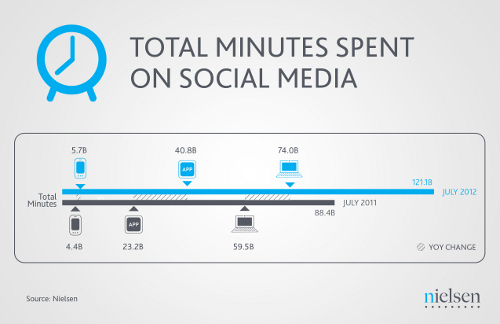
Earlier this month, Nielsen published its 2012 Social Media Report, finding that “consumers continue to spend more time on social networks than on any other category of sites—roughly 20 percent of their total time online via personal computer (PC), and 30 percent of total time online via mobile.  Additionally, total time spent on social media in the U.S. across PCs and mobile devices increased 37 percent to 121 billion minutes in July 2012, compared to 88 billion in July 2011… consumers’ time spent with social media on mobile apps and the mobile web has increased 63 percent in 2012, compared to the same period last year.”

Nielsen_socialmedia2012


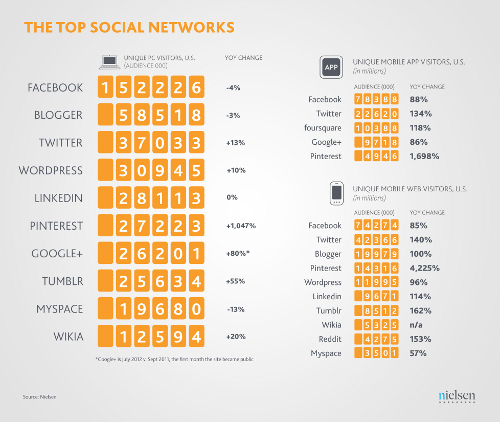
The report also found that “Pinterest emerged as a one of the breakout stars in social media for 2012, boasting the largest year-over-year increase in both unique audience and time spent of any social network across PC, mobile web and apps.”

Nielsen_socialmedia2012_2

Posted in Advertising, Internet Economy, Measurement, News, Pinterest, Social Networks, Television, Twitter | Leave a comment

Census Bureau’s Statistical Abstract Honored for 133 Years as Premier Reference Book

statisticalAbstract_USThe Reference and User Services Association (RUSA) presented its Lifetime Achievement Award to the U.S. Census Bureau for the Statistical Abstract of the United States — acknowledging the abstract’s role as one of the premier reference sources for the past 133 years.

RUSA, a division of the American Library Association, initially announced the award at its Midwinter Book and Media Awards Reception in Dallas earlier this year while recognizing the top reading and reference titles as selected by expert librarians.

RUSA President Mary Popp said the Statistical Abstract has been indispensable for librarians.

“For the student who needs to know how many rural adults play online games to include in a paper, the business owner trying to identify the number of adults 25 to 34 who purchased sporting goods to plan targeted marketing, the state official who needs to learn about how much air pollution is generated by chemical manufacturing, and many others — along with the reference librarians who work with them — the Statistical Abstract of the United States has been one of our most useful and trusted resources about American life,” Popp said. “RUSA and its members celebrate the staff of the Census Bureau and the Statistical Abstract for the rich resource made available for so many years.”

The Statistical Abstract gathers information from multiple government and nongovernment sources. The Census Bureau announced in March 2011 that it would cease production of theStatistical Abstract after the 2012 edition because of budget constraints and a major investment in digital dissemination of Census Bureau statistics. However, Bernan Press and ProQuest have taken over the Statistical Abstract and have announced that they will produce a 2013 edition.

The Statistical Abstract, published since 1878, has been the authoritative and comprehensive summary of statistics on the social, political and economic organization of the United States. It has been a convenient volume for statistical reference and a guide to sources of more information both in print and on the Web.

For more information about the Statistical Abstract, view the 2012 edition online, and view ordering information, go to <http://www.census.gov/compendia/statab/>.


Posted in Statistics | Leave a comment