
 Textfiles.com brings us a 1982 assessment of the “golden age” and subsequent decline of Bulletin Board Systems:
What ever happened to real bulletin-board systems? Continue reading
Textfiles.com brings us a 1982 assessment of the “golden age” and subsequent decline of Bulletin Board Systems:
What ever happened to real bulletin-board systems? Continue reading
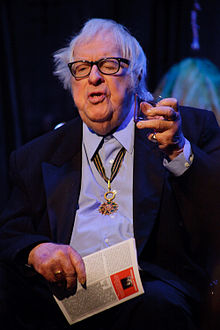 In 1950, typing rapidly on a pay-by-the-hour typewriter in UCLA’s library basement, Ray Bradbury completed in just nine days the first draft of what will become Fahrenheit 451. In the book, which was published in 1953, Bradbury described a society in which pressures from self-interest groups and the availability of mass communication technologies lead to the burning of all books rather than accepting the diversity of opinions expressed in them. Did he accurately describe many scientists today when he said “Chock them so full of ‘facts’ they feel stuffed, but absolutely ‘brilliant’ with information. Then they’ll feel they’re thinking, they’ll get a sense of motion without moving”?
 Ten years ago today, the Mozilla Organization made publicly available the Mozilla 1.0 browser suite. The Firefox project began as an experimental branch of the Mozilla project by Dave Hyatt, Joe Hewitt and Blake Ross. To combat what they saw as the Mozilla Suite’s software bloat, they created a stand-alone browser, with which they intended to replace the Mozilla Suite. On April 3, 2003, the Mozilla Organization announced that they planned to change their focus from the Mozilla Suite to Firefox. Today, Firefox has approximately 25% of worldwide usage share of web browsers, making it the third most widely used web browser.

Made by My Destination, locally informed, globally inspired travel guides.
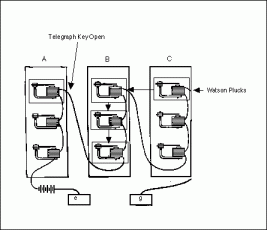
Diagram of the experiment
Today in 1875, during an experiment conducted by Alexander Graham Bell and his assistant Thomas Watson, a receiver reed failed to respond to the intermittent current supplied by an electric battery. Bell told Watson, who was at the other end of the line, to pluck the reed, thinking it had stuck to the pole of the magnet. Mr. Watson complied, and to his astonishment Bell heard a reed at his end of the line vibrate and emit the same timbre of a plucked reed, although there was no interrupted on-off-on-off current from a transmitter to make it vibrate. A few more experiments soon showed that his receiver reed had been set in vibration by the magneto-electric currents induced in the line by the motion of the distant receiver reed in the neighborhood of its magnet. The battery current was not causing the vibration but was needed only to supply the magnetic field in which the reeds vibrated. Moreover, when Bell heard the rich overtones of the plucked reed, it occurred to him that since the circuit was never broken, all the complex vibrations of speech might be converted into alternating currents, which in turn would reproduce the complex timbre, amplitude, and frequencies of speech at a distance. This led to the invention of the telephone.
 Today in 1961, IBM announced the IBM 1301 Disk Storage Unit. The storage capacity per square inch of surface was increased 13 times over what it had been with the first disk drive, the IBM 350 Disk Storage Unit, introduced five years earlier.
 Today in 1991, Sony’s President Norio Ohga announced the MiniDisc as the new personal audio format. From Sony’s official history: “Ohga had led the establishment of the CD business, and CD technology had quickly replaced analog audio technology thanks to its digitally-based, high speed random access and direct search capabilities. CDs were a great success, but they were originally a read-only media, and Ohga wanted to make something that was rewritable, a kind of disc that would replace the audio compact cassette….To enhance portability, the disc was housed in a shell. The MD combined recordable features of the cassette tape with the random access functions and high quality sound of the CD. Sony clearly explained the difference between the CD and MD; the CD was for leisure listening and the MD for enjoying music anywhere and anytime, much like the Walkman.”
Wikipedia: “The biggest competition for MiniDisc came from the emergence of MP3 players. With the Diamond Rio player in 1998, the mass market began to eschew physical media in favor of file-based systems, rendering cassette- and disc-based formats obsolete by the end of the 2000s.”
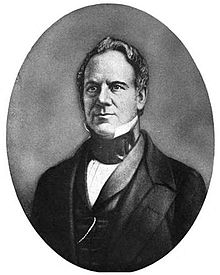
Moses Yale Beach
Today in 1846, The New York Sun carried the first dispatches from the Mexican War, marking the birth of the Asosociated Press. Moses Yale Beach (1800-68), publisher of The New York Sun, established a pony express to deliver news of the Mexican War, joining with The Journal of Commerce, The Courier and Enquirer, The New York Herald, and The Express.
Telegraphic communications between Washington and New York are established on June 5; the New York-Boston line goes into operation on June 27; and by summer’s end, the telegraph extends from New York to Albany and Buffalo, and from Philadelphia west to Harrisburg, creating a telegraph network. Editors now actively collect news as it breaks, rather than gather already published news.
“The electrical efficiency of computation has doubled roughly every year and a half for more than six decades, a pace of change comparable to that for computer performance and electrical efficiency in the microprocessor era. These efficiency improvements enabled the creation of laptops, smart phones, wireless sensors, and other mobile
computing devices, with many more such innovations yet to come.”–Jonathan G. Koomey, Stephen Berard, Marla Sanchez, Henry Wong, “Implications of Historical Trends in the Electrical Efficiency of Computing,” IEEE Annals of the History of Computing
 To cope with the present information explosion we suggest the following: 1) No one should publish any new papers. 2) If 1) is not feasible only short papers should be published. “Short” means not more than 2500 characters counting “space,” punctuation marks, etc. as characters. 3) If 2) is adopted the following restriction should apply: “Only those papers should be published which delete one or more existing papers whose combined length is 2501 characters or more.”
An important byproduct of the above suggested practice would be the reduction of the burden on personnel selection committees. This will happen because the person’s list of publications will be replaced by a single negative number denoting the net number of papers he has deleted from the present information store.
–Harry J. Gray, and Henry Ruston, “On Techniques for Coping with the Information Explosion,” in IEEE Transactions on Electronic Computers, April 1964
 The Story of Information