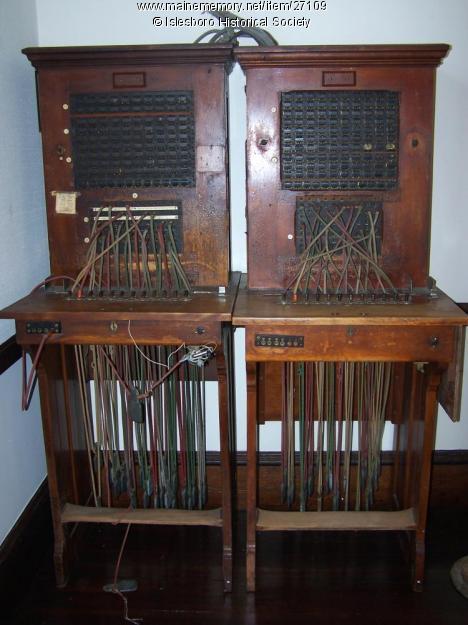
Two switchboards were used on Islesboro, Maine from ca. 1915 to 1962
Today in 1878, the first commercial switchboard began operating in New Haven, Connecticut. It served 21 telephones on 8 lines consequently with many people on a party line. On February 17, Western Union opened the first large city exchange in San Francisco. The public switched telephone network was born. On June 15, 2018, the last call will be made using this network, replaced by an all-digital, packet switching (Internet speaking) network.
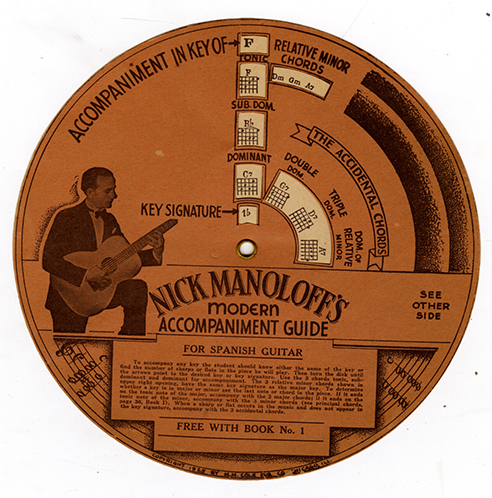
In Reinventing the Wheel, writer, design critic, and Design Observer co-founder Jessica Helfand considers the rich history of rotational diagrams — the wheel as a visual metaphor and an interactive tool for representing and understanding information, predating print by thousands of years.
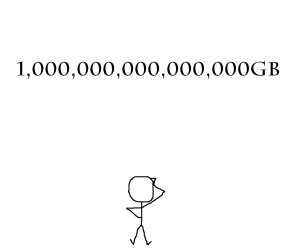
“If you wrote out the information contained in one megabyte by hand, the resulting line of 1s and 0s would be more than five times as tall as Mount Everest. If you wrote out one gigabyte by hand, it would circumnavigate the globe at the equator. If you wrote out one terabyte by hand, it would extend to Saturn and back twenty-five times. If you wrote out one petabyte by hand, you could make a round trip to the Voyager 1 probe, the most distant man-made object in the universe. If you wrote out one exabyte by hand, you would reach the star Alpha Centauri. If you wrote out all five zettabytes that humans produce each year by hand, you would reach the galactic core of the Milky Way. If instead of sending e-mails and streaming movies, you used your five zettabytes as an ancient shepherd might have—to count sheep—you could easily count a flock that filled the entire universe, leaving no empty space at all.”
–Erez Aiden and Jean-Baptiste Michel, Uncharted: Big Data as a Lens on Human Culture
Today in 1956, the development of the Semi-Automatic Ground Environment (SAGE), is disclosed to the public. From MITRE’s website: “Looking back at the development of the computers supporting the SAGE, the origins of many key computer innovations are readily apparent. SAGE’s use of telephone lines to communicate from computer to computer and computer to radar laid the groundwork for modern-day modems… Bob Everett’s invention of the light gun is often referred to as one of the precursor’s to today’s computer mouse. Whirlwind‘s control program, the largest real-time computer program written at that time, spawned a new profession, software development engineers and programmers.
Many other computer breakthroughs such as magnetic-core storage, modular design, interactive graphic displays, on-line common databases, and continuous and reliable operation can also be traced to the development of Whirlwind. In addition, software innovations like the ability to accommodate multiple, simultaneous users, the use of advanced data system structures, structured program modules, and global data definitions grew out of SAGE’s development.”
Here’s a 1998 discussion of SAGE:
The lecture takes place in front of 400 square feet of actual SAGE hardware, including Weapons Director and Intercept Technician consoles! This equipment is from the last functioning SAGE center in North Bay, Ontario (Canada), decommissioned in 1982. The USAF SAGE Film “In Your Defense” will also be shown. “I like Ike” buttons optional.
The Speakers:
This lecture’s speakers represent a variety of perspectives, from the history of technology, to hardware and software systems engineering:
Les Earnest: Senior Research Scientist Emeritus, Stanford University, Project Engineer and System Designer, SAGE system hardware. Founding President, Imagen Corporation; former Associate Chairman, Stanford University Computer Science Department; Executive Officer, Stanford AI Lab; Department Head, Information Systems Dept, MITRE Corporation; Member, Technical Staff, MIT Lincoln Laboratory… and inventor of the original (DEC-10/20) FINGER program!
James Wong: Computer Systems Engineer, Burroughs Corporation; Unisys Corporation; Project Engineer on SAGE system software for The RAND Corporation 1955-1963; Team Leader, System Development Corporation (SDC), Lincoln Laboratory, SAGE and Project “465-L.” Mathematician and programmer for the IBM CPC, 701, and RAND Johnniac. Wong is retired and currently volunteers as an instructor in Mathematics with the Learning Disabled Program at Foothill College.
Paul Edwards: Senior Research Scholar and Lecturer, Program in Science, Technology & Society, Stanford University; author of “The Closed World: Computers and the Politics of Discourse in Cold War America.” Edwards has also authored dozens of articles on the history of computing and has held visiting professorships at Stanford, Cornell, the University of Michigan and UC – Santa Cruz. His next book is entitled: “The World in a Machine: Computer Models, Data Networks, and Global Atmospheric Politics.” Edwards will be making a 30-minute presentation.
This talk was sponsored by The Computer Museum History Center and Sun Microsystems.
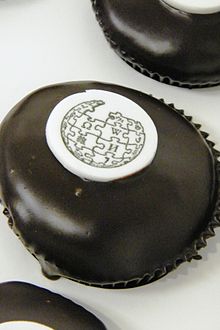
Today in 2001, Wikipedia was launched. Since its creation, Wikipedia has grown rapidly into one of the largest reference websites. As of November 2013, Wikipedia was ranked by comScore as the 8th most popular web destination in the U.S. with more than 84 million monthly unique visitors. Alexa ranks Wikipedia #6 worldwide. There are more than 77,000 active contributors working on more than 30,000,000 articles in 285 languages.
Today in 1994, The Superhighway Summit was held at UCLA’s Royce Hall. It was the “first public conference bringing together all of the major industry, government and academic leaders in the field [and] also began the national dialogue about the Information Superhighway and its implications.” The conference was organized by Richard Frank of the Academy of Television Arts & Sciences and Jeffrey Cole and Geoffrey Cowan, the former co-directors of UCLA’s Center for Communication Policy.The keynote speaker was Vice President Al Gore who said: ”We have a dream for…an information superhighway that can save lives, create jobs and give every American, young and old, the chance for the best education available to anyone, anywhere.”
According to Cynthia Lee in UCLA Today: ”The participants underscored the point that the major challenge of the Information Highway would lie in access or the ‘gap between those who will have access to it because they can afford to equip themselves with the latest electronic devices and those who can’t.’”
The U.S. Census Bureau: “In 2011, 75.6 percent of households reported having a computer, compared with only 8.2 percent in 1984 (the first year that the Census Bureau asked about computer ownership), and 61.8 percent in 2003 (the last time the Census Bureau asked about computers prior to 2010). Similar shifts occurred for household Internet use, as 71.7 percent of households reported accessing the Internet in 2011, up from 18.0 percent in 1997 (the first year the Census Bureau asked about Internet use) and 54.7 percent in 2003.”
PewInternet: “As of May 2013, 15% of American adults ages 18 and older do not use the internet or email….
34% of non-internet users think the internet is just not relevant to them, saying they are not interested, do not want to use it, or have no need for it.
32% of non-internet users cite reasons tied to their sense that the internet is not very easy to use. These non-users say it is difficult or frustrating to go online, they are physically unable, or they are worried about other issues such as spam, spyware, and hackers. This figure is considerably higher than in earlier surveys.
19% of non-internet users cite the expense of owning a computer or paying for an internet connection.
7% of non-users cited a physical lack of availability or access to the internet.”
“We absolutely had no idea what people will do with [the PC] when we started out. The two people it was designed for were Woz and myself because we couldn’t afford to buy a computer kit on the market.”
“Man as a tool maker has the ability to make a tool to amplify an inherent ability that he has. And that’s exactly what we are doing here…. We are building tools that amplify a human ability.”
“Simplicity is the ultimate sophistication–this is what we were striving for and this is what the Apple symbolizes.”




 The Story of Information