Walter Lippmann on Information Overload

Lippmann-WalterWalter Lippmann in A Preface to Morals: “The inexperienced must be offered some kind of hypothesis when they are confronted with the necessity of making choices: They cannot be so utterly open-minded that they stand inert until something collides with them.”

Quoted in Dan Slater, Love in the Time of Algorithms: What Technology does to Meeting and Mating

Posted in Information Overload | Leave a comment

Movies: First Screening

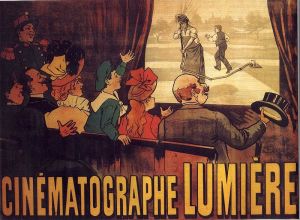
The world's first film poster, for 1895's L'Arroseur arrosé

The world’s first film poster, for 1895’s L’Arroseur arrosé

Today in 1895, Auguste and Louis Lumières held their first private screening of projected motion pictures. Who’s Who in Victorian Cinema: “The Cinématographe (a name used earlier by experimenter Bouly) gave its first public presentation in Paris, to the Société d’Encouragement de l’Industrie Nationale, on 22 March 1895. Only one film was available, La Sortie des Usines Lumière (Workers Leaving the Lumière Factory–see below), shot by Louis.”

See here for the first public screening

Posted in Film, This day in information | Leave a comment

Data-ism and Data Mania, 2013 and 1971

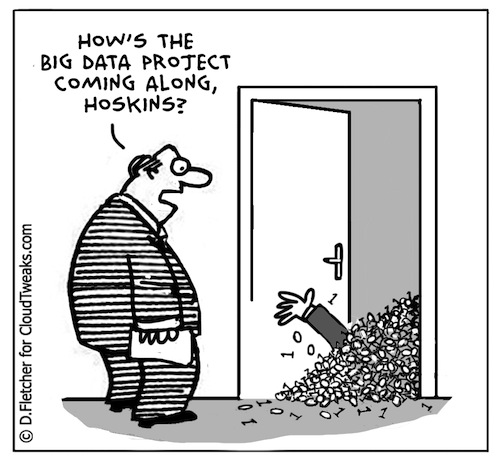
Big_Data_Cartoon“If you asked me to describe the rising philosophy of the day, I’d say it is data-ism. We now have the ability to gather huge amounts of data. This ability seems to carry with it certain cultural assumptions — that everything that can be measured should be measured; that data is a transparent and reliable lens that allows us to filter out emotionalism and ideology; that data will help us do remarkable things — like foretell the future”–David Brooks, “The Philosophy of Data,” The New York Times, February 4, 2013

“Too many information handlers seem to measure a man by the number of bits of storage capacity his dossier will occupy… The new information technologies seem to have given birth to a new social virus – ‘data mania.’ It symptoms are shortness of breath and heart palpitations when contemplating a new computer application, a feeling of possessiveness about information and a deep resentment toward those who won’t yield it, a delusion that all information handlers can walk on water, and a highly advanced case of antistigmatism that prevents the affected victim from perceiving anything but the intrinsic value of data”–Arthur Miller, The Assault on Privacy, 1971

Posted in Big Data, Social Impact | Leave a comment

First Broadcast by Ham Radio Operator

ham-radio-operatorToday in 1909, Einar Dessau of Denmark used a shortwave transmitter to converse with a government radio post about six miles away in what is believed to have been the first broadcast by a ‘ham’ radio operator.

Susan Douglas in Inventing American Broadcasting on the emergence in the U.S of a “grass-roots network of boys and young men,” amateur radio operators, between 1906 and 1912: “To the amateurs, the ether was neither the rightful province of the military nor a resource a private firm could appropriate and monopolize. The ether was, instead, an exciting new frontier in which men and boys could congregate, compete, test their mettle, and be privy to a range of new information… This realm… belonged to ‘the people.’ Thinking about the ether this way, and acting on such ideas on a daily basis, was a critical step in the transformation of wireless into radio broadcasting.”

From the forward (by Jack Binn) to The Radio Boys First Wireless (1922): “Don’t be discouraged because Edison came before you. There is still plenty of opportunity for you to become a new Edison, and no science offers the possibilities in this respect as does radio communications.”

Posted in Radio, This day in information, Wireless | Leave a comment

Edward Tufte Reviews Pocket Calculators

Texas_Instruments_SR-51AIn 1975, just before the birth of the PC industry, Edward Tufte wrote a review of pocket calculators for the American Journal of Political Science. He summarized the rate of advance of the computer technology of the day (citing Rein Turn, Computers in the 1980s, 1974): “Studies of the historical development of computational devices report that a new ‘generation’ occurs about every six years. On average, each new generation has included an increase in speed by 10 times, an increase in memory capacity by 20 times, an increase in reliability by 10 times, a decrease in component cost by 10 times, and a decrease in system cost by 2.5 times. Not only should the calculator… be depreciated quickly, but also we should remember that the replacement for today’s machine will be twice as good at half the price in a year or two.”   

Tufte’s abstract for the article reads as follows:

“Four of the fancier and newer pocket electronic calculators are evaluated in terms of their utility for doing data analysis, their price, and their quality. Some general principles, perhaps helpful for the consumer of calculators, are derived from the experience–including: (1) Always buy at a discount. (2) Competition has its benefits in this sector of the computer industry. (3) Computational technology has overrun input-output technology. (4) Calculators are designed by engineers for engineers and business people–and not for data analysts. (5) Some quite impressive (and expensive) machines are now available. (6) If in doubt, wait for a good machine that prints.”

HT: Drew Conway @drewconway

Posted in Caclulators, Computer history, Memory | 1 Comment

Piracy or Privacy?

MEGA is the new file hosting service launched by Kim Dot Com and the successor to the MegaUpload service. The service was launched on January 19, 2013, exactly one year after the U.S. government closed MegaUpload.

Mega: Piracy or Privacy – An infographic by the team at Who Is Hosting This.com


Posted in Copyrights, Infographics, Piracy, Privacy | Leave a comment

First Internet Domain Name and a New Era for IT

symbolics_firstdomainNameToday in 1985, the first Internet domain name, symbolics.com, was registered.  Bob Metcalfe connected this event with the thirty-year anniversary of the IEEE 802 standards committee starting its work on Local Area Networking and Metropolitan Area Networking standards: “These two anniversaries are an opportunity to highlight the importance of Internet innovation infrastructure, particularly standards committees. At the core, these two events are about connecting things, or networking. And successful networking requires connection standards.”

These anniversaries also marked the arrival of a new phase in the evolution of the IT industry. The 1980s are almost universally regarded as ushering in the new “PC era,” replacing the mainframe phase of the industry. Wrong. The PC was a mainframe on a desk. It obviously contributed to a giant leap in user productivity, but it continued the same one-to-one relationships between a man and his computer.  The new phase in IT’s evolution was not the PC era, it was the networking era. As Metcalfe captured in what came later to be known as “Metcalfe’s Law,” now information flows were many-to-many, first with LANs, and later with the World Wide Web running over the Internet.

Posted in Computer history, This day in information | 1 Comment

On the History of Mathematical Notation

Mathematical_NotationStephen Wolfram:

So, where did all the mathematical notation that we use today come from?

Well, that’s all bound up with the history of mathematics itself, so we have to talk a bit about that. People often have this view that mathematics is somehow the way it is because that’s the only conceivable way it could be. That somehow it’s capturing what arbitrary abstract systems are like.

One of the things that’s become very clear to me from the big science project that I’ve been doing for the past nine years is that such a view of mathematics is really not correct. Mathematics, as it’s practiced, isn’t about arbitrary abstract systems. It’s about the particular abstract system that happens to have been historically studied in mathematics. And if one traces things back, there seem to be three basic traditions from which essentially all of mathematics as we know it emerged: arithmetic, geometry, and logic.    Continue reading

Posted in Mathematics | Leave a comment

Big Data in the Age of the Telegraph

Caitlin Rosenthal writes in “Big Data in the Age of the Telegraph,” McKinsey Quarterly, March 2013:

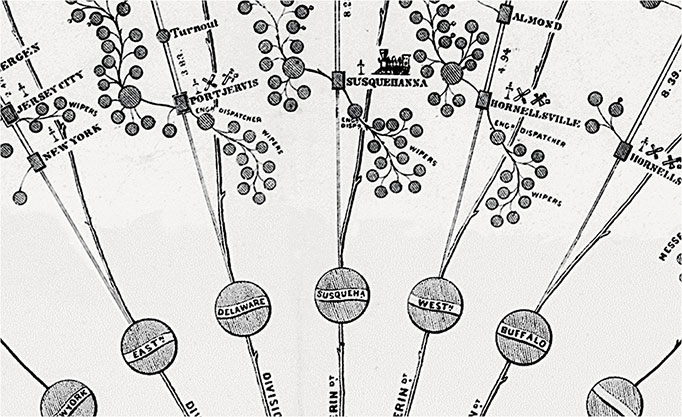
“In 1854, Daniel McCallum took charge of the operations of the New York and Erie Railroad. With nearly 500 miles of track, it was one of the world’s longest systems, but not one of the most efficient. In fact, McCallum found that far from rendering operations more efficient, the scale of the railroad exponentially increased its complexity.

The problem was not a lack of information: the growing use of the telegraph gave the company an unprecedented supply of nearly real-time data, including reports of accidents and train delays. Rather, the difficulty was putting that data to use, and it led McCallum to develop one of the era’s great low-tech management innovations: the organization chart…

OrgChart McCallum

Insert #1:

OrgChart McCallum insert 1

In crafting the organizational plan, McCallum sought to improve the way the railroad used information. Through 21st-century eyes, the chart looks both antiquarian and surprisingly modern. Far from the static, hierarchical pyramids that we today associate with such charts, his was modeled after a tree. McCallum drew the board of directors as the roots, himself and his chief officers as the tree’s trunk, and the railroad’s divisions and departments as the branches.

Critically, McCallum gained control by giving up control, delegating authority to managers who could use information in real time. He put what we would call the organization’s C-level at the ground level, supporting the railroad, not directing its operations. Following one of McCallum’s key precepts—“a proper division of responsibilities”—authority over day-to-day scheduling went to the divisional superintendents down the line…

Drowning in the details of operations, Daniel McCallum stepped back and redesigned the railroad’s organization. His insights on how to meld local authority with information gave his managers better operating tools—which are just as relevant in the age of the Internet as they were in the age of the telegraph.”


Posted in Big Data, Business history, information organization, Railroads, Social Impact, Social Networks, Telegraph | Leave a comment

Race Against the Machine Watch

Luddite

1812 engraving

Today in 1811, the first Luddite attack in which knitting frames were actually smashed occurred in the Nottinghamshire village of Arnold. Kevin Binfield in Writings of the Luddites: “The grievances consisted, first, of the use of wide stocking frames to produce large amounts of cheap, shoddy stocking material that was cut and sewn rather than completely fashioned and, second, of the employment of ‘colts,’ workers who had not completed the seven-year apprenticeship required by law.”

Andrew McAfee on the HBR Blog Network, January 29, 2013: “Previous waves of automation, like the mechanization of agriculture and the advent of electric power to factories, have not resulted in large-scale unemployment or impoverishment of the average worker. But the historical pattern isn’t giving me a lot of comfort these days, simply because we’ve never before seen automation encroach so broadly and deeply, while also improving so quickly at the same time.

I don’t know what all the consequences of the current wave of digital automation will be — no one does. But I’m not blithe about its consequences for the labor force, because that would be ignoring the data and missing the big picture.”

McAfee at TEDxBoston, June 2012, on “Are Droids Taking Our Jobs?”

Posted in Automation, Race Against the Machine, Social Impact, This day in information | Leave a comment