Earliest Works of Art

ice_age_study_304x176Ice Age Art [at the British Museum, February 7 – may 26, 2013] is less an archaeological exhibition than an exploration of the human search for and expression of meaning. For example, many of the human figures on show are female—nudes made thousands of centuries before the Greeks, who are often credited for being the first artists. Some are nubile, others more voluptuous and visibly fecund. Interpretations abound for why they exist, whether as sexual fetish symbols or matriarchal avatars. But their significance is that they exist at all, as labour-intensive embodiments of desire. Inspired by such works, Georges Bataille, an influential French literary figure, wrote in 1955 that if Greece represented the first day in art, then these carved tusks and sculpted stones mark the dazzling light of its ‘early morning’”–The Economist


Continue reading

Posted in Archeology, Art, Ice Age | Leave a comment

The Telegraph Request for Proposal

telegraphToday in 1837, The U.S. House of Representatives passed a resolution requesting the Treasury Secretary, Levi Woodbury, to report to the House at its next session, “upon the propriety of establishing a system of telegraphs for the United States.” Richard John in Network Nation: “Of the eighteen responses that Woodbury received, seventeen assumed that the telegraph would be optical and that its motive power would be human…. The only respondent to envision a different motive power was Samuel F. B. Morse… [who] proposed, instead, a new kind of telegraph of his own devising that would transmit information not by sight but, rather, by electrical impulses transmitted by wire.”


Posted in Telegraph, This day in information | Leave a comment

Our Flexible Memories: Forgetting the Useless And Remembering Other People’s Experiences

memory1“…selective forgetting of the useless is as important as selective remembering of the useful. And much of this winnowing  takes place during sleep, as two papers in this week’s Nature Neuroscience observe… the process of sleep acts as a form of triage–first choosing what to retain, and then selecting how it will be retained”–The Economist

Continue reading

Posted in Information Overload, Memory, Quotes | 2 Comments

Why Does Timbuktu Matter?

Image of damaged pages from a manuscript in Timbuktu showing the effects of the gradual loss of paper. Photo credit: Alexio Motsi and Mary Minicka for the Timbuktu Manuscripts Project.

Image of damaged pages from a manuscript in Timbuktu showing the effects of the gradual loss of paper. Photo credit: Alexio Motsi and Mary Minicka for the Timbuktu Manuscripts Project.

“Timbuktu sits on the edge of Saharan desert. It was a trading entrepôt in the age when the camel was the only means of transport and it became a centre of commerce in the region; trade in books come to be part of that exchange network. The city and its desert environs are an archive of handwritten texts in Arabic and in African languages in the Arabic script (mainly, Fulani and Songhay), produced, it appears, between the 13th and the 20th centuries. The earliest date of written heritage is still speculation for no scientific tests have been done on inks and paper.

Continue reading

Posted in Knowledge compilations, Libraries, Preservation | Leave a comment

IBM and The First Social Security Check

Ida May Fuller and the social security check

Ida May Fuller and the social security check

Today in 1940, Ida M. Fuller became the first person to receive an old-age monthly benefit check under the new Social Security law. Her first check, dated January 31, was for $22.54. The Social Security Act was signed into law by Franklin Roosevelt on August 14, 1935. In the words of Kevin Maney in The Maverick and His Machine, “no single flourish of a pen had ever created such a gigantic information processing problem.” But IBM was ready. Its President, Thomas Watson, Sr., defied the odds and during the early years of the Depression continued to invest in research and development, building inventory, and hiring people. As a result, according to Maney, “IBM won the contract to do all of the New Deal’s accounting – the biggest project to date to automate the government. … Watson borrowed a common recipe for stunning success: one part madness, one part luck, and one part hard work to be ready when luck kicked in.”  Continue reading

Posted in Automation, Computer history, Information Economy, This day in information | Leave a comment

“I’m the Oldest Criminal in History”: Why the Cash Register Was Invented

Cash Register 1879

Cash Register 1879

Today in 1883, James Ritty, a saloonkeeper in Dayton, Ohio, and John Birch received a patent (No. 271,363) for the first cash register, nicknamed the “Incorruptible Cashier.” There was a bell to ring up sales, referred to in advertising as “The Bell Heard Round the World.”

John Patterson, founding president of the National Cash Register Company, used the following message from 1885 through 1915 to demonstrate the limitations associated with the cash drawer which the cash register replaced:

“I am the oldest criminal in history.

I have acted in my present capacity for many thousands of years.

I have been trusted with million of dollars.

I have lost a great deal of this money.

I have constantly held temptation before those who have come in contact with me.

I have placed a burden upon the strong, and broken down the weak.

19th Century Cash Drawer

19th Century Cash Drawer

I have caused the downfall of many honest and ambitious young people.

I have ruined many business men who deserved success.

I have betrayed the bust of those who have depended upon me.

I am a thing of the past, a dead issue.

I am a failure.

I am the Open Cash Drawer.”

Posted in Automation, Retail, This day in information | Leave a comment

First Librarian of Congress Takes Office

John James Beckley

John James Beckley

Today in 1802, John J. Beckley became the first Librarian of the U.S. Congress. Beckley is also considered the first political campaign manager in the U.S. The Library of Congress was established less than two years earlier by an act of Congress. In 1996, the Library of Congress published Justifying Jefferson: The Political Writings of John James Beckley, edited by Gerard W. Gawalt, early American history specialist at the Library. From the Library’s website:

As political parties emerged in the new nation, Beckley campaigned in support of the Jefferson-Madison (Republican Party) coalition and in opposition to the Hamilton-Federalist coalition. To promote his candidates and raise funds, Beckley wrote letters, pamphlets, and speeches, often under a pseudonym, many of which appear in this volume. As early as 1790 Beckley became deeply involved in the political quagmire over the payment of Revolutionary War debts and the location of the national capital.

Beckley, known as a master of political polemics, was an early proponent of attack advertising. His supporters credit him with being the first political party manager (in Pennsylvania) and with writing the first campaign biography of Jefferson (in 1800). Critics have accused Beckley of destroying the political career and presidential hopes of Alexander Hamilton.

Posted in Libraries, Library of Congress | Leave a comment

The Public Switched Telephone Network Born

Two switchboards were used on Islesboro, Maine from ca. 1915 to 1962

Two switchboards were used on Islesboro, Maine from ca. 1915 to 1962

Today in 1878, the first commercial switchboard began operating in New Haven, Connecticut. It served 21 telephones on 8 lines consequently with many people on a party line. On February 17, Western Union opened the first large city exchange in San Francisco. The public switched telephone network was born. On June 15, 2018, the last call will be made using this network, replaced by an all-digital, packet switching (Internet speaking) network.

Posted in Telephone, This day in information | Leave a comment

Creating the Public Image of Computers: IBM’s SSEC

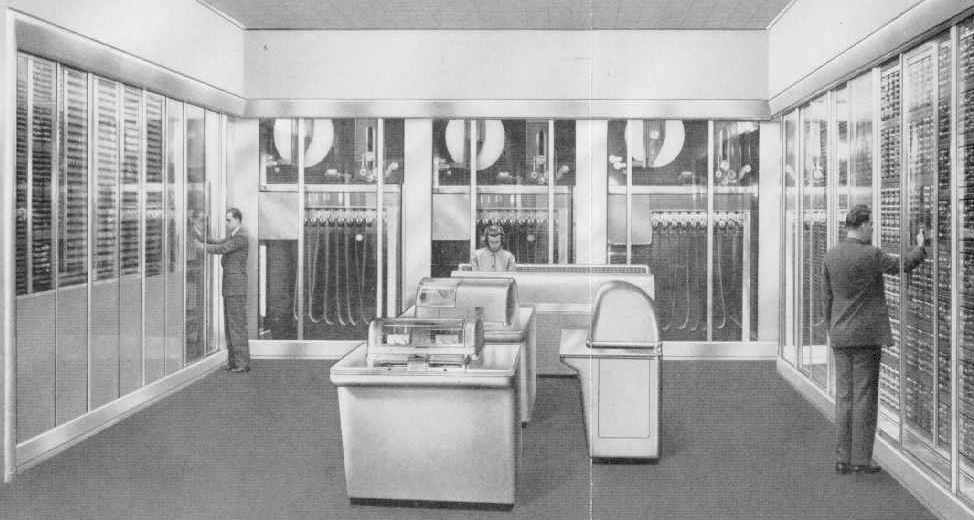
Today in 1948, IBM’s Selective Sequence Electronic Calculator (SSEC) was announced and demonstrated to the public.“The most important aspect of the SSEC,” according to Brian Randell in the Origins of Digital Computers, “was that it could perform arithmetic on, and then execute, stored instructions – it was almost certainly the first operational machine with these capabilities. ” And from the IBM archives: “During its five-year reign as one of the world’s best-known ‘electronic brains,’ the SSEC solved a wide variety of scientific and engineering problems, some involving many millions of sequential calculations. Such other projects as computing the positions of the moon for several hundred years and plotting the courses of the five outer planets—with resulting corrections in astronomical tables which had been considered standard for many years [and later assisted in preparing for the moon landing]—won such popular acclaim for the SSEC that it stimulated the imaginations of pseudo-scientific fiction writers and served as an authentic setting for such motion pictures as ‘Walk East on Beacon,’ a spy-thriller with an FBI background.”

Continue reading

Posted in Computer history, IBM, Libraries, Social Impact | Leave a comment

First Television Demo

First photograph ever taken of a television image

First photograph ever taken of a television image

Today in 1926, John Logie Baird conducted the first public demonstration of a television system that could broadcast live moving images with tone graduation.

Two days later, The Times of London wrote: “Members of the Royal Institution and other visitors to a laboratory in an upper room in Frith-Street, Soho… saw a demonstration of apparatus invented by Mr. J.L. Baird, who claims to have solved the problem of television. They were shown a transmitting machine, consisting of a large wooden revolving disc containing lenses, behind which was a revolving shutter and a light sensitive cell…  The image as transmitted was faint and often blurred, but substantiated a claim that through the ‘Televisor’ as Mr.Baird has named his apparatus, it is possible to transmit and reproduce instantly the details of movement, and such things as the play of expression on the face. ”


Posted in Television | Leave a comment